

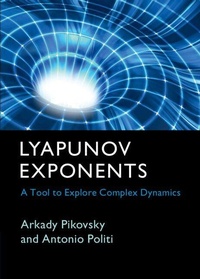
Lyapunov Exponents
A Tool to Explore Complex Dynamics
Published on 11. February 2016
Book
Hardback
298 pages
978-1-107-03042-8 (ISBN)
Description
Lyapunov exponents lie at the heart of chaos theory, and are widely used in studies of complex dynamics. Utilising a pragmatic, physical approach, this self-contained book provides a comprehensive description of the concept. Beginning with the basic properties and numerical methods, it then guides readers through to the most recent advances in applications to complex systems. Practical algorithms are thoroughly reviewed and their performance is discussed, while a broad set of examples illustrate the wide range of potential applications. The description of various numerical and analytical techniques for the computation of Lyapunov exponents offers an extensive array of tools for the characterization of phenomena such as synchronization, weak and global chaos in low and high-dimensional set-ups, and localization. This text equips readers with all the investigative expertise needed to fully explore the dynamical properties of complex systems, making it ideal for both graduate students and experienced researchers.
Reviews / Votes
'... it should be required reading for anyone seriously engaged in the quantitative analysis of the dynamics of complex systems.' Robert C. Hilborn, Physics Today 'This book is written for mainly a physics audience but mathematicians may ?nd inspiration seeing how to deal with Lyapunov exponents in practice. The book gives a very comprehensive overview of the currently available tools to explore dynamical systems through the numerical study of Lyapunov exponents, Lyapunov spectra and the extraction of the corresponding Oseledets splitting. Indeed mathematical results assure the existence of exponents and the splitting for a given invariant probability measure but give few clues as to how one may compute, in particular, the splitting. This is dealt with in much detail in the book.' Hans Henrik Rugh, Mathematical ReviewsMore details
Language
English
Place of publication
Cambridge
United Kingdom
Target group
Professional and scholarly
Illustrations
3 Tables, black and white; 30 Halftones, unspecified; 50 Line drawings, unspecified
Dimensions
Height: 260 mm
Width: 183 mm
Thickness: 21 mm
Weight
759 gr
ISBN-13
978-1-107-03042-8 (9781107030428)
Copyright in bibliographic data and cover images is held by Nielsen Book Services Limited or by the publishers or by their respective licensors: all rights reserved.
Schweitzer Classification
Other editions
Additional editions
E-Book
02/2016
Cambridge University Press
€72.49
Available for download
E-Book
02/2016
Cambridge University Press
€61.49
Available for download
Persons
Arkady Pikovsky is Professor of Theoretical Physics at the University of Potsdam. He is a member of the editorial board for Physica D and Chaotic and Complex Systems Editor for the Journal of Physics A: Mathematical and Theoretical. He is a Fellow of the American Physical Society and co-author of Synchronization: A Universal Concept in Nonlinear Sciences. His current research focuses on nonlinear physics of complex systems. Antonio Politi is the 6th Century Chair in Physics of Life Sciences at the University of Aberdeen. He is Associate Editor of Physical Review E, a Fellow of the Institute of Physics and of the American Physical Society and was awarded the Gutzwiller Prize by the Max Planck Institute for Complex Systems in Dresden, and the Humboldt Prize. He is co-author of Complexity: Hierarchical Structures and Scaling in Physics.
Content
1. Introduction; 2. The basics; 3. Numerical methods; 4. Lyapunov vectors; 5. Fluctuations and generalized exponents; 6. Dimensions and dynamical entropies; 7. Finite amplitude exponents; 8. Random systems; 9. Coupled systems; 10. High-dimensional systems: general; 11. High-dimensional systems: Lyapunov vectors and finite-size effects; 12. Applications; Appendices; Index.