

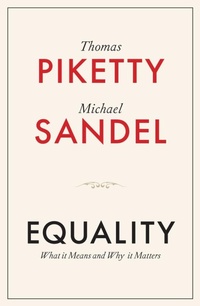
Equality
What It Means and Why It Matters
1st Edition
Published on 17. January 2025
Book
Hardback
128 pages
978-1-5095-6550-4 (ISBN)
Description
In this compelling dialogue, two of the world's most influential thinkers reflect on the value of equality and debate what citizens and governments should do to narrow the gaps that separate us. Ranging across economics, philosophy, history, and current affairs, Thomas Piketty and Michael Sandel consider how far we have come in achieving greater equality. At the same time, they confront head-on the extreme divides that remain in wealth, income, power, and status nationally and globally.
What can be done at a time of deep political instability and environmental crisis? Piketty and Sandel agree on much: more inclusive investment in health and education, higher progressive taxation, curbing the political power of the rich and the overreach of markets. But how far and how fast can we push? Should we prioritize material or social change? What are the prospects for any change at all with nationalist forces resurgent? How should the left relate to values like patriotism and local solidarity where they collide with the challenges of mass migration and global climate change?
To see Piketty and Sandel grapple with these and other problems is to glimpse new possibilities for change and justice but also the stubborn truth that progress towards greater equality never comes quickly or without deep social conflict and political struggle.
What can be done at a time of deep political instability and environmental crisis? Piketty and Sandel agree on much: more inclusive investment in health and education, higher progressive taxation, curbing the political power of the rich and the overreach of markets. But how far and how fast can we push? Should we prioritize material or social change? What are the prospects for any change at all with nationalist forces resurgent? How should the left relate to values like patriotism and local solidarity where they collide with the challenges of mass migration and global climate change?
To see Piketty and Sandel grapple with these and other problems is to glimpse new possibilities for change and justice but also the stubborn truth that progress towards greater equality never comes quickly or without deep social conflict and political struggle.
Reviews / Votes
"Noted political economist meets noted political philosopher in this discussion of inequality and its cures. ... They have a fix, and it's both surprising, intriguing, and worth trying."Kirkus Reviews
"powerful [...] a reminder of why inequality matters"
Andrew Leigh, The Age
"a plea to retrieve authentic social democratic principles to cope with huge challenges such as the green transition."
The Guardian
"very readable [...] They are unambiguously the polar opposite to the Trump-Musk war on the state, on taxation, on regulation and on equality."
The Irish Times
"compelling"
The Lancet
"this message about why (in)equality matters should be mandatory reading for the UK's political leaders a year on."
LSE Review of Books
"An interesting way of thinking about such a wide topic."
Society of Professional Economists
More details
Language
English
Place of publication
Oxford
United Kingdom
Publishing group
John Wiley and Sons Ltd
Dimensions
Height: 193 mm
Width: 129 mm
Thickness: 18 mm
Weight
232 gr
ISBN-13
978-1-5095-6550-4 (9781509565504)
Copyright in bibliographic data and cover images is held by Nielsen Book Services Limited or by the publishers or by their respective licensors: all rights reserved.
Schweitzer Classification
Other editions
Additional editions
E-Book
01/2025
1st Edition
Wiley
€10.99
Available for download
Persons
Thomas Piketty is Professor of Economics at the Ecole des hautes etudes en sciences sociales.
Michael J. Sandel is the Anne T. and Robert M. Bass Professor of Government at Harvard University.
Michael J. Sandel is the Anne T. and Robert M. Bass Professor of Government at Harvard University.
Content
1 Why worry about inequality?
2 Should money matter less?
3 The moral limits of markets
4 Globalization and populism
5 Meritocracy
6 Lotteries: Should they play a role in university admission and parliamentary selection?
7 Taxation, solidarity, and community
8 Borders, migration, and climate change
9 The future of the left: identity and economics
2 Should money matter less?
3 The moral limits of markets
4 Globalization and populism
5 Meritocracy
6 Lotteries: Should they play a role in university admission and parliamentary selection?
7 Taxation, solidarity, and community
8 Borders, migration, and climate change
9 The future of the left: identity and economics