

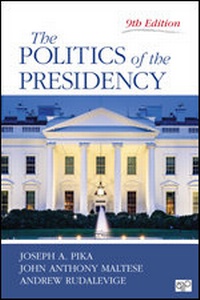
The Politics of the Presidency
9th Edition
Published on 15. March 2016
Book
Paperback/Softback
600 pages
978-1-4833-7563-2 (ISBN)
Description
Never losing sight of the foundations of the office, the authors maintain a balance between historical context and contemporary scholarship on the executive. A solid foundation for any presidency course, the Ninth Edition features updated chapters, including thorough analysis of Obama's continuing challenges as a second-term president in an entrenched partisan environment.
Reviews / Votes
"The Politics of the Presidency is well-designed and -written, easy for students to comprehend, and all-around useful in laying out the key facets and concepts of the American presidency. It is deep in its material without being dense and approachable without sacrificing rigor. I have not seen a text on the American presidency that does a better job of laying clear the history, powers, and limitations of the modern chief executive." -- Michael Julius "The authors' approach puts politics front and center in the study of the presidency. The Politics of the Presidency is clearly the work of senior scholars who have devoted many years to the study of the presidency and scholarship on the office. They know a lot about the office and convey what they know to students in a well-organized and well-written manner." -- Andrew Battista "I use The Politics of the Presidency in my undergraduate presidency courses because the essential topics are thoroughly covered in a style that is both readable and interesting. The cases and examples are always well-chosen and up-to-date, and the special circumstances and challenges facing the current president can be easily compared to enduring presidential responsibilities such as domestic politics, economic policy, and national security." -- Bruce BuchananMore details
Edition
9th Revised edition
Language
English
Place of publication
Thousand Oaks
United States
Target group
College/higher education
Edition type
Revised edition
Dimensions
Height: 229 mm
Width: 152 mm
Weight
721 gr
ISBN-13
978-1-4833-7563-2 (9781483375632)
Copyright in bibliographic data and cover images is held by Nielsen Book Services Limited or by the publishers or by their respective licensors: all rights reserved.
Schweitzer Classification
Other editions
Previous edition
Joseph A. Pika | John Anthony Maltese
The Politics of the Presidency
Book
09/2013
8th Edition
CQ Press
€80.75
Article exhausted; check for reprint
Persons
Joseph A. Pika is the James R. Soles professor emeritus of political science and international
relations at the University of Delaware. He holds a PhD from the University
of Wisconsin and taught previously at SUNY at Buffalo. He is coauthor with Jason D.
Mycoff of Conflict & Compromise: Presidential and Congressional Leadership, 2001-
2006 and coauthor with John Anthony Maltese and H. Phillips Shively of American
Democracy in Context. He served for seven years on the Delaware State Board of
Education, four years as president.
John Anthony Maltese is the Albert B. Saye professor of political science and associate
dean of the University of Georgia's School of Public and International Affairs and was
named a University professor in 2023 in recognition of significant impact on the university
beyond normal academic responsibilities. He holds a PhD from Johns Hopkins
University. He is the author of The Selling of Supreme Court Nominees and Spin Control:
The White House Office of Communications and the Management of Presidential News,
and coauthor with Joseph A. Pika and H. Phillips Shively of American Democracy in
Context. He is a Josiah Meigs Distinguished Teaching Professor and was named the
2004 Georgia Professor of the Year by the Carnegie Foundation and the Council for
Advancement and Support of Education (CASE). Professor Maltese also writes about
classical music, for which he won a Grammy Award from the National Academy of
Recording Arts and Sciences.
Andrew Rudalevige is the Thomas Brackett Reed professor of government at Bowdoin
College and former chair of the American Political Science Association's Presidents
and Executive Politics section; in 2023-2024 he is a visiting professor at the London
School of Economics. He holds a PhD from Harvard University and won the Richard
E. Neustadt Prize from the American Political Science Association for best book on the
U.S. presidency in 2003 and 2022, as well as the 2022 Louis Brownlow Prize from the
National Academy of Public Administration. His books include By Executive Order,
Managing the President's Program, The New Imperial Presidency: Renewing Presidential
Power after Watergate, and, as coeditor, a volume on the Office of Management and
Budget and a series assessing recent presidencies. Prior to his academic career, he
worked in state and local politics in Massachusetts.
relations at the University of Delaware. He holds a PhD from the University
of Wisconsin and taught previously at SUNY at Buffalo. He is coauthor with Jason D.
Mycoff of Conflict & Compromise: Presidential and Congressional Leadership, 2001-
2006 and coauthor with John Anthony Maltese and H. Phillips Shively of American
Democracy in Context. He served for seven years on the Delaware State Board of
Education, four years as president.
John Anthony Maltese is the Albert B. Saye professor of political science and associate
dean of the University of Georgia's School of Public and International Affairs and was
named a University professor in 2023 in recognition of significant impact on the university
beyond normal academic responsibilities. He holds a PhD from Johns Hopkins
University. He is the author of The Selling of Supreme Court Nominees and Spin Control:
The White House Office of Communications and the Management of Presidential News,
and coauthor with Joseph A. Pika and H. Phillips Shively of American Democracy in
Context. He is a Josiah Meigs Distinguished Teaching Professor and was named the
2004 Georgia Professor of the Year by the Carnegie Foundation and the Council for
Advancement and Support of Education (CASE). Professor Maltese also writes about
classical music, for which he won a Grammy Award from the National Academy of
Recording Arts and Sciences.
Andrew Rudalevige is the Thomas Brackett Reed professor of government at Bowdoin
College and former chair of the American Political Science Association's Presidents
and Executive Politics section; in 2023-2024 he is a visiting professor at the London
School of Economics. He holds a PhD from Harvard University and won the Richard
E. Neustadt Prize from the American Political Science Association for best book on the
U.S. presidency in 2003 and 2022, as well as the 2022 Louis Brownlow Prize from the
National Academy of Public Administration. His books include By Executive Order,
Managing the President's Program, The New Imperial Presidency: Renewing Presidential
Power after Watergate, and, as coeditor, a volume on the Office of Management and
Budget and a series assessing recent presidencies. Prior to his academic career, he
worked in state and local politics in Massachusetts.
Content
Part I: The President and the Public
Chapter 1: The Changing Presidency
The Scope of Presidential Power
Expansion of the Presidency
Presidential Culture
Conclusion: The Changeable, Political Presidency
Suggested Readings
Resources on the Web
Notes
Chapter 2: Election Politics
Evolution of the Selection Process
Defining the Pool of Eligibles
Competing for the Nomination
The National Convention
The General Election
Validation
Transitions to Governing
Suggested Readings
Resources on the Web
Notes
Chapter 3: Public Politics
Public Attitudes toward the Presidency
Rallying Public Support
The President and the Media
Conclusion: The Permanent Campaign
Suggested Readings
Notes
Chapter 4: Presidential Character and Performance
Determinants and Evaluations of Performance
What Manner of Person?
Psychological Characteristics
Management Styles of Modern Presidents
Understanding Presidents: George W. Bush and Barack Obama
Conclusion: Seeking Presidential Success
Suggested Readings
Resources on the Web
Notes
Part II: The President and the Government
Chapter 5: Legislative Politics
Three Confrontations in Interbranch Relations
Development of the President's Legislative Role
The Presidential--Congressional Relationship
The President's Formal Legislative Powers
The President's Informal Legislative Influence
Explaining Presidents' Legislative Success
Conclusion
Suggested Readings
Notes
Chapter 6: Executive Politics
The President as Executive
The President and the Executive Branch
The President and the Cabinet
The Vice President
The First Lady
Presidential Control of the Bureaucracy
Presidential Management of the Bureaucracy
Conclusion
Suggested Readings
Resources on the Web
Notes
Chapter 7: Judicial Politics
Presidential Appointment of Federal Judges
Other Presidential Influences on the Federal Courts
Judicial Oversight of Presidential Action
Conclusion
Suggested Readings
Notes
Part III: The President and Public Policy
Chapter 8: The Politics of Domestic Policy
The Domestic Policy Process
The Domestic Policy Environment
The Domestic Policy Apparatus
Conclusion
Suggested Readings
Notes
Chapter 9: The Politics of Economic Policy
Macroeconomic Policy
Microeconomic Policy
Presidents and the Economy: 1933-2014
The Politics of Macroeconomic Policymaking
The Economic Subpresidency
Presidents and Economic Policy Coordination
Congress's Role in Macroeconomic Policy
Conclusion
Suggested Readings
Resources on the Web
Notes
Chapter 10: The Politics of National Security Policy
Issues in National Security Policy: Search for a New Consensus
The Problem with National Security Policymaking
The President, Congress, and National Security
Organizing and Managing National Security
Conclusion
Suggested Readings
Notes
Chapter 11: The Challenges and Opportunities of a New President
Continuity and Change in the Presidency
Leadership in an Age of Dissensus
Conclusion
Notes
Chapter 1: The Changing Presidency
The Scope of Presidential Power
Expansion of the Presidency
Presidential Culture
Conclusion: The Changeable, Political Presidency
Suggested Readings
Resources on the Web
Notes
Chapter 2: Election Politics
Evolution of the Selection Process
Defining the Pool of Eligibles
Competing for the Nomination
The National Convention
The General Election
Validation
Transitions to Governing
Suggested Readings
Resources on the Web
Notes
Chapter 3: Public Politics
Public Attitudes toward the Presidency
Rallying Public Support
The President and the Media
Conclusion: The Permanent Campaign
Suggested Readings
Notes
Chapter 4: Presidential Character and Performance
Determinants and Evaluations of Performance
What Manner of Person?
Psychological Characteristics
Management Styles of Modern Presidents
Understanding Presidents: George W. Bush and Barack Obama
Conclusion: Seeking Presidential Success
Suggested Readings
Resources on the Web
Notes
Part II: The President and the Government
Chapter 5: Legislative Politics
Three Confrontations in Interbranch Relations
Development of the President's Legislative Role
The Presidential--Congressional Relationship
The President's Formal Legislative Powers
The President's Informal Legislative Influence
Explaining Presidents' Legislative Success
Conclusion
Suggested Readings
Notes
Chapter 6: Executive Politics
The President as Executive
The President and the Executive Branch
The President and the Cabinet
The Vice President
The First Lady
Presidential Control of the Bureaucracy
Presidential Management of the Bureaucracy
Conclusion
Suggested Readings
Resources on the Web
Notes
Chapter 7: Judicial Politics
Presidential Appointment of Federal Judges
Other Presidential Influences on the Federal Courts
Judicial Oversight of Presidential Action
Conclusion
Suggested Readings
Notes
Part III: The President and Public Policy
Chapter 8: The Politics of Domestic Policy
The Domestic Policy Process
The Domestic Policy Environment
The Domestic Policy Apparatus
Conclusion
Suggested Readings
Notes
Chapter 9: The Politics of Economic Policy
Macroeconomic Policy
Microeconomic Policy
Presidents and the Economy: 1933-2014
The Politics of Macroeconomic Policymaking
The Economic Subpresidency
Presidents and Economic Policy Coordination
Congress's Role in Macroeconomic Policy
Conclusion
Suggested Readings
Resources on the Web
Notes
Chapter 10: The Politics of National Security Policy
Issues in National Security Policy: Search for a New Consensus
The Problem with National Security Policymaking
The President, Congress, and National Security
Organizing and Managing National Security
Conclusion
Suggested Readings
Notes
Chapter 11: The Challenges and Opportunities of a New President
Continuity and Change in the Presidency
Leadership in an Age of Dissensus
Conclusion
Notes