

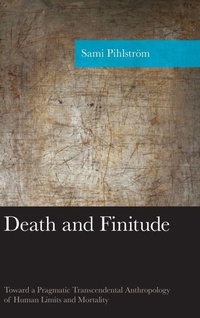
Death and Finitude
Toward a Pragmatic Transcendental Anthropology of Human Limits and Mortality
Published on 21. September 2016
Book
Hardback
228 pages
978-1-4985-2441-4 (ISBN)
Description
Death and Finitude offers an examination and defense of a pragmatic transcendental anthropology applicable to the concepts of limit, finitude, and mortality that are constitutive of human life as we know it. Sami Pihlstroem develops a special kind of philosophical anthropology-a pragmatic yet transcendental examination of the human condition-that interprets what is worth preserving in the tradition of transcendental philosophy in such a manner that this unusual combination will crucially enrich our understanding of a human problem we all share: mortality.
In some sense, all serious philosophy inevitably reflects on the human condition and is thus philosophical anthropology, broadly conceived. There can hardly be any more serious problem concerning the human condition than the problem of death. Yet, mainstream analytic contributions to the philosophy of death usually addresses death in general, and it is far from obvious that such contributions are philosophically relevant in the sense of addressing the agony of an individual human being trying to understand their own mortal condition. "Continental" philosophy of death may be frustrating in a different sense, as it often fails to be conceptually as clear and argumentatively as rigorous as the analytic literature. Claiming to address my "being-toward-death", such contributions may also fail to speak to the mortal individual if they end up in endless pseudo-philosophical jargon. It is against this background of frustration that Death and Finitude contributes to humanity's on-going reflections on death, dying, and mortality-from a pragmatist yet transcendental perspective, seeking to accommodate these topics within a broader philosophical anthropology.
The book is primarily intended for academic philosophers, but the potential readership includes not only scholars but also both graduate students and advanced undergraduates, as well as general educated readers. It is relevant to the concerns of philosophers specializing in transcendental philosophy, philosophical anthropology, pragmatism, Wittgenstein, and the philosophy of religion. As the book may be said to be an attempt to "philosophize historically," it is in principle of interest to both systematically and historically oriented philosophers and students.
In some sense, all serious philosophy inevitably reflects on the human condition and is thus philosophical anthropology, broadly conceived. There can hardly be any more serious problem concerning the human condition than the problem of death. Yet, mainstream analytic contributions to the philosophy of death usually addresses death in general, and it is far from obvious that such contributions are philosophically relevant in the sense of addressing the agony of an individual human being trying to understand their own mortal condition. "Continental" philosophy of death may be frustrating in a different sense, as it often fails to be conceptually as clear and argumentatively as rigorous as the analytic literature. Claiming to address my "being-toward-death", such contributions may also fail to speak to the mortal individual if they end up in endless pseudo-philosophical jargon. It is against this background of frustration that Death and Finitude contributes to humanity's on-going reflections on death, dying, and mortality-from a pragmatist yet transcendental perspective, seeking to accommodate these topics within a broader philosophical anthropology.
The book is primarily intended for academic philosophers, but the potential readership includes not only scholars but also both graduate students and advanced undergraduates, as well as general educated readers. It is relevant to the concerns of philosophers specializing in transcendental philosophy, philosophical anthropology, pragmatism, Wittgenstein, and the philosophy of religion. As the book may be said to be an attempt to "philosophize historically," it is in principle of interest to both systematically and historically oriented philosophers and students.
Reviews / Votes
Pragmatic naturalism has received considerable attention in recent years, and Sami Pihlstrom's most recent work is a strong addition to that literature: 1) it deepens his own ongoing transcendental approach to pragmatism and pragmatic naturalism in intriguing and forceful ways ; 2) it engages extensively with relevant analytic literature, as well as sources in other traditions, thus expanding the reach of pragmatist considerations, and 3) it offers a range of conceptual and existential insights into fundamental questions of death, dying, and mortality. This is a work that well rewards careful reading. -- John Ryder, American University of MaltaMore details
Series
Language
English
Place of publication
United States
Publishing group
Bloomsbury Publishing Plc
Target group
Professional and scholarly
Dimensions
Height: 235 mm
Width: 157 mm
Thickness: 18 mm
Weight
527 gr
ISBN-13
978-1-4985-2441-4 (9781498524414)
Copyright in bibliographic data and cover images is held by Nielsen Book Services Limited or by the publishers or by their respective licensors: all rights reserved.
Schweitzer Classification
Other editions
Additional editions
Sami Pihlstroem
Death and Finitude
Toward a Pragmatic Transcendental Anthropology of Human Limits and Mortality
E-Book
09/2016
1st Edition
Lexington Books
€90.99
Available for download
Sami Pihlstroem
Death and Finitude
Toward a Pragmatic Transcendental Anthropology of Human Limits and Mortality
E-Book
09/2016
1st Edition
Lexington Books
€90.99
Available for download
Person
Sami Pihlstroem is professor of philosophy of religion at the Faculty of Theology, University of Helsinki.
Content
Preface
IntroductionMortality and philosophical anthropologyThe self as a limit Death-mine or the other's?Death, guilt, and (in)equalityControlling death? Pragmatist philosophy of mortalityConclusion: a pragmatic transcendental anthropology
IntroductionMortality and philosophical anthropologyThe self as a limit Death-mine or the other's?Death, guilt, and (in)equalityControlling death? Pragmatist philosophy of mortalityConclusion: a pragmatic transcendental anthropology