

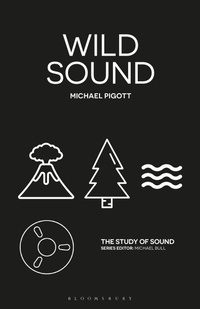
Wild Sound
Published on 16. April 2026
Book
Hardback
224 pages
978-1-5013-5091-7 (ISBN)
Description
Wild Sound turns an analytic eye and ear to the role of background sound in cinema, to the way that film sound captures, creates, represents, and even critiques the environments that we inhabit. Listening beyond music and dialogue, this book explores the relationship between location sound, sound libraries, and wider practices of field recording in the creation of the film soundtrack.
Wild Sound is also interested in the wildness of sound, in the ways in which ambient environmental sounds gesture to a world beyond the frame, and sometimes invite the chaotic, unmanageable energies of the world outside into the hyper-controlled domain of the film. 'Wild sound', or 'wild track', is a film industrial term for non-synchronised sounds that often originate from a process of field recording. Immanently useful as atmosphere and sonic filler, these sounds often smuggle a dangerously noisy materiality into the systems of cinema.
Ambient sound has been chronically under-appreciated and critically under-examined in the study of cinema. This book asserts that the background sounds of place onscreen are never neutral. Pigott reveals them to be carefully constructed 'sonic environments' that play a quiet but substantial role in determining how film audiences feel about the places, people and events that populate the screen.
Each chapter tracks individual sounds across a wide range of international films from the history of cinema, providing rich cultural context and technical detail, drawing out the multiple meanings and formal characteristics of those ambient sounds that are often dismissed as inconsequential. Pigott demonstrates the value of paying close attention to the cinematic sound of place, at a time when it has never been more vital to examine how we imagine and treat our environments.
Wild Sound is also interested in the wildness of sound, in the ways in which ambient environmental sounds gesture to a world beyond the frame, and sometimes invite the chaotic, unmanageable energies of the world outside into the hyper-controlled domain of the film. 'Wild sound', or 'wild track', is a film industrial term for non-synchronised sounds that often originate from a process of field recording. Immanently useful as atmosphere and sonic filler, these sounds often smuggle a dangerously noisy materiality into the systems of cinema.
Ambient sound has been chronically under-appreciated and critically under-examined in the study of cinema. This book asserts that the background sounds of place onscreen are never neutral. Pigott reveals them to be carefully constructed 'sonic environments' that play a quiet but substantial role in determining how film audiences feel about the places, people and events that populate the screen.
Each chapter tracks individual sounds across a wide range of international films from the history of cinema, providing rich cultural context and technical detail, drawing out the multiple meanings and formal characteristics of those ambient sounds that are often dismissed as inconsequential. Pigott demonstrates the value of paying close attention to the cinematic sound of place, at a time when it has never been more vital to examine how we imagine and treat our environments.
More details
Series
Language
English
Place of publication
New York
United States
Publishing group
Bloomsbury Publishing Plc
Target group
College/higher education
Illustrations
20 bw illus
Dimensions
Height: 222 mm
Width: 145 mm
Thickness: 16 mm
Weight
419 gr
ISBN-13
978-1-5013-5091-7 (9781501350917)
Copyright in bibliographic data and cover images is held by Nielsen Book Services Limited or by the publishers or by their respective licensors: all rights reserved.
Schweitzer Classification
Person
Michael Pigott is Associate Professor of Video Art and Digital Media at the University of Warwick, UK. He is the author of Joseph Cornell Versus Cinema (Bloomsbury, 2013).
Content
Acknowledgements
List of Illustrations
Introduction
1. The Wildness of Sound
2. Ghosts in the Grass
3. Lumberjack Westerns
4. Volcanic Cinema
5. Oceans of Sound
Afterword: Atmosphere, Dead Air and the Deep Hum of the World
Bibliography
Filmography
Index
List of Illustrations
Introduction
1. The Wildness of Sound
2. Ghosts in the Grass
3. Lumberjack Westerns
4. Volcanic Cinema
5. Oceans of Sound
Afterword: Atmosphere, Dead Air and the Deep Hum of the World
Bibliography
Filmography
Index