

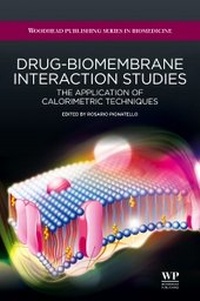
Drug-Biomembrane Interaction Studies
The Application of Calorimetric Techniques
Published on 31. October 2013
Book
Hardback
440 pages
978-1-907568-05-3 (ISBN)
Description
The design and development of drugs and new pharmaceutical formulations require a full characterization of the chemical and physicochemical events occurring at the level of the single active ingredients or excipients, as well as their reciprocal interaction. Thermal analysis techniques are among the most widely used methods to achieve this; among them, the Differential Scanning Calorimetry (DSC) technique, in which the thermotropic behaviour of a single substance or mixtures is analyzed as a function of a controlled temperature program. DSC is an accurate and rapid thermo-analytical technique, widely used by the pharmaceutical industry and in drug research to investigate several physico-chemical phenomena, such as polymorphism, melting and crystallization, purity, and drug-excipient interaction; as well as characterizing biomolecules such as genetic material.Drug-biomembrane interaction studies is written by scientists renowned for their work in the field of DSC applications to drug development and delivery, and especially to drug-biomembrane interaction studies. The book combines insights from biochemistry and physiology with those from structural biology, nanotechnology and biothermodynamics, to obtain a complete depiction of cell membranes and their functions.
More details
Series
Language
English
Place of publication
Cambridge
United Kingdom
Publishing group
Elsevier Science & Technology
Target group
College/higher education
Professional and scholarly
Dimensions
Height: 234 mm
Width: 156 mm
Weight
800 gr
ISBN-13
978-1-907568-05-3 (9781907568053)
Copyright in bibliographic data and cover images is held by Nielsen Book Services Limited or by the publishers or by their respective licensors: all rights reserved.
Schweitzer Classification
Other editions
Additional editions
Drug-Biomembrane Interaction Studies
The Application of Calorimetric Techniques
E-Book
10/2013
Woodhead Publishing Ltd
€195.00
Available for download
Person
Professor Rosario Pignatello is Professor of Pharmaceutical Technology and Legislation at the University of Catania, Italy, where he works at the Department of Drug Sciences. Professor Pignatello is author of 120 scientific publications in peer-reviewed journals and about 130 oral and poster communications to international symposia. His research activity in the area of innovative pharmaceutical technology in particular focuses on: preparation, physico-chemical characterization and nanoparticles including modified drug delivery systems; synthesis, characterization and biological evaluation and QSAR studies on lipophilic prodrugs and conjugates.
Content
Dedication
Figures
Tables
List of abbreviations
Preface
About the editor and contributors
Chapter 1: Biological membranes and their role in physio-pathological conditions
Abstract:
1.1 Importance of drug-biomembrane interactions in biomedical and pharmaceutical research
1.2 The structure of cell membranes
1.3 Properties of plasma membranes
1.4 Movement of molecules across the plasma membrane
1.5 Functions of cell membranes
1.6 Conclusion
Chapter 2: Biomembrane models
Abstract:
2.1 Introduction
2.2 The fluid mosaic model of a biological membrane
2.3 Lipid phases and lipid phase transitions
2.4 Models of biological membranes and their applications
2.5 Conclusion
Chapter 3: Analytical methods for studying drugaEUR"biomembrane interactions
Abstract:
3.1 Introduction
3.2 Spectroscopic techniques
3.3 Chromatographic methods
3.4 Zeta potential measurement
3.5 Microscopy techniques
3.6 The Langmuir-Blodgett (LB) film balance technique
3.7 Other techniques and mixed techniques
3.8 Conclusions
Chapter 4: Differential scanning calorimetry (DSC): theoretical fundamentals
Abstract:
4.1 Introduction
4.2 Brief survey of the main thermodynamic techniques
4.3 Application to lipid systems
4.4 Membrane partitioning and binding of additives
4.5 The effects of additives on membrane properties
4.6 Kinetic phenomena
Chapter 5: DSC: history, instruments and devices
Abstract:
5.1 Introduction
5.2 History
5.3 Instruments
5.4 Special devices
Chapter 6: DSC in drugaEUR"biomembrane interaction studies
Abstract:
6.1 Introduction
6.2 Aims and advantages of DSC
6.3 Drug-biomembrane interactions
6.4 Surfactants
6.5 Genetic materials
6.6 Polymers
6.7 Drug delivery systems (DDSs)
6.8 Toxicity of biomolecules
6.9 Conclusion
Chapter 7: DSC applications: macromolecules
Abstract:
7.1 Introduction
7.2 Proteins
7.3 Nucleic acids
7.4 Polysaccharides
7.5 Biopolymers
7.6 Conclusion
Chapter 8: DSC applications: nucleic acids and membrane interactions
Abstract:
8.1 Introduction
8.2 DNA-membrane interaction studies with DSC
8.3 RNA-membrane interaction studies with DSC
8.4 Conclusions
Chapter 9: Non-steroidal anti-inflammatory drugs
Abstract:
9.1 Introduction to anti-inflammatory drugs
9.2 The interaction of NSAIDs with biomembrane models
9.3 NSAID-loaded DDSs
9.4 Conclusion
Chapter 10: Antimicrobial agents
Abstract:
10.1 Introduction
10.2 What are the appropriate biomembrane models for antimicrobial agents?
10.3 Antivirals, virus envelopes, and biomembrane models
10.4 Antifungals and biomembrane models
10.5 Conclusion
Chapter 11: Drug delivery systems: drug nanocarriers
Abstract:
11.1 Introduction
11.2 Drug delivery systems
11.3 Experimental protocols
11.4 Applications
Appendix 1: General experimental set-up of liposomal systems for DSC
Appendix 2: Journals
Index
Figures
Tables
List of abbreviations
Preface
About the editor and contributors
Chapter 1: Biological membranes and their role in physio-pathological conditions
Abstract:
1.1 Importance of drug-biomembrane interactions in biomedical and pharmaceutical research
1.2 The structure of cell membranes
1.3 Properties of plasma membranes
1.4 Movement of molecules across the plasma membrane
1.5 Functions of cell membranes
1.6 Conclusion
Chapter 2: Biomembrane models
Abstract:
2.1 Introduction
2.2 The fluid mosaic model of a biological membrane
2.3 Lipid phases and lipid phase transitions
2.4 Models of biological membranes and their applications
2.5 Conclusion
Chapter 3: Analytical methods for studying drugaEUR"biomembrane interactions
Abstract:
3.1 Introduction
3.2 Spectroscopic techniques
3.3 Chromatographic methods
3.4 Zeta potential measurement
3.5 Microscopy techniques
3.6 The Langmuir-Blodgett (LB) film balance technique
3.7 Other techniques and mixed techniques
3.8 Conclusions
Chapter 4: Differential scanning calorimetry (DSC): theoretical fundamentals
Abstract:
4.1 Introduction
4.2 Brief survey of the main thermodynamic techniques
4.3 Application to lipid systems
4.4 Membrane partitioning and binding of additives
4.5 The effects of additives on membrane properties
4.6 Kinetic phenomena
Chapter 5: DSC: history, instruments and devices
Abstract:
5.1 Introduction
5.2 History
5.3 Instruments
5.4 Special devices
Chapter 6: DSC in drugaEUR"biomembrane interaction studies
Abstract:
6.1 Introduction
6.2 Aims and advantages of DSC
6.3 Drug-biomembrane interactions
6.4 Surfactants
6.5 Genetic materials
6.6 Polymers
6.7 Drug delivery systems (DDSs)
6.8 Toxicity of biomolecules
6.9 Conclusion
Chapter 7: DSC applications: macromolecules
Abstract:
7.1 Introduction
7.2 Proteins
7.3 Nucleic acids
7.4 Polysaccharides
7.5 Biopolymers
7.6 Conclusion
Chapter 8: DSC applications: nucleic acids and membrane interactions
Abstract:
8.1 Introduction
8.2 DNA-membrane interaction studies with DSC
8.3 RNA-membrane interaction studies with DSC
8.4 Conclusions
Chapter 9: Non-steroidal anti-inflammatory drugs
Abstract:
9.1 Introduction to anti-inflammatory drugs
9.2 The interaction of NSAIDs with biomembrane models
9.3 NSAID-loaded DDSs
9.4 Conclusion
Chapter 10: Antimicrobial agents
Abstract:
10.1 Introduction
10.2 What are the appropriate biomembrane models for antimicrobial agents?
10.3 Antivirals, virus envelopes, and biomembrane models
10.4 Antifungals and biomembrane models
10.5 Conclusion
Chapter 11: Drug delivery systems: drug nanocarriers
Abstract:
11.1 Introduction
11.2 Drug delivery systems
11.3 Experimental protocols
11.4 Applications
Appendix 1: General experimental set-up of liposomal systems for DSC
Appendix 2: Journals
Index