

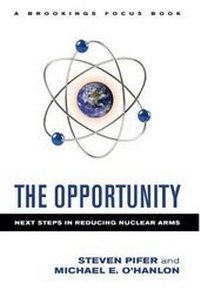
The Opportunity
Next Steps in Reducing Nuclear Arms
Published on 11. October 2012
Book
Hardback
160 pages
978-0-8157-2429-2 (ISBN)
Description
For some observers, nuclear arms control is either a relic of the cold war, or a utopian dream about a denuclearized planet decades in the future. But, as Brookings scholars Steven Pifer and Michael O'Hanlon argue in The Opportunity , arms control can address some key security challenges facing Washington today and enhance both American and global security.
Pifer and O'Hanlon make a compelling case for further arms control measures -to reduce the nuclear threat to the United States and its allies, to strengthen strategic stability, to promote greater transparency regarding secretive nuclear arsenals, to create the possibility for significant defence budget savings, to bolster American credibility in the fight to curb nuclear proliferation, and to build a stronger and more sustainable U.S.-Russia relationship.
President Obama gave priority to nuclear arms control early in his first term and, by all accounts, would like to be transformational on these questions. Can there be another major U.S.-Russia arms treaty? Can the tactical and surplus strategic nuclear warheads that have so far escaped controls be brought into such a framework? Can a modus vivendi be reached between the two countries on missile defence? And what of multilateral accords on nuclear testing and production of fissile materials for nuclear weapons? Pifer and O'Hanlon concisely frame the issues, the background, and the choices facing the president; provide practical policy recommendations, and put it all in clear and readable prose that will be easily understood by the layman.
Pifer and O'Hanlon make a compelling case for further arms control measures -to reduce the nuclear threat to the United States and its allies, to strengthen strategic stability, to promote greater transparency regarding secretive nuclear arsenals, to create the possibility for significant defence budget savings, to bolster American credibility in the fight to curb nuclear proliferation, and to build a stronger and more sustainable U.S.-Russia relationship.
President Obama gave priority to nuclear arms control early in his first term and, by all accounts, would like to be transformational on these questions. Can there be another major U.S.-Russia arms treaty? Can the tactical and surplus strategic nuclear warheads that have so far escaped controls be brought into such a framework? Can a modus vivendi be reached between the two countries on missile defence? And what of multilateral accords on nuclear testing and production of fissile materials for nuclear weapons? Pifer and O'Hanlon concisely frame the issues, the background, and the choices facing the president; provide practical policy recommendations, and put it all in clear and readable prose that will be easily understood by the layman.
Reviews / Votes
" The Opportunity offers a comprehensive, concise, and thoughtful explanation of the nuclear arms control challenges facing the next president. While some will disagree with Pifer and O'Hanlon's specific recommendations, no one can fault the clarity and fairness of their analysis. This book will be a valuable resource for policymakers, practitioners, and academics of all political persuasions." --Ambassador Linton Brooks, chief U.S. negotiator, 1991 START I Treaty " The Opportunity is a must-read. It offers superb analysis and real recommendations on reductions of the nuclear stockpile, missile defense cooperation with Russia, the test ban treaty and stockpile stewardship, and other key issues. I enthusiastically recommend this book to all and especially to my former congressional colleagues on the Hill, at the State Department, and in the White House." --Ellen Tauscher, U.S. under secretary of state for arms control and international security 2009-12), former member of Congress "Notwithstanding my disagreement with many of its recommendations, I found The Opportunity indispensable. It provides a sober, fair, and balanced discussion of contentious and complex issues like missile defense, negotiations with Russia, and the future of the nation's nuclear enterprise. This accessible and concise book lays out a prospective agenda that both supporters and critics of Global Zero will be forced to engage." --Ambassador Eric Edelman, U.S. under secretary of defense for policy (2005-09) " The Opportunity... is a practical and hard-headed analysis of how another Strategic Arms Reduction Treaty might be achieved." -- FT magazine " The Opportunity is an indispensable guide... It is comprehensive. It is practical. And it could not be more timely." --William Perry, U.S. secretary of defense (1994-97) " The Opportunity is a must-read. It offers superb analysis and real recommendations..." --Ellen Tauscher, former member of Congress "While some will disagree with Pifer and O'Hanlon's specific recommendations, no one can fault the clarity and fairness of their analysis... This book will be a valuable resource for policymakers, practitioners, and academics of all political persuasions." --Ambassador Linton Brooks, chief U.S. negotiator, 1991 START I TreatyMore details
Series
Language
English
Place of publication
United States
Publishing group
Bloomsbury Publishing Plc
Target group
College/higher education
Dimensions
Height: 216 mm
Width: 140 mm
ISBN-13
978-0-8157-2429-2 (9780815724292)
Copyright in bibliographic data and cover images is held by Nielsen Book Services Limited or by the publishers or by their respective licensors: all rights reserved.
Schweitzer Classification
Other editions
Additional editions
E-Book
10/2012
1st Edition
Brookings Institution
€21.49
Available for download
E-Book
10/2012
1st Edition
Brookings Institution
€21.49
Available for download
Persons
Steven Pifer is a senior fellow in Foreign Policy studies and the Center on the United States and Europe at the Brookings Institution, where he directs the Brookings Arms Control Initiative. His long diplomatic career included considerable work on nuclear arms reductions and three years as U.S. ambassador to Ukraine.Michael E. O'Hanlon is a senior fellow with the 21st Century Defence Initiative and director of research for Foreign Policy at Brookings, where he holds the Sydney Stein Jr. Chair in International Security. His many books include Bending History: The Foreign Policy of Barack Obama , with Martin Indyk and Kenneth Lieberthal (Brookings, 2012).