

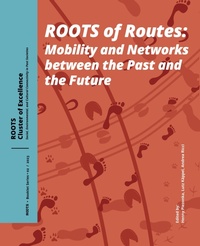
Roots of Routes
Mobility and Networks between the Past and the Future
1st Edition
Published on 15. August 2023
Book
Paperback/Softback
122 pages
978-94-6426-191-2 (ISBN)
Description
People and spaces have always been connected by routes: paths, trails, roads - on land, on water and sometimes even through the air, over hill and dale as well as over wooden planks, pavement and asphalt. Humans and animals followed them. The routes directed the circulation of raw materials and goods. They determined the paths on which humans fled from misery and danger, and they constituted the physical and imagined veins of networks between communities. All these cultural and biological connectivities are the building blocks of reshaping past (and present) societies.In this booklet - the second in the booklet series of the Cluster of Excellence ROOTS at Kiel University - we uncover the roots of these routes: From the earliest stages of the Stone Age to the present day, there have been well-defined routes, which enabled the exchange of things, practices and knowledge between people. Many of these ancient routes are not only still visible today, but even continue to operate: from the Silk Roads spanning the continents to the local routes of the Ox Trail in Schleswig-Holstein, from the waterways of Mesopotamia and the river worlds of the forest zone to the spiritual routes of philosophical contemplation. Moreover, isolation and disruptions of formerly established routes, for example in the Viking diaspora, have also proven to be directional for cultural developments. In a kaleidoscope of perspectives, the roles of landscape and climate are examined. Special attention is given to those routes along which objects, rituals, and therefore also cultural practices were transported. Religious rituals, knowledge, even philosophical insights are shown to have their roots in movement along routes.These and the many other topics in this booklet illustrate to what extent the development of human societies is determined by the routes through which they are connected - or not connected. Modern narratives of a limitless, openly accessible world, grounded in an urban-industrialised experience (or agenda), can get cracks if we look deep enough into the past. It is the paths, the very concrete connections in a material as well as a spiritual sense that influence human lives, their existence and their development. Communication and dialogue along the routes and networks must be maintained, as they were and are the guarantors for a good coexistence of humans in this world.
More details
Edition
1. Auflage
Language
English
Place of publication
Leiden
Netherlands
Target group
Professional and scholarly
Illustrations
82fc / 10bw
Dimensions
Height: 210 mm
Width: 170 mm
Thickness: 9 mm
Weight
281 gr
ISBN-13
978-94-6426-191-2 (9789464261912)
DOI
https://doi.org/10.59641/y1811bk
Copyright in bibliographic data and cover images is held by Nielsen Book Services Limited or by the publishers or by their respective licensors: all rights reserved.
Schweitzer Classification
Persons
Henny Piezonka (PhD, Free University Berlin, 2010) has been a Junior Professor for Anthropological Archaeology at Kiel University, Germany, since 2016. In May 2023, she was appointed University Professor for Prehistoric Archaeology at the Free University Berlin, Germany.
Her research and teaching focuses on the archaeology and anthropology of mobile hunter-gatherer and herder societies in North Eurasia and beyond. It covers three main, interconnected areas: hunter-gatherer diversity, technological innovations such as pottery as a source for socio-economic reconstruction, and Neolithisation pathways. While much of her work deals with the Stone Age, she also conducts ethnoarchaeological work in collaboration with indigenous hunter-fisher-reindeer herder groups in Western Siberia.
As one of the PIs of the Kiel Cluster of Excellence "ROOTS - Social, Environmental, and Cultural Connectivity in Past Societies" she has been studying the dynamics of social inequalities and the entanglement of domestication, diet and diseases. In the Collaborative Research Centre "Scales of Transformation: Human-environmental Interaction in Prehistoric and Archaic Societies" she works on theoretical approaches to transformation. In a project funded by the Gerda Henkel Foundation, Piezonka and her team investigate roles and perception of abandoned urban sites within the Mongolian nomadic society at the interface between archaeology and cultural anthropology.
Key publications:
Piezonka, H., Chairkina, N., Dubovtseva, E., Kosinskaya, L., Meadows, J., Schreiber, T. (forthcoming), The world's oldest known promontory fort - Amnya and the acceleration of hunter-gatherer diversity in Siberia 8000 years ago. Antiquity.
Piezonka, H., 2021. North of the Farmers. Mobility and sedentism among Stone Age hunter-gatherers from the Baltic to the Barents Sea. In: Orschiedt, J., Liebermann, C., Staeuble, H., Schier, W. (eds), Mesolithic or Neolithic? - Searching for the late hunter-gatherers. Topoi. Berlin Studies of the Ancient World, 72, 245-302.
Piezonka, H., Poshekhonova, O., Adaev, V., Rud', A., 2020. A. Migration and its effects on life ways and subsistence strategies of boreal hunter-fishers: Ethnoarchaeological research among the Selkup, Siberia. Quaternary International, 541, 189-203.
Piezonka, H., Kosinskaya, L., Dubovtseva, E., Chemyakin, Yu., Enshin, D., Hartz, S., Kovaleva, V., Panina, S., Savchenko, S., Skochina, S., Terberger, T., Zakh, V., Zhilin, M., Zykov, A.P., 2020. The emergence of early pottery in the Urals and Western Siberia - New dating and stable isotope evidence. Journal of Archaeological Science, 116, 105100. DOI: 10.1016/j.jas.2020.105100
Piezonka, H., 2015. Jaeger, Fischer, Toepfer. Wildbeuter mit frueher Keramik in Nordosteuropa im 6. und 5. Jahrtausend v. Chr.. Archaeologie in Eurasien 30. Bonn: Habelt. Studies of Classics in Tuebingen and Oxford, PhD 1990, Habilitation 1997, Professor of Classics, especially Greek Literature at the Christian-Albrechts-Universitaet zu Kiel 1999-, Ordinary Member of the German Archaeological Institute 2000-, Dean of the Faculty of Humanities 2006-2008, Co-Coordinator of the Kiel Graduate School 'Human Development in Landscapes' 2007-2016; Speaker of the University's Research Focus 'Social, Environmental, Cultural Change' 2007-.
Key publications:
Kaeppel 1992: L. Kaeppel, Das Theater von Epidauros. Die mathematische Grundidee des Gesamtentwurfs und ihr moeglicher Sinn. Jahrbuch des Deutschen Archaeologischen Instituts 104, 1989, 83-106.
Kaeppel 1992: L. Kaeppel, Paian. Studien zur Geschichte einer Gattung (Berlin/New-York 1992).
Kaeppel 1998: L. Kaeppel, Die Konstruktion der Handlung in der Orestie des Aischylos. Die Makrostruktur des 'Plot' als Sinntraeger in der Darstellung des Geschlechterfluchs (Mu?nchen 1998).
Kaeppel 1999: L. Kaeppel, Die PARADEGMA-Inschrift im Tunnel des Eupalinos auf Samos. Antike und Abendland 45 (1999) 75-100.
Kaeppel 2015: L. Kaeppel, Landscape and the Magic of Music in Pindar'sTwelfth Pythian Ode. In: L. Kaeppel/V. Pothou (ed.), Human Development in Sacred Landscapes. Between Ritual Tradition, Creativity and Emotionality (Goettingen 2015) 155-172.
Kaeppel 2016: L. Kaeppel, Charis als Bindung und Bann. Vom Zauber der Musik in Pindars zwoelfter pythischer Ode. In: Carsten Binder et al. (eds.), Diwan. Studies in the History and Culture of the Ancient Near East and the Eastern Mediterranean (Duisburg 2016) 273-302.
Kaeppel/Loehr 2016: L. Kaeppel/J. Loehr, Friedrich Schleiermacher, Platons Werke I,1, Berlin 1804. 1817, Einleitung, Phaidros, Lysis, Protagoras, Laches (Berlin/Boston 2016).
Kaeppel 2017: L. Kaeppel, The Philosophical Banquet in Greek Literature. In: D. Hellholm/D. Saenger (eds.), The Eucharist - Its Origins and Contexts. Sacred Meal, Communal Meal, Table Fellowship in Late Antiquity, Early Judaism, and Early Christianity III (Tu?bingen 2017) 1519-1527.
Kaeppel 2017: L. Kaeppel, Heraklits Kosmologie als Praxis von Modellierung. In: E. Fantino/U. Muss/C. Schubert/K. Sier (eds.), Heraklit im Kontext (Berlin/Boston 2017) 211-230. Andrea Ricci is an archaeologist specialised in the study of the prehistory of Southwestern Asia. He completed his first MA studies at La Sapienza University in Rome (Italy) and then he received a second MA degree at Durham University (UK). After completing his PhD in the framework of the Graduate School "Human Development in Landscapes" at Kiel University, he held a post-doctoral position at the Eurasia Department of the German Archaeological Institute. He is currently a scientific coordinator of the Cluster of Excellence ROOTS at Kiel University. He has conducted field projects in Azerbaijan, Georgia, and Syria.
His main research topics include the investigation of Holocene human-environmental dynamics, the process of neolithisation, and the emergence of the first forms of social and economic complexity.
Key publications: Andrea Ricci
Laneri, N., Jalilov, B., Crescioli, L., Guarducci, G., Kneisel, J., Poulmarc'h, M., Ricci, A., Valentini, S. 2019. GaRKAp 2018: The first season of the Azero-Italian Ganja Region Kurgan Archaeological Project in Western Azerbaijan. Ancient Near Eastern Studies 56, 135-162.
Ricci, A., D?Anna, M.B., Helwing, B., Aliyev, T., Lawrence, D. 2018. Human mobility and early sedentism. The Late Neolithic (mid-sixth millennium BC) landscapes of south-western Azerbaijan. Antiquity 92/366, 1-17.
Neumann, D., Gambashidze, I., Ricci, A., Mindiashvili, G., Gogochuri, G. 2018. Reassessing the hills. Results of an archaeological field survey on the Akhalkalaki Plateau, South Georgia. Eurasia Antiqua 21, 21-44.
Wilkinson, T.J., Philip, G., Bradbury, J., Donoghue, D., Dunford, R., Galiatsatos, N., Lawrence, D., Ricci, A., Smith, S. 2014. Contextualizing Early Urbanization: Settlement Cores, Early States and Agro-Pastoral Strategies in the Fertile Crescent during the Fourth and Third millennia BC. Journal of World Prehistory 27/1, 43-109.
Ricci, A., Helwing, B., Aliyev, T. 2012. The Neolithic on the Move: High Resolution Settlement Dynamics Investigations and Their Impact on Archaeological Landscape Studies in Southwest Azerbaijan. eTopoi. Journal for Ancient Studies, Special Volume 3, 369-375.
Wilkinson, T.J., Galiatsatos, N., Lawrence, D., Ricci, A., Dunford, R., Philip, G. 2012. Landscapes of Settlement and Mobility in the Middle Euphrates of Turkey and Syria During the Late Chalcolithic and Early Bronze Age: A Re-assessment. Levant 44/2, 139-185.
Ricci, A. 2012. 'Ancient Kura' Project. Archaeological landscape studies. The Mil-Karabakh Plain and the Kvemo Kartli Survey Projects: a preliminary account of the first two field seasons (2010-11), in: Lyonnet, B., Guliyev, F., Helwing, B., Aliyev, T., Hansen, S., Mirtskhulava, G. (eds.), Ancient Kura 2010-2011. The first two seasons of joint fieldwork in the Southern Caucasus. Archaeologische Mitteilungen aus Iran und Turan 44. Berlin: Reimer, 1-190 (127-145).
Her research and teaching focuses on the archaeology and anthropology of mobile hunter-gatherer and herder societies in North Eurasia and beyond. It covers three main, interconnected areas: hunter-gatherer diversity, technological innovations such as pottery as a source for socio-economic reconstruction, and Neolithisation pathways. While much of her work deals with the Stone Age, she also conducts ethnoarchaeological work in collaboration with indigenous hunter-fisher-reindeer herder groups in Western Siberia.
As one of the PIs of the Kiel Cluster of Excellence "ROOTS - Social, Environmental, and Cultural Connectivity in Past Societies" she has been studying the dynamics of social inequalities and the entanglement of domestication, diet and diseases. In the Collaborative Research Centre "Scales of Transformation: Human-environmental Interaction in Prehistoric and Archaic Societies" she works on theoretical approaches to transformation. In a project funded by the Gerda Henkel Foundation, Piezonka and her team investigate roles and perception of abandoned urban sites within the Mongolian nomadic society at the interface between archaeology and cultural anthropology.
Key publications:
Piezonka, H., Chairkina, N., Dubovtseva, E., Kosinskaya, L., Meadows, J., Schreiber, T. (forthcoming), The world's oldest known promontory fort - Amnya and the acceleration of hunter-gatherer diversity in Siberia 8000 years ago. Antiquity.
Piezonka, H., 2021. North of the Farmers. Mobility and sedentism among Stone Age hunter-gatherers from the Baltic to the Barents Sea. In: Orschiedt, J., Liebermann, C., Staeuble, H., Schier, W. (eds), Mesolithic or Neolithic? - Searching for the late hunter-gatherers. Topoi. Berlin Studies of the Ancient World, 72, 245-302.
Piezonka, H., Poshekhonova, O., Adaev, V., Rud', A., 2020. A. Migration and its effects on life ways and subsistence strategies of boreal hunter-fishers: Ethnoarchaeological research among the Selkup, Siberia. Quaternary International, 541, 189-203.
Piezonka, H., Kosinskaya, L., Dubovtseva, E., Chemyakin, Yu., Enshin, D., Hartz, S., Kovaleva, V., Panina, S., Savchenko, S., Skochina, S., Terberger, T., Zakh, V., Zhilin, M., Zykov, A.P., 2020. The emergence of early pottery in the Urals and Western Siberia - New dating and stable isotope evidence. Journal of Archaeological Science, 116, 105100. DOI: 10.1016/j.jas.2020.105100
Piezonka, H., 2015. Jaeger, Fischer, Toepfer. Wildbeuter mit frueher Keramik in Nordosteuropa im 6. und 5. Jahrtausend v. Chr.. Archaeologie in Eurasien 30. Bonn: Habelt. Studies of Classics in Tuebingen and Oxford, PhD 1990, Habilitation 1997, Professor of Classics, especially Greek Literature at the Christian-Albrechts-Universitaet zu Kiel 1999-, Ordinary Member of the German Archaeological Institute 2000-, Dean of the Faculty of Humanities 2006-2008, Co-Coordinator of the Kiel Graduate School 'Human Development in Landscapes' 2007-2016; Speaker of the University's Research Focus 'Social, Environmental, Cultural Change' 2007-.
Key publications:
Kaeppel 1992: L. Kaeppel, Das Theater von Epidauros. Die mathematische Grundidee des Gesamtentwurfs und ihr moeglicher Sinn. Jahrbuch des Deutschen Archaeologischen Instituts 104, 1989, 83-106.
Kaeppel 1992: L. Kaeppel, Paian. Studien zur Geschichte einer Gattung (Berlin/New-York 1992).
Kaeppel 1998: L. Kaeppel, Die Konstruktion der Handlung in der Orestie des Aischylos. Die Makrostruktur des 'Plot' als Sinntraeger in der Darstellung des Geschlechterfluchs (Mu?nchen 1998).
Kaeppel 1999: L. Kaeppel, Die PARADEGMA-Inschrift im Tunnel des Eupalinos auf Samos. Antike und Abendland 45 (1999) 75-100.
Kaeppel 2015: L. Kaeppel, Landscape and the Magic of Music in Pindar'sTwelfth Pythian Ode. In: L. Kaeppel/V. Pothou (ed.), Human Development in Sacred Landscapes. Between Ritual Tradition, Creativity and Emotionality (Goettingen 2015) 155-172.
Kaeppel 2016: L. Kaeppel, Charis als Bindung und Bann. Vom Zauber der Musik in Pindars zwoelfter pythischer Ode. In: Carsten Binder et al. (eds.), Diwan. Studies in the History and Culture of the Ancient Near East and the Eastern Mediterranean (Duisburg 2016) 273-302.
Kaeppel/Loehr 2016: L. Kaeppel/J. Loehr, Friedrich Schleiermacher, Platons Werke I,1, Berlin 1804. 1817, Einleitung, Phaidros, Lysis, Protagoras, Laches (Berlin/Boston 2016).
Kaeppel 2017: L. Kaeppel, The Philosophical Banquet in Greek Literature. In: D. Hellholm/D. Saenger (eds.), The Eucharist - Its Origins and Contexts. Sacred Meal, Communal Meal, Table Fellowship in Late Antiquity, Early Judaism, and Early Christianity III (Tu?bingen 2017) 1519-1527.
Kaeppel 2017: L. Kaeppel, Heraklits Kosmologie als Praxis von Modellierung. In: E. Fantino/U. Muss/C. Schubert/K. Sier (eds.), Heraklit im Kontext (Berlin/Boston 2017) 211-230. Andrea Ricci is an archaeologist specialised in the study of the prehistory of Southwestern Asia. He completed his first MA studies at La Sapienza University in Rome (Italy) and then he received a second MA degree at Durham University (UK). After completing his PhD in the framework of the Graduate School "Human Development in Landscapes" at Kiel University, he held a post-doctoral position at the Eurasia Department of the German Archaeological Institute. He is currently a scientific coordinator of the Cluster of Excellence ROOTS at Kiel University. He has conducted field projects in Azerbaijan, Georgia, and Syria.
His main research topics include the investigation of Holocene human-environmental dynamics, the process of neolithisation, and the emergence of the first forms of social and economic complexity.
Key publications: Andrea Ricci
Laneri, N., Jalilov, B., Crescioli, L., Guarducci, G., Kneisel, J., Poulmarc'h, M., Ricci, A., Valentini, S. 2019. GaRKAp 2018: The first season of the Azero-Italian Ganja Region Kurgan Archaeological Project in Western Azerbaijan. Ancient Near Eastern Studies 56, 135-162.
Ricci, A., D?Anna, M.B., Helwing, B., Aliyev, T., Lawrence, D. 2018. Human mobility and early sedentism. The Late Neolithic (mid-sixth millennium BC) landscapes of south-western Azerbaijan. Antiquity 92/366, 1-17.
Neumann, D., Gambashidze, I., Ricci, A., Mindiashvili, G., Gogochuri, G. 2018. Reassessing the hills. Results of an archaeological field survey on the Akhalkalaki Plateau, South Georgia. Eurasia Antiqua 21, 21-44.
Wilkinson, T.J., Philip, G., Bradbury, J., Donoghue, D., Dunford, R., Galiatsatos, N., Lawrence, D., Ricci, A., Smith, S. 2014. Contextualizing Early Urbanization: Settlement Cores, Early States and Agro-Pastoral Strategies in the Fertile Crescent during the Fourth and Third millennia BC. Journal of World Prehistory 27/1, 43-109.
Ricci, A., Helwing, B., Aliyev, T. 2012. The Neolithic on the Move: High Resolution Settlement Dynamics Investigations and Their Impact on Archaeological Landscape Studies in Southwest Azerbaijan. eTopoi. Journal for Ancient Studies, Special Volume 3, 369-375.
Wilkinson, T.J., Galiatsatos, N., Lawrence, D., Ricci, A., Dunford, R., Philip, G. 2012. Landscapes of Settlement and Mobility in the Middle Euphrates of Turkey and Syria During the Late Chalcolithic and Early Bronze Age: A Re-assessment. Levant 44/2, 139-185.
Ricci, A. 2012. 'Ancient Kura' Project. Archaeological landscape studies. The Mil-Karabakh Plain and the Kvemo Kartli Survey Projects: a preliminary account of the first two field seasons (2010-11), in: Lyonnet, B., Guliyev, F., Helwing, B., Aliyev, T., Hansen, S., Mirtskhulava, G. (eds.), Ancient Kura 2010-2011. The first two seasons of joint fieldwork in the Southern Caucasus. Archaeologische Mitteilungen aus Iran und Turan 44. Berlin: Reimer, 1-190 (127-145).
Content
Preface: Perspectives on Past Routes, Networks and Society in Challenging Times
Johannes Mueller
Chapter 1: The ROOTS of Routes - Framing Connections in (Pre-)History
Introduction: A Deep History of Routes Connecting People, Places, and Ideas
Henny Piezonka, Lutz Kaeppel, Andrea Ricci
Globalisation? What Globalisation?
Tim Kerig
Chapter 2: How to Choose a Route?
Routes in the Landscape - Ecological and Social Conditions for the Exchange of Goods, Ideas and People in the Past
Walter Doerfler
Entangled Mobilities - The Interconnection of Human Routes and Animal Movement
Henny Piezonka and Karolina Varkuleviciute
Climate Refugees
Mara Weinelt
Chapter 3: How Far Back Do Our Routes Go?
Sunken Pathways in the North Sea - Tracking Late Palaeolithic Reindeer Hunters off the Coast of Heligoland
Berit Valentin Eriksen and Wolfgang Rabbel
Rooting the Silk Road
Johanna Hilpert and Jutta Kneisel
On the Road Again: Travelling through Jutland - The Ox Trail, a Millennia-old Road
Jutta Kneisel, Bente Majchczack, Franziska Engelbogen, Anna K. Loy, Oliver Nakoinz
Walking on Ancient Paths - Are We Still Using Celtic Trails?
Franziska Engelbogen
Connection Breakdown - Three Vikings Abroad
Jens Schneeweiss and Henny Piezonka
Chapter 4: Routes of Things and Technologies
Cattle and Wagons - The First "Wild West" in Europe? The Wheel Innovation in the Baltic-Pontic Region 3500-2500 BCE
Johannes Mueller
Trackways across the Bog
Jan-Piet Brozio
Road to Riches - Amber Routes in Bronze Age Europe
Benjamin Serbe and Khurram Saleem
Analysing Amber
Khurram Saleem and Benjamin Serbe
The Power of Water - Water Connectivities in Mesopotamia
Andrea Ricci
How Did Buddha Come to Sweden?
Jens Schneeweiss
Chapter 5: Routes of Rituals and Knowledge
At the End of the Road - What Graves Tell Us about Networks and Contacts in Prehistory
Fynn Wilkes and Henry Skorna
Mermaids, Faces, Houses and Birds - Symbols of Connectivity
Jutta Kneisel
Theoria - The Pilgrimage to the Sanctuary as a Journey to Knowledge or What the Modern Concept of "Theory" Has to Do with a Religious Practice in Ancient Greece
Lutz Kaeppel
Pathways between the Worlds - The Sacred Ecology of River Routes
Henny Piezonka
Chapter 6: Conclusions and Outlook
Along the Way: A Look Back Ahead
Lutz Kaeppel, Henny Piezonka, Andrea Ricci
Map of Project Locations
Contributors
For further reading
Imprint
Johannes Mueller
Chapter 1: The ROOTS of Routes - Framing Connections in (Pre-)History
Introduction: A Deep History of Routes Connecting People, Places, and Ideas
Henny Piezonka, Lutz Kaeppel, Andrea Ricci
Globalisation? What Globalisation?
Tim Kerig
Chapter 2: How to Choose a Route?
Routes in the Landscape - Ecological and Social Conditions for the Exchange of Goods, Ideas and People in the Past
Walter Doerfler
Entangled Mobilities - The Interconnection of Human Routes and Animal Movement
Henny Piezonka and Karolina Varkuleviciute
Climate Refugees
Mara Weinelt
Chapter 3: How Far Back Do Our Routes Go?
Sunken Pathways in the North Sea - Tracking Late Palaeolithic Reindeer Hunters off the Coast of Heligoland
Berit Valentin Eriksen and Wolfgang Rabbel
Rooting the Silk Road
Johanna Hilpert and Jutta Kneisel
On the Road Again: Travelling through Jutland - The Ox Trail, a Millennia-old Road
Jutta Kneisel, Bente Majchczack, Franziska Engelbogen, Anna K. Loy, Oliver Nakoinz
Walking on Ancient Paths - Are We Still Using Celtic Trails?
Franziska Engelbogen
Connection Breakdown - Three Vikings Abroad
Jens Schneeweiss and Henny Piezonka
Chapter 4: Routes of Things and Technologies
Cattle and Wagons - The First "Wild West" in Europe? The Wheel Innovation in the Baltic-Pontic Region 3500-2500 BCE
Johannes Mueller
Trackways across the Bog
Jan-Piet Brozio
Road to Riches - Amber Routes in Bronze Age Europe
Benjamin Serbe and Khurram Saleem
Analysing Amber
Khurram Saleem and Benjamin Serbe
The Power of Water - Water Connectivities in Mesopotamia
Andrea Ricci
How Did Buddha Come to Sweden?
Jens Schneeweiss
Chapter 5: Routes of Rituals and Knowledge
At the End of the Road - What Graves Tell Us about Networks and Contacts in Prehistory
Fynn Wilkes and Henry Skorna
Mermaids, Faces, Houses and Birds - Symbols of Connectivity
Jutta Kneisel
Theoria - The Pilgrimage to the Sanctuary as a Journey to Knowledge or What the Modern Concept of "Theory" Has to Do with a Religious Practice in Ancient Greece
Lutz Kaeppel
Pathways between the Worlds - The Sacred Ecology of River Routes
Henny Piezonka
Chapter 6: Conclusions and Outlook
Along the Way: A Look Back Ahead
Lutz Kaeppel, Henny Piezonka, Andrea Ricci
Map of Project Locations
Contributors
For further reading
Imprint