


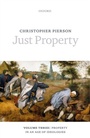
Just Property
Volume Three: Property in an Age of Ideologies
Published on 1. May 2020
Book
Hardback
354 pages
978-0-19-878710-5 (ISBN)
Description
This third and concluding volume of Just Property brings critical accounts of property right up to the present. The book is made up of five pairs of chapters located in five major ideological traditions of modernity: liberalism, libertarianism, social democracy, conservatism, and feminism. As before, the focus is on particular thinkers and their daring, puzzling and sometimes outrageous views. The concluding chapter returns to the project's opening questions about property and inequality and about property under the imperative of growth to limits. If we are to confront the enormous challenges that loom in front of us, we have, above all else, to think again, and quite radically, about the place of property in our collective lives.
More details
Language
English
Place of publication
Oxford
United Kingdom
Target group
Professional and scholarly
Dimensions
Height: 240 mm
Width: 161 mm
Thickness: 24 mm
Weight
696 gr
ISBN-13
978-0-19-878710-5 (9780198787105)
Copyright in bibliographic data and cover images is held by Nielsen Book Services Limited or by the publishers or by their respective licensors: all rights reserved.
Schweitzer Classification
Other editions
Additional editions
E-Book
05/2020
1st Edition
OUP eBook
€60.99
Available for download
E-Book
05/2020
1st Edition
OUP eBook
€52.49
Available for download
Person
Christopher Pierson has been Professor of Politics at the University of Nottingham since 1996. He has held visiting positions at the Australian National University, the University of California, Santa Barbara, Johns Hopkins University (Baltimore), the University of Auckland, and at the Hansewissenschaftskolleg in Lower Saxony. He has published extensively on the themes of the welfare state, the problems of social democracy and, over the last decade, on the politics of property.
Content
Introduction
1: Liberals I
2: Liberals II
3: Libertarians I
4: Libertarians II
5: Social Democrats I
6: Social Democrats II
7: Radical Conservatives I
8: Radical Conservatives II
9: Feminists I
10: Feminists II
Conclusion
1: Liberals I
2: Liberals II
3: Libertarians I
4: Libertarians II
5: Social Democrats I
6: Social Democrats II
7: Radical Conservatives I
8: Radical Conservatives II
9: Feminists I
10: Feminists II
Conclusion