

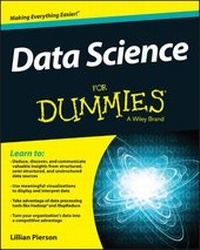
Data Science For Dummies
Published on 9. March 2015
Book
Paperback/Softback
408 pages
978-1-118-84155-6 (ISBN)
Description
Discover how data science can help you gain in-depth insight into your business - the easy way!
Jobs in data science abound, but few people have the data science skills needed to fill these increasingly important roles in organizations. Data Science For Dummies is the perfect starting point for IT professionals and students interested in making sense of their organization's massive data sets and applying their findings to real-world business scenarios. From uncovering rich data sources to managing large amounts of data within hardware and software limitations, ensuring consistency in reporting, merging various data sources, and beyond, you'll develop the know-how you need to effectively interpret data and tell a story that can be understood by anyone in your organization.
* Provides a background in data science fundamentals before moving on to working with relational databases and unstructured data and preparing your data for analysis
* Details different data visualization techniques that can be used to showcase and summarize your data
* Explains both supervised and unsupervised machine learning, including regression, model validation, and clustering techniques
* Includes coverage of big data processing tools like MapReduce, Hadoop, Dremel, Storm, and Spark
It's a big, big data world out there - let Data Science For Dummies help you harness its power and gain a competitive edge for your organization.
Jobs in data science abound, but few people have the data science skills needed to fill these increasingly important roles in organizations. Data Science For Dummies is the perfect starting point for IT professionals and students interested in making sense of their organization's massive data sets and applying their findings to real-world business scenarios. From uncovering rich data sources to managing large amounts of data within hardware and software limitations, ensuring consistency in reporting, merging various data sources, and beyond, you'll develop the know-how you need to effectively interpret data and tell a story that can be understood by anyone in your organization.
* Provides a background in data science fundamentals before moving on to working with relational databases and unstructured data and preparing your data for analysis
* Details different data visualization techniques that can be used to showcase and summarize your data
* Explains both supervised and unsupervised machine learning, including regression, model validation, and clustering techniques
* Includes coverage of big data processing tools like MapReduce, Hadoop, Dremel, Storm, and Spark
It's a big, big data world out there - let Data Science For Dummies help you harness its power and gain a competitive edge for your organization.
More details
Other editions
New editions
Lillian Pierson
Data Science For Dummies
Book
03/2017
2nd Edition
Wiley
Unfortunately, price unknown
Article exhausted; check for reprint
Additional editions
Person
Lillian Pierson, P.E. is an entrepreneurial data scientist and professional environmental engineer. She's the founder of Data-Mania, a start-up that focuses mainly on web analytics, data-driven growth services, data journalism, and data science training services. She also covers the topics of data science, analytics, and statistics for prominent organizations like IBM and UBM.
Content
Foreword xv Introduction 1 Part I: Getting Started With Data Science 5 Chapter 1: Wrapping Your Head around Data Science 7 Chapter 2: Exploring Data Engineering Pipelines and Infrastructure 17 Chapter 3: Applying Data Science to Business and Industry 33 Part II: Using Data Science to Extract Meaning from Your Data 47 Chapter 4: Introducing Probability and Statistics 49 Chapter 5: Clustering and Classification 73 Chapter 6: Clustering and Classification with Nearest Neighbor Algorithms 87 Chapter 7: Mathematical Modeling in Data Science 99 Chapter 8: Modeling Spatial Data with Statistics 113 Part III: Creating Data Visualizations that Clearly Communicate Meaning 129 Chapter 9: Following the Principles of Data Visualization Design 131 Chapter 10: Using D3.js for Data Visualization 157 Chapter 11: Web-Based Applications for Visualization Design 171 Chapter 12: Exploring Best Practices in Dashboard Design 189 Chapter 13: Making Maps from Spatial Data 195 Part IV: Computing for Data Science 215 Chapter 14: Using Python for Data Science 217 Chapter 15: Using Open Source R for Data Science 239 Chapter 16: Using SQL in Data Science 255 Chapter 17: Software Applications for Data Science 267 Part V: Applying Domain Expertise to Solve Real-World Problems Using Data Science 279 Chapter 18: Using Data Science in Journalism 281 Chapter 19: Delving into Environmental Data Science 299 Chapter 20: Data Science for Driving Growth in E-Commerce 311 Chapter 21: Using Data Science to Describe and Predict Criminal Activity 327 Part VI: The Part of Tens 337 Chapter 22: Ten Phenomenal Resources for Open Data 339 Chapter 23: Ten (or So) Free Data Science Tools and Applications 351 Index 365