

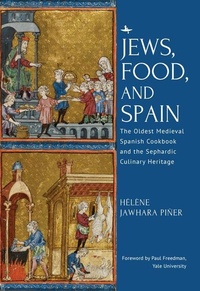
Jews, Food, and Spain
The Oldest Medieval Spanish Cookbook and the Sephardic Culinary Heritage
Published on 6. November 2025
Book
Paperback/Softback
300 pages
979-8-89783-095-4 (ISBN)
Description
2023 Gourmand World Cookbook Awards Best Jewish Food Culture Book; 2022 National Jewish Book Award FinalistA fascinating study that will appeal to both culinarians and readers interested in the intersecting histories of food, Sephardic Jewish culture, and the Mediterranean world of Iberia and northern Africa.
In the absence of any Jewish cookbook from the pre-1492 era, it requires arduous research and a creative but disciplined imagination to reconstruct Sephardic tastes from the past and their survival and transmission in communities around the Mediterranean in the early modern period, followed by the even more extensive diaspora in the New World. In this intricate and absorbing study, Helene Jawhara Piner presents readers with the dishes, ingredients, techniques, and aesthetic principles that make up a sophisticated and attractive cuisine, one that has had a mostly unremarked influence on modern Spanish and Portuguese recipes.
In the absence of any Jewish cookbook from the pre-1492 era, it requires arduous research and a creative but disciplined imagination to reconstruct Sephardic tastes from the past and their survival and transmission in communities around the Mediterranean in the early modern period, followed by the even more extensive diaspora in the New World. In this intricate and absorbing study, Helene Jawhara Piner presents readers with the dishes, ingredients, techniques, and aesthetic principles that make up a sophisticated and attractive cuisine, one that has had a mostly unremarked influence on modern Spanish and Portuguese recipes.
Reviews / Votes
"By linking culinary practice to institutional power, Piner shows that food was not merely sustenance but a medium through which identity was constructed, contested, and regulated. Her work thus deepens our understanding of how minority identities were materially and symbolically produced in Iberian history."- Ana M. Gomez-Bravo, Contemporary Jewry
"Jews, Food, and Spain is a fascinating study in which the author, Helene Jawhara Piner, asserts that food is an important key to unraveling the complexities of the Jewish cultural heritage, especially in early Medieval Spain. Using the 13th century Arabic language cookbook Kitab Tabikh as guide, she explores what can be discerned from its contents regarding Jewish culture and its evolution in the multicultural setting of Al-Andalus. Cuisine, as Jawhara Piner explains, is so much more than just recipes... [The book] would be a valuable addition to an academic Jewish history and culture collection as well one focused on food studies."
- C. and Anne-Marie Belinfante, AJL News & Reviews
"Tell me what you eat, and I will tell you who you are. This should be the motto of any book that examines the medieval food culture of Iberia. In her new book entitled Jews, Food, and Spain, Helene Jawhara Piner seeks to demonstrate both the process through which the Jewish cuisine of the Iberian Middle Ages acted as a cultural identifier, and how this culinary culture has been maintained in modern Sephardic communities. ... This book is a welcome addition to the growing discussion of the culinary multiculturalism that existed in the Iberian Middle Ages. ... there is no doubt that this book is an important examination of the influence of Jewish culinary culture on medieval Iberia and on the diasporic culinary journey of Iberian Jews."
- Martha Daas, Speculum
"Helene Jawhara Piner's new book, Jews, Food, and Spain, is a wonder. Her research is deep and comprehensive, her presentation detailed and wise, and her 'gift' to the reader generous. Her work answers every question about the Sephardic culinary heritage you have ever had, and many questions you didn't even know how to ask. This is a book anyone interested in food, its history, and its meanings, will want to read."
- Dr. David Kraemer, Jewish Theological Seminary Librarian and Professor of Talmud and Rabbinics. Author of Jewish Eating and Identity Through the Ages
"In Jews, Food, and Spain, Helene Jawhara Piner invites us into the medieval kitchens of Muslim Spain, where she uncovers compelling evidence of several unknown, distinctively Jewish culinary practices that over the centuries have been integrated into Spanish cuisine. Her meticulous research into the foodways of Spain's Sephardim will be eye-opening to all those with an interest in the food, history, and culture of the region."
- Darra Goldstein, Food historian and founding editor of the journal Gastronomica
"In this fascinating study, which will appeal to readers (and cooks!) interested in the intersecting histories of food, Sephardic Jewish culture, and the Mediterranean world of Iberia and northern Africa, Helene Jawhara Piner studies Kitab al-tabikh, a cookbook of uncertain authorship written in Arabic around the year 1200 which also includes dietary advice about which foods to eat to address individuals' variable health needs. Remarkably, this volume includes several recipes which its author describes as explicitly Jewish, such as "Jewish Partridge" and "A Jewish Dish of Eggplants Stuffed with Meat." Piner uses this volume and these recipes as her point of departure to investigate far-reaching questions: What is Jewish cuisine, what is Sephardic culture, and how can we use the history of food to trace Jewish experiences in the Iberian Peninsula and later, following Jewish and Muslim expulsions from Spain? Piner makes a case for the role of ingredients, methods, cultural associations, and even utensils or cooking pots that probably once made a recipe discernibly Jewish."
- Heather J. Sharkey, Professor and Chair, Department of Near Eastern Languages & Civilizations, University of Pennsylvania, Philadelphia
"'To eat is to remember'. These words which conclude Piner's fascinating book are its basic postulation. Jews, Food, and Spain unfolds the story of the of Sephardic Jews through the unique perspective of its cuisine. It starts with a brilliant reconstruction of the medieval Arabic cookbook Kitab al-?abi? in which Piner uncovers the Jewish layers through a painstaking linguistic and textual analysis and goes on in the footsteps of the almost invisible traces left by Jewish cuisine in Spain after the expulsion as well as in the Sephardic diasporas around the Mediterranean and in the new world. Through the history of food and foodways, Sephardic identity is discovered and reaffirmed. This is a captivating book with enormous erudition which brings new insight into the history of Sephardim, Spain and the Mediterranean."
- Miriam Frenkel, Menahem Ben-Sasson Chair in Judaism & Islam Through the Ages, The Hebrew University of Jerusalem
"Through a refined 'counter-hair' reading of historical sources (Islamic texts in the Middle Ages, then Christian texts), Helene reconstructs the identity (not only culinary, since what we eat is what we are) of a people of which others speak, to describe and mark its diversity. It is an exciting detective story that reveals not only the characteristics of Jewish cuisine in those distant centuries, but also the strength with which those characteristics have been transmitted over time, until today."
- Massimo Montanari, Professor of Food History, Bologna University
More details
Language
English
Place of publication
Brighton
United States
Target group
College/higher education
Product notice
Paperback (trade)
Illustrations
Illustrations
Weight
430 gr
ISBN-13
979-8-89783-095-4 (9798897830954)
Copyright in bibliographic data and cover images is held by Nielsen Book Services Limited or by the publishers or by their respective licensors: all rights reserved.
Schweitzer Classification
Persons
Helene Jawhara Piner holds a
doctoral degree in Medieval History and the History of Food. She has lectured
at Bar-Ilan University, the Hebrew University of Jerusalem, the Casa de
Velasquez in Madrid, and the Weitzman National Museum of American Jewish History
(Philadelphia). Dr. Jawhara Piner's main research interest is the medieval culinary
history of Spain through inter- and multiculturalism, with a special focus on
Jewish culinary heritage. She is the author of the historical cookbook
Sephardi: Cooking the History (Academic Studies Press) which was praised by
the Los Angeles Times, El Pais, and the Jewish Book Council and is a winner of the
2021 Gourmand World Cookbook Awards. Piner spearheads the culinary live show "Sephardic Culinary History with Chef Helene
Jawhara Piner," promoted the ASF & The Center for Jewish History. Her new
historical cookbook is forthcoming in Winter 2023.
doctoral degree in Medieval History and the History of Food. She has lectured
at Bar-Ilan University, the Hebrew University of Jerusalem, the Casa de
Velasquez in Madrid, and the Weitzman National Museum of American Jewish History
(Philadelphia). Dr. Jawhara Piner's main research interest is the medieval culinary
history of Spain through inter- and multiculturalism, with a special focus on
Jewish culinary heritage. She is the author of the historical cookbook
Sephardi: Cooking the History (Academic Studies Press) which was praised by
the Los Angeles Times, El Pais, and the Jewish Book Council and is a winner of the
2021 Gourmand World Cookbook Awards. Piner spearheads the culinary live show "Sephardic Culinary History with Chef Helene
Jawhara Piner," promoted the ASF & The Center for Jewish History. Her new
historical cookbook is forthcoming in Winter 2023.
Content
Acknowledgments
Foreword by Paul Freedman
Introduction
Part One. The Jews' Place in the Construction of an Andalusian Cuisine (Twelfth to Fourteenth Centuries)
1. A Unique "Witness" to Complex Realities
2. The Jewish Stamp in the Kitab al-?abi?
3. Jewish and Muslims Food Consumption and Cooking Practices in the Kitab al-?abi?
4. Eggplant: The Jewishness Marker
Part Two. The Legacy of the Multicultural Cuisine of Al-Andalus (Fourteenth to Seventeenth Century): The Evolution and Perception of Jewish Food
5. The Counterpoint of Christian-Dominated Cookbooks
6. Iberian Literary Works: Witnesses to Food Discrimination against Jews
7. Trends and Evidence: Food as an Identity Marker
8. The Trials of the Inquisition: Written Witnesses of an Oral Transmission of Jewish Skills
Part Three. Sephardic Jewish Culinary Heritage: Between Rebirth and the Desire to Recognize a Past Legacy
9. Common Dishes in Spanish Sephardic cuisine
10. Dishes and Diaspora: From the Kitab al-?abi? to the Sephardic Culinary Heritage of the Mediterranean Basin
11. Recipes and Photos of Jewish Dishes from the Kitab al-?abi?
12. Recipes and Photos of Iberian Medieval Dishes in the Sephardic Culinary Heritage of the Mediterranean Basin
Conclusion
Bibliography
Index
Foreword by Paul Freedman
Introduction
Part One. The Jews' Place in the Construction of an Andalusian Cuisine (Twelfth to Fourteenth Centuries)
1. A Unique "Witness" to Complex Realities
2. The Jewish Stamp in the Kitab al-?abi?
3. Jewish and Muslims Food Consumption and Cooking Practices in the Kitab al-?abi?
4. Eggplant: The Jewishness Marker
Part Two. The Legacy of the Multicultural Cuisine of Al-Andalus (Fourteenth to Seventeenth Century): The Evolution and Perception of Jewish Food
5. The Counterpoint of Christian-Dominated Cookbooks
6. Iberian Literary Works: Witnesses to Food Discrimination against Jews
7. Trends and Evidence: Food as an Identity Marker
8. The Trials of the Inquisition: Written Witnesses of an Oral Transmission of Jewish Skills
Part Three. Sephardic Jewish Culinary Heritage: Between Rebirth and the Desire to Recognize a Past Legacy
9. Common Dishes in Spanish Sephardic cuisine
10. Dishes and Diaspora: From the Kitab al-?abi? to the Sephardic Culinary Heritage of the Mediterranean Basin
11. Recipes and Photos of Jewish Dishes from the Kitab al-?abi?
12. Recipes and Photos of Iberian Medieval Dishes in the Sephardic Culinary Heritage of the Mediterranean Basin
Conclusion
Bibliography
Index