

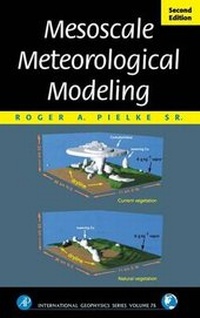
Mesoscale Meteorological Modeling: Volume 98
2nd Edition
Published on 11. December 2001
Book
Hardback
696 pages
978-0-12-554766-6 (ISBN)
Description
The second edition of Mesoscale Meteorological Modeling is a fully revised resource for researchers and practitioners in the growing field of meteorological modeling at the mesoscale. Pielke has enhanced the new edition by quantifying model capability (uncertainty) by a detailed evaluation of the assumptions of parameterization and error propagation. Mesoscale models are applied in a wide variety of studies, including weather prediction, regional and local climate assessments, and air pollution investigations.
Reviews / Votes
"This book is a useful reference for those interested int he application of numerical models as applied to mesoscale phenomena...a worthwhile addition to one's library." --BAMS (Bulletin of the American Meteorological Society)"Roger A. Pielke, Sr., has been working at the forefront of mesoscale meteorological research for the past thirty years...I recommend this book to all those interested in mesoscale meteorological modelling." --Dale Hess, Bureau of Meteorology Research Centre, Australian Meteorological Magazine, September, 2002
More details
Series
Edition
2nd edition
Language
English
Place of publication
San Diego
United States
Publishing group
Elsevier Science Publishing Co Inc
Target group
College/higher education
Postgraduate courses and researchers in the field of atmospheric science
Edition type
New edition
Dimensions
Height: 229 mm
Width: 152 mm
Weight
1060 gr
ISBN-13
978-0-12-554766-6 (9780125547666)
Copyright in bibliographic data and cover images is held by Nielsen Book Services Limited or by the publishers or by their respective licensors: all rights reserved.
Schweitzer Classification
Other editions
New editions
Book
11/2013
3rd Edition
Academic Press
€124.50
Shipment within 15-20 days
Person
Content
1. Introduction2. Basic Set of Equations3. Simplification of the Basic Equations4. Averaging the Conservation Relations5. Physical and Analytic Modeling6. Coordinate Transformations7. Parameterization-Averaged Subgrid-Scale Fluxes8. Averaged Radiation Flux Divergence9. Parameterization of Moist Thermodynamic Processes10. Methods of Solution11. Boundary and Initial Conditions12. Model Evaluation13. Examples of Mesoscale Models