

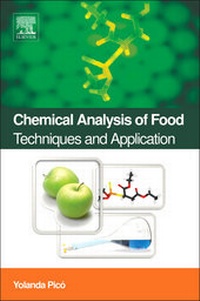
Chemical Analysis of Food: Techniques and Applications
Published on 20. August 2012
Book
Hardback
812 pages
978-0-12-384862-8 (ISBN)
Description
Chemical Analysis of Food: Techniques and Applications reviews new technology and challenges in food analysis from multiple perspectives: a review of novel technologies being used in food analysis, an in-depth analysis of several specific approaches, and an examination of the most innovative applications and future trends. This book won a 2012 PROSE Award Honorable Mention in Chemistry and Physics from the Association of American Publishers.
The book is structured in two parts: the first describes the role of the latest developments in analytical and bio-analytical techniques and the second reviews the most innovative applications and issues in food analysis. Each chapter is written by experts on the subject and is extensively referenced in order to serve as an effective resource for more detailed information. The techniques discussed range from the non-invasive and non-destructive, such as infrared spectroscopy and ultrasound, to emerging areas such as nanotechnology, biosensors and electronic noses and tongues. Important tools for problem-solving in chemical and biological analysis are discussed in detail.
The book is structured in two parts: the first describes the role of the latest developments in analytical and bio-analytical techniques and the second reviews the most innovative applications and issues in food analysis. Each chapter is written by experts on the subject and is extensively referenced in order to serve as an effective resource for more detailed information. The techniques discussed range from the non-invasive and non-destructive, such as infrared spectroscopy and ultrasound, to emerging areas such as nanotechnology, biosensors and electronic noses and tongues. Important tools for problem-solving in chemical and biological analysis are discussed in detail.
Reviews / Votes
"Chemical Analysis of Foods is a very helpful book for those involved in food research and analysis, including post-graduate students. The format of the book, with analytical techniques being presented in the first part and specific applications being discussed and extensively referenced in the second part, is extremely convenient." --Analytical and Bioanalytical Chemistry online, May 2013"Because of its comprehensiveness, this book will likely become a key resource for food scientists and those evaluating food safety and quality." --CHOICE, March 2013
"New analytical techniques and new applications in food analysis are surveyed by researchers from food and food safety sciences and from analytic chemistry. Among their topics are data analysis and chemometrics, low-intensity ultrasound, electronic noses and tongues, liquid and gas chromatography, electrophoresis, food authenticity and fraud, nutritional supplements, genetically modified organisms, emerging contaminants, and allergens. Academic Press in an imprint of Elsevier." --Reference and Research Book News, October 2012
More details
Language
English
Place of publication
San Diego
United States
Publishing group
Elsevier Science Publishing Co Inc
Target group
Professional and scholarly
This book is intended for food researchers in university departments of food science, food industry laboratories, and governmental food regulatory departments. Specifically, scientists and researchers working in biochemistry, biology, food chemistry, toxicology, chemistry, agronomy, hygiene are those who are involved in food analysis.
Dimensions
Height: 235 mm
Width: 191 mm
Weight
1630 gr
ISBN-13
978-0-12-384862-8 (9780123848628)
Copyright in bibliographic data and cover images is held by Nielsen Book Services Limited or by the publishers or by their respective licensors: all rights reserved.
Schweitzer Classification
Other editions
New editions
Book
06/2020
2nd Edition
Academic Press
€228.50
Shipment within 15-20 days
Additional editions
Book
08/2016
Academic Press
€168.65
Shipment within 15-20 days
E-Book
09/2012
Academic Press
€149.00
Available for download
Person
Yolanda Pico was born in Valencia, Spain, in 1964. She received her Ph.D. in Pharmacy in 1992, after which she was a post-doctoral fellow at the Vrije Universiteit of Amsterdam (The Netherlands) (1992/1993) and at the "La Sapienza? University (Rome, Italy) (1996); Assistant Professor of Nutrition and Bromatology at the University of Valencia (1993-1998). Since 1998 she is full Professor of Nutrition and Food Science at the Department of Preventive Medicine and Public Health, Food Science, Toxicology and Legal Medicine of the University of Valencia and the Head of the research group in Food and Environmental Safety (SAMA-UV). Her research interests include identification of unknown compounds by liquid chromatography-mass spectrometry, microextraction separations and environmental and food safety, development of new analytical methods to determine contaminants in food and the environment and the application of methodologies to the risk assessment of different hazard within both field. She is the author of nearly 240 peer-reviewed papers 180 scientific papers in journals of SCI, 30 book chapters and editor of 3 books on Food and Environmental Safety and Applications of liquid chromatography-mass spectrometry. She has a hirsh index of 47 has been a member of various international scientific committees of renowned institutions. Other relevant activities include the following: Member of the Scientific Panel of Plant Protection Products and their Residues (PPR Panel) of the European Food Safety Authority (EFSA) (2009-2012) and partner of projects related with food, water and soil quality at the different national and international levels. She has been supervising 9 Ph.D. theses on food analysis (1992-2014).
Her main focusses are: risk assessment of the exposure to pesticide residues, veterinary and human medicines, illicit drugs, perfluorinated compounds, and other emerging compounds including toxic-analytical aspects, of bioavailability and bioaccesibility, synergisms, toxicity evaluation and detoxification.
Her main focusses are: risk assessment of the exposure to pesticide residues, veterinary and human medicines, illicit drugs, perfluorinated compounds, and other emerging compounds including toxic-analytical aspects, of bioavailability and bioaccesibility, synergisms, toxicity evaluation and detoxification.
Content
Part I. Chemical Analyis of Food
1. Basics and advances in sampling and sample preparation
2. Data analysis and chemometrics
3. Near-infrared, mid-infrared and Raman spectroscopy
4 Magnetic Resonance
5. Low intensity ultrasound
6. The applications of nanotechnology
7. Microfluidic devices: biosensors
8. Electronic noses and tongues
9. Mass spectrometry
10. Liquid Chromatography
11. Gas chromatography
12. Electrophoresis
13. Molecular Techniques
Part II. Applications
14. Traceability
15. Food Authenticity and Fraud
16. Food Proteomics
17. Nutritional Supplements
18. A particular case of novel food: Genetically modified organisms
19. Flavours and Odours
20. Emerging contaminants
21. Allergens
22. Metal speciation
23. Readionuclides
1. Basics and advances in sampling and sample preparation
2. Data analysis and chemometrics
3. Near-infrared, mid-infrared and Raman spectroscopy
4 Magnetic Resonance
5. Low intensity ultrasound
6. The applications of nanotechnology
7. Microfluidic devices: biosensors
8. Electronic noses and tongues
9. Mass spectrometry
10. Liquid Chromatography
11. Gas chromatography
12. Electrophoresis
13. Molecular Techniques
Part II. Applications
14. Traceability
15. Food Authenticity and Fraud
16. Food Proteomics
17. Nutritional Supplements
18. A particular case of novel food: Genetically modified organisms
19. Flavours and Odours
20. Emerging contaminants
21. Allergens
22. Metal speciation
23. Readionuclides