

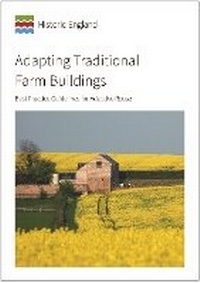
Adapting Traditional Farm Buildings
Best Practice Guidelines for Adaptive Reuse
Published on 20. October 2017
Book
Paperback/Softback
52 pages
978-1-84802-500-4 (ISBN)
Description
Traditional farmsteads and farm buildings make an important contribution to the remarkably varied character of England's landscape. They are fundamental to its sense of place and local distinctiveness. Although the majority of traditional farm buildings have now become partly or wholly redundant for modern agricultural purposes unsupported by income to fund their maintenance and repair, they often have the potential to be of economic value in terms of their capacity to accommodate a variety of new uses.
Successful adaptive reuse of any farmstead or building depends upon an understanding of its significance, its relationship to the wider landscape setting and its sensitivity to and capacity for change.
This advice is aimed at owners of farm buildings, building professionals and local authority planning and conservation officers. It explains how significance can be retained and enhanced through well-informed maintenance and sympathetic development, provided that repairs, design and implementation are carried out to a high standard.
This replaces The Conversion of Traditional Farm Buildings published September 2006.
Successful adaptive reuse of any farmstead or building depends upon an understanding of its significance, its relationship to the wider landscape setting and its sensitivity to and capacity for change.
This advice is aimed at owners of farm buildings, building professionals and local authority planning and conservation officers. It explains how significance can be retained and enhanced through well-informed maintenance and sympathetic development, provided that repairs, design and implementation are carried out to a high standard.
This replaces The Conversion of Traditional Farm Buildings published September 2006.
More details
Series
Language
English
Place of publication
Swindon
United Kingdom
Target group
Professional and scholarly
Illustrations
60 Illustrations
Dimensions
Height: 297 mm
Width: 210 mm
ISBN-13
978-1-84802-500-4 (9781848025004)
Copyright in bibliographic data and cover images is held by Nielsen Book Services Limited or by the publishers or by their respective licensors: all rights reserved.
Schweitzer Classification
Persons
David Pickles is a Senior Architect with Historic England. Jeremy Lake works with Historic Environment Intelligence Team, focusing on understanding and informing responses to potential future scenarios for change to landscapes and resources across England.
Content
* Introduction
* Introducing traditional farmsteads
* Assessing character and significance
* Adapting farm buildings
* Obtaining consents
* Where to get advice
* Acknowledgements
* Introducing traditional farmsteads
* Assessing character and significance
* Adapting farm buildings
* Obtaining consents
* Where to get advice
* Acknowledgements