

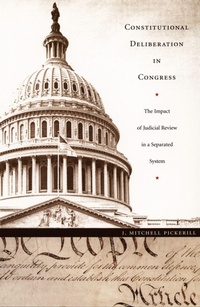
Constitutional Deliberation in Congress
The Impact of Judicial Review in a Separated System
Will be published approx. on 17. May 2004
Book
Hardback
208 pages
978-0-8223-3235-0 (ISBN)
Description
In Constitutional Deliberation in Congress J. Mitchell Pickerill analyzes the impact of the Supreme Court's constitutional decisions on Congressional debates and statutory language. Based on a thorough examination of how Congress responds to key Court rulings and strategizes in anticipation of them, Pickerill argues that judicial review-or the possibility of it-encourages Congressional attention to constitutional issues. Revealing critical aspects of how laws are made, revised, and refined within the separated system of government of the United States, he makes an important contribution to "constitutionalism outside the courts" debates.Pickerill combines legislative histories, extensive empirical findings, and interviews with current and former members of Congress, congressional staff, and others. He examines data related to all of the federal legislation struck down by the Supreme Court from the beginning of the Warren Court in 1953 through the 1996-97 term of the Rehnquist Court. By looking at the legislative histories of Congressional acts that invoked the Commerce Clause and presented Tenth Amendment conflicts-such as the Child Labor Act (1916), the Civil Rights Act (1965), the Gun-Free School Zones Act (1990), and the Brady Bill (1994)-Pickerill illuminates how Congressional deliberation over newly proposed legislation is shaped by the possibility of judicial review. The Court's invalidation of the Gun-Free School Zones Act in its 1995 ruling United States v. Lopez signaled an increased judicial activism regarding issues of federalism. Pickerill examines that case and compares congressional debate over constitutional issues in key pieces of legislation that preceded and followed it: the Violence Against Women Act of 1994 and the Hate Crimes Prevention Act of 1997. He shows that Congressional attention to federalism increased in the 1990s along with the Court's greater scrutiny.
Reviews / Votes
"Legal scholars have recently questioned judicial review on the ground that constitutional deliberation should be returned to the people and their political representatives. Drawing from case studies of several federal statutes invalidated by the Supreme Court, Mitch Pickerill thoughtfully suggests that serious constitutional discourse in the legislature is unlikely unless the Court continues to exercise its power of judicial review. I found his argumentation persuasive as well as informative. Constitutional Deliberation in Congress is well worth reading by lawyers as well as by students of American government."-William N. Eskridge Jr., Yale Law School "Constitutional Deliberation in Congress brings to light important new evidence regarding how Congress and the Court relate to one another in constitutional cases, and it provides the first high-quality and systematic examination of how Congress responds to judicial invalidations of its legislation."-Keith Whittington, Princeton UniversityMore details
Series
Language
English
Place of publication
North Carolina
United States
Target group
Professional and scholarly
Product notice
Cloth over boards
Illustrations
11 tables, 4 figures
Dimensions
Height: 239 mm
Width: 152 mm
Thickness: 18 mm
Weight
544 gr
ISBN-13
978-0-8223-3235-0 (9780822332350)
Copyright in bibliographic data and cover images is held by Nielsen Book Services Limited or by the publishers or by their respective licensors: all rights reserved.
Schweitzer Classification
Other editions
Additional editions
J. Mitchell Pickerill | Neal Devins | Mark A. Graber
Constitutional Deliberation in Congress
The Impact of Judicial Review in a Separated System
E-Book
05/2004
1st Edition
De Gruyter
€188.99
Available for download
Person
J. Mitchell Pickerill is Assistant Professor of Political Science at Washington State University.
Content
List of Tables and Figures ix
Acknowledgments xi
Introduction 1
1. Constitutional Deliberation in a Separated System 11
2. Judicial Review: Roadblock, Speed Bump, or Detour? 31
3. The Shadows of Uncertain Scrutiny: Legislating in a Period of Judicial Dualism 63
4. The Missing Constitution: Legislating in the Darkness of Judicial Deference 95
5. The Nature of Things: Anticipation and Negotiation, Interaction and Reaction 133
Appendix A. Judicial Review Decisions and Relevant Legislation (Chapter 2 Dataset) 155
Appendix B. In-Depth Interviews 161
Notes 167
Table of Cases 175
Bibliography 177
Index 183
Acknowledgments xi
Introduction 1
1. Constitutional Deliberation in a Separated System 11
2. Judicial Review: Roadblock, Speed Bump, or Detour? 31
3. The Shadows of Uncertain Scrutiny: Legislating in a Period of Judicial Dualism 63
4. The Missing Constitution: Legislating in the Darkness of Judicial Deference 95
5. The Nature of Things: Anticipation and Negotiation, Interaction and Reaction 133
Appendix A. Judicial Review Decisions and Relevant Legislation (Chapter 2 Dataset) 155
Appendix B. In-Depth Interviews 161
Notes 167
Table of Cases 175
Bibliography 177
Index 183