

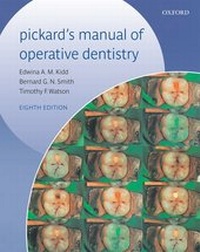
Pickard's Manual of Operative Dentistry
Edited by Kidd, Edwina A.M. / Smith, Bernard G.N. / Watson, Timothy F.
8th Edition
Published on 28. August 2003
Book
Paperback/Softback
224 pages
978-0-19-850928-8 (ISBN)
Description
The new edition of this bestselling dental textbook has been thoroughly updated to keep abreast of current knowledge of the disease processes, and the role of operative dentistry in their management. The book describes, clearly and concisely, the indications and methods for many common operative and conservative procedures in dental practice. Procedures and techniques are illustrated in full colour, and where appropriate, step-by-step sequences are given. Its popularity lies in the fact that it doubles as an atlas, and the text is clear and accessible. The new co-author, Tim Watson, is well known as an expert in adhesive dentistry. A new chapter has been added on adhesion and adhesive restorations, since these are now the first choice for primary lesions for all surfaces and all teeth in the mouth. Amalgam is still thoroughly described, but bonding techniques are now included with a shift away from pins where retention is a problem. The diagnosis of failed restorations has been updated in the light of new research and techniques for refurbishment and repair of restorations are advocated where appropriate.
As in previous editions, the approach is disease and prevention orientated, is problem based and the changes have a research evidence-base.
As in previous editions, the approach is disease and prevention orientated, is problem based and the changes have a research evidence-base.
Reviews / Votes
The authors are to be congratulated on the clear, non-fussy descriptions of techniques throughout the book, and the extremely high quality colour photography which complements the text ... A book for undergraduates? Well yes, this is the main aim of the manual. And yet, as I read the book, I was reminded how far dentistry has come in the 23 years since I qualified and I was struck by the need for all general practitioners who have been qualified as long as I have (or longer!) to use this book as a refresher on all the procedures that modern dentistry can offer. If you have the opportunity, sitting with a glass of the red stuff, this would make a valuable refreshing read. Alternatively, it would give valuable help to a vocational trainer as a basis for a tutorial session with a VDP. Dental Practice, Vol 42, No 11 Pickard's Manual of Operative Dentistry has been and in my opinion still is the authoritative text on simple operative dentistry and should find a place on the shelves of all undergraduate dental students, student hygiene/therapists and student dental nurses. I also feel that this book can have considerable value to new postgraduates involved with any aspect of operative dentistry as a simple refresher text. British Dental Journal, 196More details
Edition
8th Revised edition
Language
English
Place of publication
Oxford
United Kingdom
Target group
College/higher education
Edition type
Revised edition
Illustrations
numerous colour, black & white and line illustrations
Dimensions
Height: 276 mm
Width: 220 mm
Thickness: 14 mm
Weight
899 gr
ISBN-13
978-0-19-850928-8 (9780198509288)
Copyright in bibliographic data and cover images is held by Nielsen Book Services Limited or by the publishers or by their respective licensors: all rights reserved.
Schweitzer Classification
Other editions
New editions
Avijit Banerjee | Timothy F. Watson
Pickard's Manual of Operative Dentistry
Book
01/2011
9th Edition
Oxford University Press
€53.22
Article is exhausted; no reprint
Persons
Content
PART I - DISEASES, DISORDERS, DIAGNOSES, DECISIONS, AND DESIGN; 1. Why restore teeth?; 2. Making clinical decisions; 3. Principles of cavity design and preparation; PART II - TREATMENT TECHNIQUES; 4. The operator and the environment; 5. Instruments and handpieces; 6. Bonding to tooth structure; 7. Treatment of pit and fissure caries; 8. Treatment of approximal caries in posterior teeth; 9. Treatment of smooth surface caries, erosion - abrasion lesions, and enamel hypolasia; 10. Treatment of approximal caries, trauma, developmental disorders and discoloration in anterior teeth; 11. Indirect cast metal, porcelain and composite intracoronal restorations; PART III - MONITORING AND MAINTENANCE; 12. The long-term management of patients with restored dentitions