

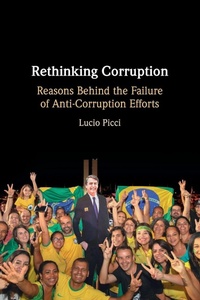
Rethinking Corruption
Reasons Behind the Failure of Anti-Corruption Efforts
Will be published approx. on 12. February 2026
Book
Paperback/Softback
272 pages
978-1-009-46881-7 (ISBN)
Description
Why have anti-corruption efforts often failed? Current thinking on corruption has largely overlooked the profound implications of its contested nature, which paradoxically makes it an effective yet highly dysfunctional 'tool of government.' As a tool of government, it helps execute policies and guarantees a degree of political order. Moreover, anti-corruption measures are wielded as political instruments, strategically embraced by governments and oppositions to further their respective agendas. Based on an analysis of Russia, Brazil and the United States, Rethinking Corruption takes a fresh look at corruption and critiques the prevailing view of anti-corruption policies. Embarking on a captivating journey through these countries, this book encompasses the notion of legal corruption and invites a comprehensive reconsideration of corruption, with a focal point on questions of economic and political equality.
Reviews / Votes
'thought-provoking ... provocative ... Recommended.' J. Albanese, ChoiceMore details
Language
English
Place of publication
Cambridge
United Kingdom
Product notice
Paperback (trade)
Illustrations
Worked examples or Exercises
Dimensions
Height: 229 mm
Width: 152 mm
Thickness: 15 mm
Weight
367 gr
ISBN-13
978-1-009-46881-7 (9781009468817)
Copyright in bibliographic data and cover images is held by Nielsen Book Services Limited or by the publishers or by their respective licensors: all rights reserved.
Schweitzer Classification
Other editions
Additional editions

Book
02/2024
Cambridge University Press
€121.50
Shipment within 15-20 days
Person
Lucio Picci is Professor of Economics at the University of Bologna. He has written three books and published articles in the American Journal of Political Science, the Review of Economics and Statistics, Research Policy, and the World Bank Economic Review.
Content
Part I. Laying the Groundwork: 1. Introduction; 2. The consensus on corruption; 3. The mutual shaping of measures and concept; 4. Of causality and historical junctures; 5. What we talk about when we talk about corruption: some methodological considerations; Part II. Three Case Studies: 6. The carrot and the stick: systemic corruption in Russia; 7. Corruption as the glue of the system: the case of Brazil; 8. Legal corruption in the United States of America; Part III. Rethinking Corruption: 9. Legal corruption and other societal geographies; 10. A problem of control: corruption is a tool of government; 11. Fighting corruption, fighting for corruption; 12. Conclusions: whither corruption?.