

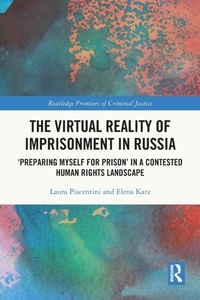
The Virtual Reality of Imprisonment in Russia
'Preparing myself for Prison' in a Contested Human Rights Landscape
1st Edition
Published on 27. May 2024
Book
Paperback/Softback
260 pages
978-1-032-22292-9 (ISBN)
Description
In outlining the online expressions of penal life, this book disrupts the conventional human encounters that underpin empirical criminological scholarship on prisons because, figuratively speaking, prisons in Russia are de-nesting from their institutional moorings and borders.
Using the online world of Runet as the research site and presenting research from selectively drawn evidence gathered from secondary data from prison-related websites, it explores the 'moving walls' of the prison from socio-political and cultural perspectives. The book discusses how prisoners and their families articulate and give meaning to their experiences when they are online, and while doing so develop their rights awareness.
This book is a pioneering methodological, criminological and theoretical study, the first of its kind in global criminology and humanities, and because it is forging a new path for penal scholarship, cannot be all-encompassing but rather acts as a 'map' for other researchers in different fields to use. It will be useful for scholars working in comparative fields and jurisdictions on the subject of prisons, rights and how the internet is being utilised by prisoners, their families and communities organised around prison activism.
Using the online world of Runet as the research site and presenting research from selectively drawn evidence gathered from secondary data from prison-related websites, it explores the 'moving walls' of the prison from socio-political and cultural perspectives. The book discusses how prisoners and their families articulate and give meaning to their experiences when they are online, and while doing so develop their rights awareness.
This book is a pioneering methodological, criminological and theoretical study, the first of its kind in global criminology and humanities, and because it is forging a new path for penal scholarship, cannot be all-encompassing but rather acts as a 'map' for other researchers in different fields to use. It will be useful for scholars working in comparative fields and jurisdictions on the subject of prisons, rights and how the internet is being utilised by prisoners, their families and communities organised around prison activism.
More details
Series
Language
English
Place of publication
London
United Kingdom
Publishing group
Taylor & Francis Ltd
Target group
College/higher education
Postgraduate and Undergraduate
Illustrations
1 s/w Zeichnung, 1 s/w Tabelle, 6 s/w Abbildungen, 5 s/w Photographien bzw. Rasterbilder
1 Tables, black and white; 1 Line drawings, black and white; 5 Halftones, black and white; 6 Illustrations, black and white
Dimensions
Height: 234 mm
Width: 156 mm
Thickness: 15 mm
Weight
424 gr
ISBN-13
978-1-032-22292-9 (9781032222929)
Copyright in bibliographic data and cover images is held by Nielsen Book Services Limited or by the publishers or by their respective licensors: all rights reserved.
Schweitzer Classification
Other editions
Additional editions
Laura Piacentini | Elena Katz
The Virtual Reality of Imprisonment in Russia
'Preparing myself for Prison' in a Contested Human Rights Landscape
Book
04/2022
1st Edition
Routledge
€207.90
Shipment within 10-20 days
Laura Piacentini | Elena Katz
The Virtual Reality of Imprisonment in Russia
'Preparing myself for Prison' in a Contested Human Rights Landscape
E-Book
04/2022
1st Edition
Routledge
€55.49
Available for download
Laura Piacentini | Elena Katz
The Virtual Reality of Imprisonment in Russia
'Preparing myself for Prison' in a Contested Human Rights Landscape
E-Book
04/2022
1st Edition
Routledge
€55.49
Available for download
Persons
Laura Piacentini is Professor of Criminology and Fellow of the Royal Society of Edinburgh at the University of Strathclyde, Glasgow, Scotland. A trained Russian speaker, she has been researching Russian prisons since 1994. She is widely recognised, through grant capture, articles and books, as a leading international expert on Russian penal culture. Her work is multi-disciplinary and she is a passionate advocate for innovative research methods. She is a penal abolitionist.
Elena Katz is a Research Consultant for the ERC Gulag Echoes project run at the University of Helsinki. Her research and teaching are in Russian Area studies and Elena has published widely in the humanities and cultural studies. Her most recent book is a collaboration with Judith Pallot: Waiting at the Prison Gate: Women, Identity and the Russian Penal System (2017). She has served as an expert witness in extradition proceedings. She is Senior Member and College Advisor at St Antony's College of the University of Oxford where she first came as a Max Hayward Fellow in Russian Literature.
Elena Katz is a Research Consultant for the ERC Gulag Echoes project run at the University of Helsinki. Her research and teaching are in Russian Area studies and Elena has published widely in the humanities and cultural studies. Her most recent book is a collaboration with Judith Pallot: Waiting at the Prison Gate: Women, Identity and the Russian Penal System (2017). She has served as an expert witness in extradition proceedings. She is Senior Member and College Advisor at St Antony's College of the University of Oxford where she first came as a Max Hayward Fellow in Russian Literature.
Content
Introduction: Against the past or towards the future
1. Russia, 1991: Carceral modernisation begins, prison doors shaken?
2. Methodology: Being locked up and 'being free online'
3. Conceptualising carceralilty and human rights in prisons
4. Pain and banality of jail: 'Death by a thousand cuts'
5. Seeking life, looking for justice: Rights consciousness of prisoners and their families
6. Prisoners' rights in the online world in the global context
Conclusion: Crossing the boundary of illusion: What next for Russian prisons?
1. Russia, 1991: Carceral modernisation begins, prison doors shaken?
2. Methodology: Being locked up and 'being free online'
3. Conceptualising carceralilty and human rights in prisons
4. Pain and banality of jail: 'Death by a thousand cuts'
5. Seeking life, looking for justice: Rights consciousness of prisoners and their families
6. Prisoners' rights in the online world in the global context
Conclusion: Crossing the boundary of illusion: What next for Russian prisons?