

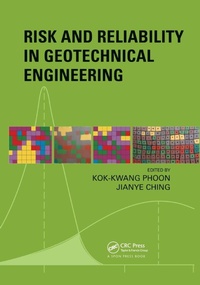
Risk and Reliability in Geotechnical Engineering
1st Edition
Published on 26. July 2017
Book
Paperback/Softback
624 pages
978-1-138-89286-6 (ISBN)
Description
Establishes Geotechnical Reliability as Fundamentally Distinct from Structural Reliability
Reliability-based design is relatively well established in structural design. Its use is less mature in geotechnical design, but there is a steady progression towards reliability-based design as seen in the inclusion of a new Annex D on "Reliability of Geotechnical Structures" in the third edition of ISO 2394. Reliability-based design can be viewed as a simplified form of risk-based design where different consequences of failure are implicitly covered by the adoption of different target reliability indices. Explicit risk management methodologies are required for large geotechnical systems where soil and loading conditions are too varied to be conveniently slotted into a few reliability classes (typically three) and an associated simple discrete tier of target reliability indices.
Provides Realistic Practical Guidance
Risk and Reliability in Geotechnical Engineering
makes these reliability and risk methodologies more accessible to practitioners and researchers by presenting soil statistics which are necessary inputs, by explaining how calculations can be carried out using simple tools, and by presenting illustrative or actual examples showcasing the benefits and limitations of these methodologies.With contributions from a broad international group of authors, this text:
Presents probabilistic models suited for soil parameters
Provides easy-to-use Excel-based methods for reliability analysis
Connects reliability analysis to design codes (including LRFD and Eurocode 7)
Maximizes value of information using Bayesian updating
Contains efficient reliability analysis methods
Accessible To a Wide Audience
Risk and Reliability in Geotechnical Engineering presents all the "need-to-know" information for a non-specialist to calculate and interpret the reliability index and risk of geotechnical structures in a realistic and robust way. It suits engineers, researchers, and students who are interested in the practical outcomes of reliability and risk analyses without going into the intricacies of the underlying mathematical theories.
Reliability-based design is relatively well established in structural design. Its use is less mature in geotechnical design, but there is a steady progression towards reliability-based design as seen in the inclusion of a new Annex D on "Reliability of Geotechnical Structures" in the third edition of ISO 2394. Reliability-based design can be viewed as a simplified form of risk-based design where different consequences of failure are implicitly covered by the adoption of different target reliability indices. Explicit risk management methodologies are required for large geotechnical systems where soil and loading conditions are too varied to be conveniently slotted into a few reliability classes (typically three) and an associated simple discrete tier of target reliability indices.
Provides Realistic Practical Guidance
Risk and Reliability in Geotechnical Engineering
makes these reliability and risk methodologies more accessible to practitioners and researchers by presenting soil statistics which are necessary inputs, by explaining how calculations can be carried out using simple tools, and by presenting illustrative or actual examples showcasing the benefits and limitations of these methodologies.With contributions from a broad international group of authors, this text:
Presents probabilistic models suited for soil parameters
Provides easy-to-use Excel-based methods for reliability analysis
Connects reliability analysis to design codes (including LRFD and Eurocode 7)
Maximizes value of information using Bayesian updating
Contains efficient reliability analysis methods
Accessible To a Wide Audience
Risk and Reliability in Geotechnical Engineering presents all the "need-to-know" information for a non-specialist to calculate and interpret the reliability index and risk of geotechnical structures in a realistic and robust way. It suits engineers, researchers, and students who are interested in the practical outcomes of reliability and risk analyses without going into the intricacies of the underlying mathematical theories.
Reviews / Votes
"Risk and Reliability in Geotechnical Engineering ...was, originally, to be an update of the 2008 book Reliability-based Design in Geotechnical Engineering - Computations and Applications (edited by K. K. Phoon). The update turns out to be a completely new book, and is a 'must-read', not only for those interested in risk and reliability in geotechnical engineering, but also for the geotechnical practitioner."-Suzanne Lacasse in Proceedings of the Institution of Civil Engineers: Geotechnical Engineering
"This is a welcome continuation of the very successful volume, Reliability-Based Design in Geotechnical Engineering... Practitioners will find very useful information that range from simple to advanced methods, and from site characterization to design and decision. The book will certainly encourage the use of reliability in practice."
-Georisk, 2015
"This is an excellent book, written by acknowledged experts in the field for practicing engineers interested in geotechnical reliability analysis. The presentation is very clear and the subject matter delivered at just the right level - not too mathematical, yet still rigorous in approach. Practical matters, such as designing site investigations and selecting parameters for design, are covered well. Highly recommended."
-Dr. Andrew Bond, Geocentrix Ltd.
"The main strength of the materials I have reviewed is that they address the needs and questions of users of many different backgrounds, from practicing engineers who are curious about the added value of doing risk and reliability analyses, but are intimidated by the terminology and mathematics, to professional risk analysts who are more concerned about safety philosophy and application of more advanced analysis methods in assessing the value of information."
Farrokh Nadim, Technical Director, Norwegian Geotechnical Institute
More details
Language
English
Place of publication
London
United Kingdom
Publishing group
Taylor & Francis Ltd
Target group
College/higher education
Researchers and graduate students in geotechnical engineering, and consulting geotechnical engineers.
Illustrations
260 s/w Abbildungen, 118 s/w Tabellen
118 Tables, black and white; 260 Illustrations, black and white
Dimensions
Height: 254 mm
Width: 178 mm
Thickness: 33 mm
Weight
1159 gr
ISBN-13
978-1-138-89286-6 (9781138892866)
Copyright in bibliographic data and cover images is held by Nielsen Book Services Limited or by the publishers or by their respective licensors: all rights reserved.
Schweitzer Classification
Other editions
Additional editions
Kok-Kwang Phoon | Jianye Ching
Risk and Reliability in Geotechnical Engineering
E-Book
10/2018
1st Edition
CRC Press
€128.99
Available for download
Kok-Kwang Phoon | Jianye Ching
Risk and Reliability in Geotechnical Engineering
Book
12/2014
1st Edition
CRC Press
€382.70
Article not available for order
Persons
Kok-Kwang Phoon is a distinguished professor and head of the Department of Civil and Environmental Engineering, National University of Singapore, and past president of the Geotechnical Society of Singapore. His main research interests include statistical characterization of geotechnical parameters and reliability-based design in geotechnical engineering. He is the recipient of numerous research awards, including the ASCE Norman Medal in 2005 and the NUS Outstanding Researcher Award in 2010. He is the founding editor of Georisk and chair of TC304 (Engineering Practice of Risk Assessment and Management) in the International Society for Soil Mechanics and Geotechnical Engineering.
Jianye Ching is a professor in the Department of Civil Engineering, National Taiwan University. His main research interests include geotechnical reliability analysis and reliability-based design, basic uncertainties in soil properties, random fields and spatial variability, and geotechnical design codes. He is the secretary of TC304 (risk) in the International Society for Soil Mechanics and Geotechnical Engineering. He is the recipient of the Outstanding Research Award and the Wu-Da-Yu Memorial Award from the National Science Council of Taiwan, Republic of China.
Jianye Ching is a professor in the Department of Civil Engineering, National Taiwan University. His main research interests include geotechnical reliability analysis and reliability-based design, basic uncertainties in soil properties, random fields and spatial variability, and geotechnical design codes. He is the secretary of TC304 (risk) in the International Society for Soil Mechanics and Geotechnical Engineering. He is the recipient of the Outstanding Research Award and the Wu-Da-Yu Memorial Award from the National Science Council of Taiwan, Republic of China.
Content
Part I. Properties. Constructing multivariate distributions for soil parameters. Modeling and simulation of bivariate distribution of shear strength parameters using copulas. Part II. Methods. Evaluating reliability in geotechnical engineering. Maximum likelihood principle and its application in soil liquefaction assessment. Bayesian analysis for learning and updating geotechnical parameters and models with measurements. Polynomial chaos expansions and stochastic finite-element methods. Practical reliability analysis and design by Monte Carlo Simulation in spreadsheet. Part III. Design. LRFD calibration of simple limit state functions in geotechnical soil-structure design. Reliability-based design: Practical procedures, geotechnical examples, and insights. Managing risk and achieving reliable geotechnical designs using Eurocode 7. Part IV. Risk and decision. Practical risk assessment for embankments, dams, and slopes. Evolution of geotechnical risk analysis in North American practice. Assessing the value of information to design site investigation and construction quality assurance programs. Verification of geotechnical reliability using load tests and integrity tests. Part V. Spatial variability. Application of the subset simulation approach to spatially varying soils. Appendices. List of symbols. References. Index.