

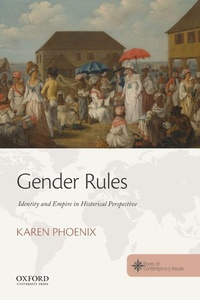
Gender Rules
Identity and Empire in Historical Perspective
Published on 3. March 2021
Book
Paperback/Softback
192 pages
978-0-19-069624-5 (ISBN)
Description
Growing directly out of the experiences of a team of historians at Washington State University who designed a new foundational course for WSU's common requirements, the Roots of Contemporary Issues series is built on the premise that students will be better at facing current and future challenges, no matter their major or career path, if they are capable of addressing controversial and pressing issues in mature, reasoned ways using evidence, critical thinking, and clear written and oral communication skills. To help students achieve these goals, each title in the Roots of Contemporary Issues series argues that we need both a historical understanding and an appreciation of the ways in which humans have been interconnected with places around the world for decades and even centuries.
Much of the world's politics revolve around questions about gender and imperialism, including the relationship between gender and empire over the last five hundred years. There are no easy answers to these questions, but the decisions that all of us make about them will have tremendous consequences for individuals and for the planet in the future.
Gender Rules introduces students to history from the point of view of controversial and pressing issues they already know about and many of whom already feel invested in. Each chapter includes both Western and non-Western content, allowing readers to understand the deep past as connected to the present, and to see that the West has interacted with non-Western regions for centuries.
Much of the world's politics revolve around questions about gender and imperialism, including the relationship between gender and empire over the last five hundred years. There are no easy answers to these questions, but the decisions that all of us make about them will have tremendous consequences for individuals and for the planet in the future.
Gender Rules introduces students to history from the point of view of controversial and pressing issues they already know about and many of whom already feel invested in. Each chapter includes both Western and non-Western content, allowing readers to understand the deep past as connected to the present, and to see that the West has interacted with non-Western regions for centuries.
Reviews / Votes
Recommended. All undergraduates. * N. B. Rosenthal, CHOICE * Some of us love history for its own sake, but for most students the contents of a college history course seem detached, unrelated to their lives, even meaningless. Yet we are surrounded by the legacy of history. Everything around us - policy, population, culture, economy, environment - is a product of the actions and activities of people in the past. How can we hope to address the challenges we face and resolve contentious issues - inequality, health, immigration, climate change - without understanding where they come from? The volumes in the Roots of Contemporary Issues series are the tested products of years of classroom teaching and research. They address controversial issues with impartiality but not detachment, combining historical context and human agency to create accounts that are meaningful and usable for any student confronting the complex world in which they will live." - Trevor R. Getz, San Francisco State University This is a truly innovative series that promises to revolutionize how world history is taught, freeing students and faculty alike from the "tyranny of coverage" often embedded within civilizational paradigms, and facilitating sustained reflection on the roots of the most pressing issues in our contemporary world. Students' understanding of the importance of history and their interest in our discipline is sure to be heightened by these volumes that deeply contextualize and historicize current global problems." - Nicola Foote, Vice Dean of Barrett, The Honors College and Professor of Latin American and Caribbean History at Arizona State University Gender Rules targets two major topics in world history * imperialism and genderand brings them together as related issues. To accomplish this it selects five case studies on which students and teachers can focus instead of trying to understand the relationship and details of empire and gender over the course of five hundred years. The volume is thus teachable, usable, and engaging." - Bonnie G. Smith, Rutgers University*
More details
Series
Language
English
Place of publication
New York
United States
Target group
College/higher education
Dimensions
Height: 234 mm
Width: 156 mm
Thickness: 10 mm
Weight
298 gr
ISBN-13
978-0-19-069624-5 (9780190696245)
Copyright in bibliographic data and cover images is held by Nielsen Book Services Limited or by the publishers or by their respective licensors: all rights reserved.
Schweitzer Classification
Person
Karen Phoenix is Clinical Assistant Professor in the Roots of Contemporary Issues Program at Washington State University.
Content
List of Maps/Images
About the Author
Acknowledgments
Series Introduction: Connecting the Past and Present INTRODUCTION: Gender and Imperialism CHAPTER ONE: Law and Religion in Spanish Latin America Religion: The Introduction of Catholicism Government: Race, Class, Gender, and the Family Work: The Impacts of the Mita/Repartimiento System Nonbinary Genders: Two-Spirit Peoples Conclusion Further Reading CHAPTER TWO: Gender and Commerce in the Atlantic World European Manufacturing for the Slave Trade Impacts of the Atlantic Slave Trade in Africa The British Caribbean: Jamaica The end of the Slave Trade: England and Abolition Conclusion Further Reading CHAPTER THREE: Gender and Imperial Spaces in French Algeria and Indochina The City Itself: Algiers and Hanoi Tropical Respite: Dalat Hill Station Domestic Spaces: The Harem and the European Home Conclusion Further Reading CHAPTER FOUR: Gender, Attire, and Nationalist Movements in India and Egypt The Body Itself Covering the Body: Clothing The Top of the Body: Headwear Conclusion Further Reading CHAPTER FIVE: Gender, Soft Power, and the Western in Cold War Europe The Archetypal Cowboy Westerns West and East Germany The Role of Women in Westerns Conclusion Further Reading CONCLUSION: A Postgender World? Index
About the Cover
About the Author
Acknowledgments
Series Introduction: Connecting the Past and Present INTRODUCTION: Gender and Imperialism CHAPTER ONE: Law and Religion in Spanish Latin America Religion: The Introduction of Catholicism Government: Race, Class, Gender, and the Family Work: The Impacts of the Mita/Repartimiento System Nonbinary Genders: Two-Spirit Peoples Conclusion Further Reading CHAPTER TWO: Gender and Commerce in the Atlantic World European Manufacturing for the Slave Trade Impacts of the Atlantic Slave Trade in Africa The British Caribbean: Jamaica The end of the Slave Trade: England and Abolition Conclusion Further Reading CHAPTER THREE: Gender and Imperial Spaces in French Algeria and Indochina The City Itself: Algiers and Hanoi Tropical Respite: Dalat Hill Station Domestic Spaces: The Harem and the European Home Conclusion Further Reading CHAPTER FOUR: Gender, Attire, and Nationalist Movements in India and Egypt The Body Itself Covering the Body: Clothing The Top of the Body: Headwear Conclusion Further Reading CHAPTER FIVE: Gender, Soft Power, and the Western in Cold War Europe The Archetypal Cowboy Westerns West and East Germany The Role of Women in Westerns Conclusion Further Reading CONCLUSION: A Postgender World? Index
About the Cover