

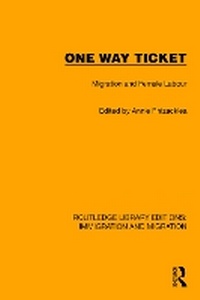
One Way Ticket
Migration and Female Labour
1st Edition
Published on 15. April 2024
Book
Paperback/Softback
170 pages
978-1-032-36524-4 (ISBN)
Description
One Way Ticket (1983) examines the 'hidden armies' of migrant women workers who have since the 1950s fulfilled a demand for low-skilled, low paid and insecure work in both the formal and informal economies of Western Europe. It presents a new focus for the examination of labour migration and of the specific character of female employment. It looks at the relationship between motherhood, waged work and ethnicity; the position of a second generation of black women workers; and the oppression and exploitation of migrant women by their male counterparts through the creation of 'ethnic' economies.
More details
Series
Language
English
Place of publication
London
United Kingdom
Publishing group
Taylor & Francis Ltd
Target group
College/higher education
Postgraduate, Undergraduate Advanced, and Undergraduate Core
Dimensions
Height: 234 mm
Width: 156 mm
Weight
320 gr
ISBN-13
978-1-032-36524-4 (9781032365244)
Copyright in bibliographic data and cover images is held by Nielsen Book Services Limited or by the publishers or by their respective licensors: all rights reserved.
Schweitzer Classification
Other editions
Additional editions
Book
11/2022
1st Edition
Routledge
€131.50
Shipment within 10-20 days
E-Book
11/2022
1st Edition
Routledge
€41.99
Available for download
E-Book
11/2022
1st Edition
Routledge
€41.99
Available for download
Person
Annie Phizacklea
Content
Introduction Annie Phizacklea 1. Women in Migration: Beyond the Reductionist Outlook Mirjana Morokvasic 2. Motherhood and Waged Work: West Indian, Asian and White Mothers Compared Karen Stone 3. The Second Generation: West Indian Female School-Leavers Shirley Dex 4. Sexual Divisions and Ethnic Adaptation: The Case of Greek-Cypriot Women Floya Anthias 5. In the Front Line Annie Phizacklea 6. Living in Between: Turkish Women in their Homeland and in the Netherlands Lenie Brower and Marijke Priester 7. Transnational Production and Women Workers Mary Hancock