

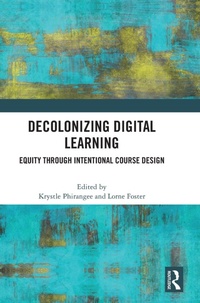
Decolonizing Digital Learning
Equity Through intentional Course Design
1st Edition
Published on 2. May 2025
Book
Hardback
144 pages
978-1-041-01116-3 (ISBN)
Description
This book explores strategies to decolonize digital education, focusing on building inclusive, equitable online learning environments that respect and integrate diverse lived experiences and ways of knowing into the educational process. Addressing themes of accessibility, representation, and community-building, it offers reflective essays, teaching briefs, and research articles that highlight how digital platforms and online course design can evolve to support marginalized voices and foster collaborative, culturally responsive learning.
Recent trends toward decolonizing education highlight the critical need to address inequities in digital learning, especially in the age of generative AI. The shift to emergency remote teaching during COVID-19 exposed the digital divide, impacting students' ability to participate fully, with marginalized groups often bearing the brunt. Beyond just access to devices, issues like privacy, cultural representation, and inclusivity of diverse lived experiences in learning environments became apparent. As digital platforms increasingly shape knowledge production, they can embed power dynamics that marginalize certain voices. This book explores strategies to counter this by promoting a more inclusive curriculum, where digital platforms enable equity and diverse perspectives. Reflective essays, teaching briefs, and research articles within this book encourage educators to prioritize community, identity congruence, and culturally responsive teaching methods, transforming courses, especially online courses, into spaces for collaborative knowledge sharing and innovation.
This volume stresses the importance of incorporating Indigenous and marginalized perspectives to redefine education, pushing for a digital learning environment where all students' experiences and insights are valued equally. It was originally published as a special issue of Distance Education.
Recent trends toward decolonizing education highlight the critical need to address inequities in digital learning, especially in the age of generative AI. The shift to emergency remote teaching during COVID-19 exposed the digital divide, impacting students' ability to participate fully, with marginalized groups often bearing the brunt. Beyond just access to devices, issues like privacy, cultural representation, and inclusivity of diverse lived experiences in learning environments became apparent. As digital platforms increasingly shape knowledge production, they can embed power dynamics that marginalize certain voices. This book explores strategies to counter this by promoting a more inclusive curriculum, where digital platforms enable equity and diverse perspectives. Reflective essays, teaching briefs, and research articles within this book encourage educators to prioritize community, identity congruence, and culturally responsive teaching methods, transforming courses, especially online courses, into spaces for collaborative knowledge sharing and innovation.
This volume stresses the importance of incorporating Indigenous and marginalized perspectives to redefine education, pushing for a digital learning environment where all students' experiences and insights are valued equally. It was originally published as a special issue of Distance Education.
More details
Language
English
Place of publication
London
United Kingdom
Publishing group
Taylor & Francis Ltd
Target group
College/higher education
Postgraduate, Undergraduate Advanced, and Undergraduate Core
Dimensions
Height: 250 mm
Width: 175 mm
Thickness: 13 mm
Weight
464 gr
ISBN-13
978-1-041-01116-3 (9781041011163)
Copyright in bibliographic data and cover images is held by Nielsen Book Services Limited or by the publishers or by their respective licensors: all rights reserved.
Schweitzer Classification
Other editions
Additional editions
Krystle Phirangee | Lorne Foster
Decolonizing Digital Learning
Equity Through intentional Course Design
E-Book
05/2025
1st Edition
Routledge
€73.99
Available for download
Krystle Phirangee | Lorne Foster
Decolonizing Digital Learning
Equity Through intentional Course Design
E-Book
05/2025
1st Edition
Routledge
€73.99
Available for download
Persons
Krystle Phirangee, PhD is a Lecturer at the Ontario Institute for Studies in Education at the University of Toronto (St. George Campus), Toronto, Canada. She is also a Senior Educational Developer and Lead, Assessment & Digital Learning for the Centre for Teaching and Learning at the University of Toronto (Scarborough Campus), Toronto, Canada.
Lorne Foster, PhD is a Professor of Public Policy and Equity Studies, as well as the Director of the Institute for Social Research, and holds the Research Chair in Black Canadian Studies and Human Rights (Tier 1) at York University, Toronto Canada.
Lorne Foster, PhD is a Professor of Public Policy and Equity Studies, as well as the Director of the Institute for Social Research, and holds the Research Chair in Black Canadian Studies and Human Rights (Tier 1) at York University, Toronto Canada.
Content
Introduction: Decolonizing digital learning: equity through intentional course design 1. Designing MOOCs in South America towards open and equitable education 2. Promoting culturally responsive teaching in online learning: experiences and challenges of instructors and students in higher education 3. Mapping racial justice to online teacher education 4. Open educational resources as the panacea for the decolonisation of e-learning content in South Africa 5. Decolonizing online learning: a reflective approach to equitable pedagogies 6. "Welcome to my backyard": an intersectional approach to inclusive teaching in the asynchronous learning environment 7. Photos from home: Integrating lived experience in a remote-learning environment 8. Utilizing the Learner Variability Navigator to support inclusive instructional design 9. Who gets to decolonize: a reflection on the importance of positionality in the decolonization of digital learning spaces and learning design 10. Beyond the virtual classroom: integrating artificial intelligence in online learning