

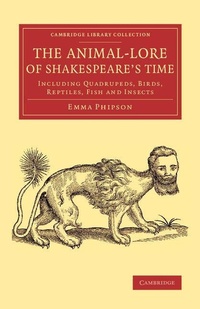
The Animal-Lore of Shakespeare's Time
Including Quadrupeds, Birds, Reptiles, Fish and Insects
Published on 11. December 2014
Book
Paperback/Softback
498 pages
978-1-108-07643-2 (ISBN)
Description
Shakespeare's plays contain a rich abundance of metaphors, similes and phrases relating to animals and the natural world, much of which can seem obscure to us today. First published in 1883, Emma Phipson's classic study sets in context the animal lore of the late sixteenth and early seventeenth centuries to show how it affected the literature of the time. Drawing on a collection of compelling sources, this book explores the beliefs about natural science that influenced the works of Shakespeare and his contemporaries. Phipson considers obscure writings by naturalists and antiquarians on a wide range of animals from the familiar to the exotic, and from the real to the mythical. Whether discussing hedgehogs or unicorns, the text shows how the Elizabethans' understanding of animals was coloured by hunting, travel, folklore and the Bible, and how this had a lasting impact upon language and culture.
More details
Series
Language
English
Place of publication
Cambridge
United Kingdom
Target group
Professional and scholarly
Product notice
Paperback (trade)
Illustrations
1 Plates, black and white
Dimensions
Height: 216 mm
Width: 140 mm
Thickness: 30 mm
Weight
696 gr
ISBN-13
978-1-108-07643-2 (9781108076432)
Copyright in bibliographic data and cover images is held by Nielsen Book Services Limited or by the publishers or by their respective licensors: all rights reserved.
Schweitzer Classification
Content
Preface; Introduction; 1. Monkey, etc.; 2. Lion, etc.; 3. Dog; 4. Fox, etc.; 5. Walrus, etc.; 6. Horse, etc.; 7. Rat, etc.; 8. Thrush, etc.; 9. Woodpecker, etc.; 10. Vulture, etc.; 11. Water-rail, etc.; 12. Goose, etc.; 13. Tortoise, etc.; 14. Stickleback, etc.; 15. Salmon, etc.; 16. Pilchard, etc.; 17. Cochineal, etc.; 18. Lobster, etc.; 19. Unicorn, etc.; Index.