

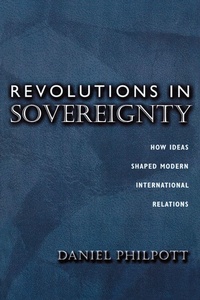
Revolutions in Sovereignty
How Ideas Shaped Modern International Relations
Will be published approx. on 25. February 2001
Book
Paperback/Softback
352 pages
978-0-691-05747-7 (ISBN)
Description
How did the world come to be organized into sovereign states? Daniel Philpott argues that two historical revolutions in ideas are responsible. First, the Protestant Reformation ended medieval Christendom and brought a system of sovereign states in Europe, culminating at the Peace of Westphalia in 1648. Second, ideas of equality and colonial nationalism brought a sweeping end to colonial empires around 1960, spreading the sovereign states system to the rest of the globe. In both cases, revolutions in ideas about legitimate political authority profoundly altered the "constitution" that establishes basic authority in the international system. Ideas exercised influence first by shaping popular identities, then by exercising social power upon the elites who could bring about new international constitutions. Swaths of early modern Europeans, for instance, arrived at Protestant beliefs, then fought against the temporal powers of the Church on behalf of the sovereignty of secular princes, who could overthrow the formidable remains of a unified medieval Christendom.
In the second revolution, colonial nationalists, domestic opponents of empire, and rival superpowers pressured European cabinets to relinquish their colonies in the name of equality and nationalism, resulting in a global system of sovereign states. Bringing new theoretical and historical depth to the study of international relations, Philpott demonstrates that while shifts in military, economic, and other forms of material power cannot be overlooked, only ideas can explain how the world came to be organized into a system of sovereign states.
In the second revolution, colonial nationalists, domestic opponents of empire, and rival superpowers pressured European cabinets to relinquish their colonies in the name of equality and nationalism, resulting in a global system of sovereign states. Bringing new theoretical and historical depth to the study of international relations, Philpott demonstrates that while shifts in military, economic, and other forms of material power cannot be overlooked, only ideas can explain how the world came to be organized into a system of sovereign states.
Reviews / Votes
"This convincing portrait show how power and ideas together shape international relations."--John Ikenberry, Foreign AffairsMore details
Series
Language
English
Place of publication
New Jersey
United States
Target group
Professional and scholarly
College/higher education
Product notice
Paperback (trade)
Illustrations
5 line illus., 7 tables
Dimensions
Height: 229 mm
Width: 152 mm
Thickness: 21 mm
Weight
572 gr
ISBN-13
978-0-691-05747-7 (9780691057477)
Copyright in bibliographic data and cover images is held by Nielsen Book Services Limited or by the publishers or by their respective licensors: all rights reserved.
Schweitzer Classification
Other editions
Additional editions
E-Book
07/2010
1st Edition
Princeton University Press
€216.95
Available for download
Person
Daniel Philpott is Assistant Professor of Political Science at the University of California, Santa Barbara. He has published on such topics as self-determination, sovereignty, and ethics and international relations.
Content
TABLES AND FIGURES ix PREFACE xi PART ONE: REVOLUTIONS IN SOVEREIGNTY 1 ONE Introduction: Revolutions in Sovereignty 3 TWO The Constitution of International Society 11 THREE A Brief History of Constitutions of International Society in the West 28 FOUR How Revolutions in Ideas Bring Revolutions in Sovereignty 46 PART TWO: THE FOUNDING OF THE SOVEREIGN STATES SYSTEM AT WESTPHALIA 73 FIVE Westphalia as Origin 75 SIX The Origin of Westphalia 97 SEVEN The Power of Protestant Propositions 123 PART THREE: THE REVOLUTION OF COLONIAL INDEPENDENCE: THE GLOBAL EXPANSION OF WESTPHALIA 151 EIGHT Ideas and the End of Empire 153 NINE The End of the British Empire: Cashing Out the Promise of Self-Government 168 TEN Revolutionary Ideas in the British Colonies 190 ELEVEN Britain's Burden of Empire 203 TWELVE The Fall of Greater France 220 PART FOUR: THE REVOLUTIONS CONSIDERED TOGETHER 251 THIRTEEN Conclusion: Two Revolutions, One Movement 253 NOTES 263 BIBLIOGRAPHY 309 INDEX 331