

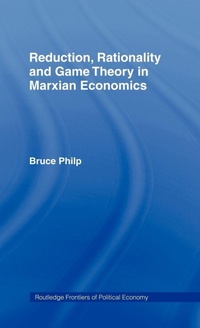
Reduction, Rationality and Game Theory in Marxian Economics
1st Edition
Published on 28. October 2004
Book
Hardback
160 pages
978-0-415-28765-4 (ISBN)
Description
This book examines the main areas of interest in Marxian economics, paying particular attention to class conflict, analytical Marxism and game theory. Very few books can claim to cover the areas that this book does with such clarity, academic rigour and originality. Its study of game theory and Marxism makes it a particularly unique book that will interest a wider variety of economists and social scientists than would normally be the case.
More details
Series
Language
English
Place of publication
London
United Kingdom
Publishing group
Taylor & Francis Ltd
Target group
College/higher education
Postgraduate and Professional
Illustrations
4 s/w Zeichnungen
4 Line drawings, black and white
Dimensions
Height: 222 mm
Width: 145 mm
Thickness: 12 mm
Weight
341 gr
ISBN-13
978-0-415-28765-4 (9780415287654)
Copyright in bibliographic data and cover images is held by Nielsen Book Services Limited or by the publishers or by their respective licensors: all rights reserved.
Schweitzer Classification
Other editions
Additional editions

Book
08/2006
1st Edition
Routledge
€70.50
Shipment within 15-20 days
E-Book
10/2004
Routledge
€64.49
Available for download
E-Book
10/2004
Routledge
€64.49
Available for download
Person
Bruce Philp is a lecturer in Economics at Nottingham Trent University. He is author of several articles on Marxism and game theory.
Content
1. Introduction
2. Methodology of Reduction
3. Marxism and the Foundations of Collective Action
4. Value, Price and Exploitation
5. Marxian Theories of Exploitation and Class
6. Class Conflict and Working Hours
7. Reduction, Rationality and the Rate of Profit
8. Conclusion
2. Methodology of Reduction
3. Marxism and the Foundations of Collective Action
4. Value, Price and Exploitation
5. Marxian Theories of Exploitation and Class
6. Class Conflict and Working Hours
7. Reduction, Rationality and the Rate of Profit
8. Conclusion