

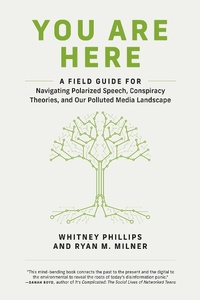
You Are Here
A Field Guide for Navigating Polarized Speech, Conspiracy Theories, and Our Polluted Media Landscape
Published on 2. March 2021
Book
Paperback/Softback
280 pages
978-0-262-53991-3 (ISBN)
Description
How to understand a media environment in crisis, and how to make things better by approaching information ecologically.
Our media environment is in crisis. Polarization is rampant. Polluted information floods social media. Even our best efforts to help clean up can backfire, sending toxins roaring across the landscape. In You Are Here, Whitney Phillips and Ryan Milner offer strategies for navigating increasingly treacherous information flows. Using ecological metaphors, they emphasize how our individual me is entwined within a much larger we, and how everyone fits within an ever-shifting network map.
Phillips and Milner describe how our poisoned media landscape came into being, beginning with the Satanic Panics of the 1980s and 1990s—which, they say, exemplify “network climate change”—and proceeding through the emergence of trolling culture and the rise of the reactionary far right (as well as its amplification by journalists) during and after the 2016 election. They explore the history of conspiracy theories in the United States, focusing on those concerning the Deep State; explain why old media literacy solutions fail to solve new media literacy problems; and suggest how we can navigate the network crisis more thoughtfully, effectively, and ethically. We need a network ethics that looks beyond the messages and the messengers to investigate toxic information's downstream effects.
Our media environment is in crisis. Polarization is rampant. Polluted information floods social media. Even our best efforts to help clean up can backfire, sending toxins roaring across the landscape. In You Are Here, Whitney Phillips and Ryan Milner offer strategies for navigating increasingly treacherous information flows. Using ecological metaphors, they emphasize how our individual me is entwined within a much larger we, and how everyone fits within an ever-shifting network map.
Phillips and Milner describe how our poisoned media landscape came into being, beginning with the Satanic Panics of the 1980s and 1990s—which, they say, exemplify “network climate change”—and proceeding through the emergence of trolling culture and the rise of the reactionary far right (as well as its amplification by journalists) during and after the 2016 election. They explore the history of conspiracy theories in the United States, focusing on those concerning the Deep State; explain why old media literacy solutions fail to solve new media literacy problems; and suggest how we can navigate the network crisis more thoughtfully, effectively, and ethically. We need a network ethics that looks beyond the messages and the messengers to investigate toxic information's downstream effects.
More details
Language
English
Place of publication
Cambridge (Massachusetts)
United States
Publishing group
MIT Press Ltd
Dimensions
Height: 228 mm
Width: 157 mm
Thickness: 25 mm
Weight
392 gr
ISBN-13
978-0-262-53991-3 (9780262539913)
Copyright in bibliographic data and cover images is held by Nielsen Book Services Limited or by the publishers or by their respective licensors: all rights reserved.
Schweitzer Classification
Other editions
Additional editions
Whitney Phillips | Ryan M. Milner
You Are Here
A Field Guide for Navigating Polarized Speech, Conspiracy Theories, and Our Polluted Media Landscape
E-Book
03/2021
MIT Press
€22.49
Available for download
Persons
Whitney Phillips and Ryan M. Milner
Content
INTRODUCTION: MAPPING NETWORK POLLUTION 1
1 THE DEVIL’S IN THE DEEP FRAMES 17
2 THE ROOT OF ALL MEMES 49
3 TILLING BIGOTED LANDS, SOWING BIGOTED SEEDS 81
4 THE GATHERING STORM 115
5 CULTIVATING ECOLOGICAL LITERACY 149
6 CHOOSE YOUR OWN ETHICS ADVENTURE 181
Acknowledgments 203
Notes 205
Bibliography 237
Index 259
1 THE DEVIL’S IN THE DEEP FRAMES 17
2 THE ROOT OF ALL MEMES 49
3 TILLING BIGOTED LANDS, SOWING BIGOTED SEEDS 81
4 THE GATHERING STORM 115
5 CULTIVATING ECOLOGICAL LITERACY 149
6 CHOOSE YOUR OWN ETHICS ADVENTURE 181
Acknowledgments 203
Notes 205
Bibliography 237
Index 259