

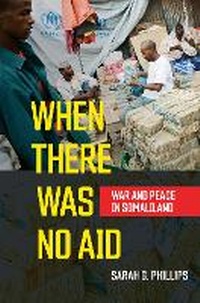
When There Was No Aid
War and Peace in Somaliland
Published on 15. March 2020
Book
Hardback
256 pages
978-1-5017-4715-1 (ISBN)
Description
For all of the doubts raised about the effectiveness of international aid in advancing peace and development, there are few examples of developing countries that are even relatively untouched by it. Sarah G. Phillips's When There Was No Aid offers us one such example.
Using evidence from Somaliland's experience of peace-building, When There Was No Aid challenges two of the most engrained presumptions about violence and poverty in the global South. First, that intervention by actors in the global North is self-evidently useful in ending them, and second that the quality of a country's governance institutions (whether formal or informal) necessarily determines the level of peace and civil order that the country experiences.
Phillips explores how popular discourses about war, peace, and international intervention structure the conditions of possibility to such a degree that even the inability of institutions to provide reliable security can stabilize a prolonged period of peace. She argues that Somaliland's post-conflict peace is grounded less in the constraining power of its institutions than in a powerful discourse about the country's structural, temporal, and physical proximity to war. Through its sensitivity to the ease with which peace gives way to war, Phillips argues, this discourse has indirectly harnessed an apparent propensity to war as a source of order.
Using evidence from Somaliland's experience of peace-building, When There Was No Aid challenges two of the most engrained presumptions about violence and poverty in the global South. First, that intervention by actors in the global North is self-evidently useful in ending them, and second that the quality of a country's governance institutions (whether formal or informal) necessarily determines the level of peace and civil order that the country experiences.
Phillips explores how popular discourses about war, peace, and international intervention structure the conditions of possibility to such a degree that even the inability of institutions to provide reliable security can stabilize a prolonged period of peace. She argues that Somaliland's post-conflict peace is grounded less in the constraining power of its institutions than in a powerful discourse about the country's structural, temporal, and physical proximity to war. Through its sensitivity to the ease with which peace gives way to war, Phillips argues, this discourse has indirectly harnessed an apparent propensity to war as a source of order.
Reviews / Votes
This remarkable study of a non-state upends dominant scholarly and policy discourses about statehood, conflict, peace, development, and international interventions. Phillips skillfully engages the relevant literature and methodological issues, and employs a creative multimethod approach to capture both the uniqueness of Somaliland and its value for comparative analysis and political theory. This is an excellent volume for college and larger public libraries, and for collections supporting programs in international affairs, as well as for Africana, peace, development, and security studies.(Choice) When There Was No Aid is the result of extensive fieldwork.... Phillips has drawn on impressive empirical research to produce a compelling account of Somaliland's path to peace. While it is evidently written with an academic audience in mind, this book is lively and accessible.
(Times Literary Supplement) Phillips's nuanced and provocative study is the most compelling account yet of Somaliland's recent history.
(Foreign Affairs) Theoretically sophisticated and beautifully written, Sarah Phillips's book is a remarkable study that is an example of some of the very finest research and scholarship to emerge from political science and international relations in recent years. When There Was No Aid is destined to become a landmark text in the fields of development, international affairs, peace, conflict and security studies.
(Australian Political Studies Association)
More details
Language
English
Place of publication
Ithaca
United States
Target group
Professional and scholarly
Product notice
Paper over boards
Illustrations
1 map - 1 Maps
Dimensions
Height: 229 mm
Width: 152 mm
Thickness: 25 mm
Weight
454 gr
ISBN-13
978-1-5017-4715-1 (9781501747151)
Copyright in bibliographic data and cover images is held by Nielsen Book Services Limited or by the publishers or by their respective licensors: all rights reserved.
Schweitzer Classification
Other editions
Additional editions
E-Book
03/2020
Cornell University Press
€29.49
Available for download
Person
Sarah G. Phillips is Associate Professor in the Department of Government and International Relations at the University of Sydney. Follow her on X @DrSarahPhillips.
Content
Introduction: What if We Don't Intervene?
1. The Imperative of Intervention
2. Somaliland's Relative Isolation
3. Self-Reliance and Elite Networks
4. Local Ownership and the Rules of the Game
5. War and Peace in the Independence Discourse
Conclusion: Why Aid Matters Less than We Think
1. The Imperative of Intervention
2. Somaliland's Relative Isolation
3. Self-Reliance and Elite Networks
4. Local Ownership and the Rules of the Game
5. War and Peace in the Independence Discourse
Conclusion: Why Aid Matters Less than We Think