

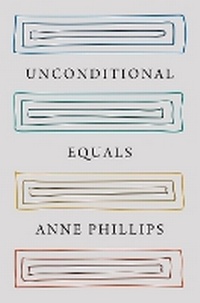
Unconditional Equals
Published on 21. September 2021
Book
Hardback
160 pages
978-0-691-21035-3 (ISBN)
Description
Why equality cannot be conditional on a shared human "nature" but has to be for all
For centuries, ringing declarations about all men being created equal appealed to a shared human nature as the reason to consider ourselves equals. But appeals to natural equality invited gradations of natural difference, and the ambiguity at the heart of "nature" enabled generations to write of people as equal by nature while barely noticing the exclusion of those marked as inferior by their gender, race, or class. Despite what we commonly tell ourselves, these exclusions and gradations continue today. In Unconditional Equals, political philosopher Anne Phillips challenges attempts to justify equality by reference to a shared human nature, arguing that justification turns into conditions and ends up as exclusion. Rejecting the logic of justification, she calls instead for a genuinely unconditional equality.
Drawing on political, feminist, and postcolonial theory, Unconditional Equals argues that we should understand equality not as something grounded in shared characteristics but as something people enact when they refuse to be considered inferiors. At a time when the supposedly shared belief in human equality is so patently not shared, the book makes a powerful case for seeing equality as a commitment we make to ourselves and others, and a claim we make on others when they deny us our status as equals.
For centuries, ringing declarations about all men being created equal appealed to a shared human nature as the reason to consider ourselves equals. But appeals to natural equality invited gradations of natural difference, and the ambiguity at the heart of "nature" enabled generations to write of people as equal by nature while barely noticing the exclusion of those marked as inferior by their gender, race, or class. Despite what we commonly tell ourselves, these exclusions and gradations continue today. In Unconditional Equals, political philosopher Anne Phillips challenges attempts to justify equality by reference to a shared human nature, arguing that justification turns into conditions and ends up as exclusion. Rejecting the logic of justification, she calls instead for a genuinely unconditional equality.
Drawing on political, feminist, and postcolonial theory, Unconditional Equals argues that we should understand equality not as something grounded in shared characteristics but as something people enact when they refuse to be considered inferiors. At a time when the supposedly shared belief in human equality is so patently not shared, the book makes a powerful case for seeing equality as a commitment we make to ourselves and others, and a claim we make on others when they deny us our status as equals.
Reviews / Votes
"Unsettlingly brilliant. . . . Her work is proof positive of the richness of political theory in its authentically Aristotelian sense: as the abstract contemplation of politics for the sake of doing it better-if not always well."---Teresa M. Bejan, Boston Review "Conceptually rich and compulsively readable.-David Livingstone Smith, Notre Dame Philosophical Reviews"
More details
Language
English
Place of publication
New Jersey
United States
Target group
College/higher education
Professional and scholarly
Product notice
Trade binding
Dimensions
Height: 235 mm
Width: 156 mm
ISBN-13
978-0-691-21035-3 (9780691210353)
Copyright in bibliographic data and cover images is held by Nielsen Book Services Limited or by the publishers or by their respective licensors: all rights reserved.
Schweitzer Classification
Other editions
Additional editions
Anne Phillips
Unconditional Equals
E-Book
09/2021
1st Edition
Princeton University Press
€22.49
Available for download
Person
Anne Phillips is the Graham Wallas Professor of Political Science at the London School of Economics, where she previously directed the LSE Gender Institute. Her books include Engendering Democracy; The Politics of Presence; Which Equalities Matter?; Multiculturalism without Culture (Princeton); Our Body, Whose Property? (Princeton); and The Politics of the Human.