

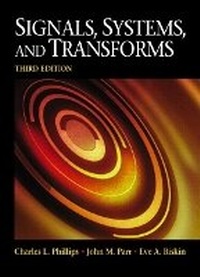
Signals, Systems, and Transforms
International Edition
3rd Edition
Published on 27. August 2003
Book
Paperback/Softback
765 pages
978-0-13-111500-2 (ISBN)
Description
For sophomore/junior-level signals and systems courses in Electrical and Computer Engineering departments.
This text provides a clear, comprehensive presentation of both the theory and applications in signals, systems, and transforms. It presents the mathematical background of signals and systems, including the Fourier transform, the Fourier series, the Laplace transform, the discrete-time and the discrete Fourier transforms, and the z-transform. The contents of each chapter are organized into well-defined units that allow instructors great flexibility in course emphasis. The text integrates MATLAB examples into the presentation of signal and system theory and applications.
This text provides a clear, comprehensive presentation of both the theory and applications in signals, systems, and transforms. It presents the mathematical background of signals and systems, including the Fourier transform, the Fourier series, the Laplace transform, the discrete-time and the discrete Fourier transforms, and the z-transform. The contents of each chapter are organized into well-defined units that allow instructors great flexibility in course emphasis. The text integrates MATLAB examples into the presentation of signal and system theory and applications.
More details
Edition
3rd edition
Language
English
Place of publication
United States
Publishing group
Pearson Education (US)
Target group
Professional and scholarly
Dimensions
Height: 235 mm
Width: 192 mm
Thickness: 28 mm
Weight
1203 gr
ISBN-13
978-0-13-111500-2 (9780131115002)
Copyright in bibliographic data and cover images is held by Nielsen Book Services Limited or by the publishers or by their respective licensors: all rights reserved.
Schweitzer Classification
Other editions
New editions
Book
03/2008
4th Edition
Pearson
€165.88
Article exhausted; check for reprint
Content
(NOTE: Each chapter ends with a Summary, References, and Problems section.)
1. Introduction.
Modeling. Continuous-Time Physical Systems. Samplers and Discrete-Time Physical Systems. MATLAB and SIMULINK. Signals and Systems References.
2. Continuous-Time Signals and Systems.
Transformations of Continuous-Time Signals. Signal Characteristics. Common Signals in Engineering. Singularity Functions. Mathematical Functions for Signals. Continuous-Time Systems. Properties of Continuous-Time Systems.
3. Continuous-Time Linear Time-Invariant Systems.
Impulse Representation of Continuous-Time Signals. Convolution for Continuous-Time LTI Systems. Properties of Convolution. Properties of Continuous-Time LTI Systems. Differential-Equation Models. Terms in the Natural Response. System Response for Complex-Exponential Inputs. Block Diagrams.
4. Fourier Series.
Approximating Periodic Functions. Fourier Series. Fourier Series and Frequency Spectra. Properties of Fourier Series. System Analysis. Fourier Series Transformations.
5. The Fourier Transform.
Definition of the Fourier Transform. Properties of the Fourier Transform. Fourier Transforms of Time Functions. Fourier Transforms of Sampled Signals. Application of the Fourier Transform. Energy and Power Density Spectra.
6. Applications of the Fourier Transform.
Ideal Filters. Real Filters. Bandwidth Relationships. Reconstruction of Signals from Sample Data. Sinusoidal Amplitude Modulation. Pulse-Amplitude Modulation.
7. The Laplace Transform.
Definitions of Laplace Transforms. Examples. Laplace Transforms of Functions. Laplace Transform Properties. Additional Properties. Response of LTI Systems. LTI Systems Characteristics. Bilateral Laplace Transform. Relationship of the Laplace Transform to the Fourier Transform.
8. State Variables for Continuous-Time Systems.
State-Variable Modeling. Simulation Diagrams. Solution of State Equations. Properties of the State Transition Matrix. Transfer Functions. Similarity Transformations.
9. Discrete-Time Signals and Systems.
Discrete-Time Signals and Systems. Transformations of Discrete-Time Signals. Characteristics of Discrete-Time Signals. Common Discrete-Time Signals. Discrete-Time Systems. Properties of Discrete-Time Systems.
10. Discrete-Time Linear Time-Invariant Systems.
Impulse Representation of Discrete-Time Signals. Convolution for Discrete-Time LTI Systems. Properties of Discrete-Time LTI Systems. Difference-Equation Models. Terms in the Natural Response. Block Diagrams. System Response for Complex-Exponential Inputs.
11. The z-Transform.
Definitions of z-Transforms. Examples. z-Transforms of Functions. z-Transform Properties. Additional Properties. LTI System Applications. Bilateral z-Transform.
12. Fourier Transforms of Discrete-Time Signals.
Discrete-Time Fourier Transform. Properties of the Discrete-Time Fourier Transform. Discrete-Time Fourier Transform. Discrete Fourier Transform. Fast Fourier Transform. Applications of the Discrete Fourier Transform. The Discrete Cosine Transform.
13. State Variables for Discrete-Time Systems.
State-Variable Modeling. Simulation Diagrams. Solution of State Equations. Properties of the State Transition Matrix. Transfer Functions. Similarity Transformations.
Appendix A: Integrals and Trigonometric Identities.
Appendix B: Leibnitz's and L'Hopital's Rules.
Appendix C: Summation Formulas for Geometric Series.
Appendix D: Complex Numbers and Euler's Relation.
Appendix E: Solution of Differential Equations.
Appendix F: Partial-Fraction Expansions.
Appendix G: Review of Matrices.
Appendix H: Answers to Selected Problems.
Index.
1. Introduction.
Modeling. Continuous-Time Physical Systems. Samplers and Discrete-Time Physical Systems. MATLAB and SIMULINK. Signals and Systems References.
2. Continuous-Time Signals and Systems.
Transformations of Continuous-Time Signals. Signal Characteristics. Common Signals in Engineering. Singularity Functions. Mathematical Functions for Signals. Continuous-Time Systems. Properties of Continuous-Time Systems.
3. Continuous-Time Linear Time-Invariant Systems.
Impulse Representation of Continuous-Time Signals. Convolution for Continuous-Time LTI Systems. Properties of Convolution. Properties of Continuous-Time LTI Systems. Differential-Equation Models. Terms in the Natural Response. System Response for Complex-Exponential Inputs. Block Diagrams.
4. Fourier Series.
Approximating Periodic Functions. Fourier Series. Fourier Series and Frequency Spectra. Properties of Fourier Series. System Analysis. Fourier Series Transformations.
5. The Fourier Transform.
Definition of the Fourier Transform. Properties of the Fourier Transform. Fourier Transforms of Time Functions. Fourier Transforms of Sampled Signals. Application of the Fourier Transform. Energy and Power Density Spectra.
6. Applications of the Fourier Transform.
Ideal Filters. Real Filters. Bandwidth Relationships. Reconstruction of Signals from Sample Data. Sinusoidal Amplitude Modulation. Pulse-Amplitude Modulation.
7. The Laplace Transform.
Definitions of Laplace Transforms. Examples. Laplace Transforms of Functions. Laplace Transform Properties. Additional Properties. Response of LTI Systems. LTI Systems Characteristics. Bilateral Laplace Transform. Relationship of the Laplace Transform to the Fourier Transform.
8. State Variables for Continuous-Time Systems.
State-Variable Modeling. Simulation Diagrams. Solution of State Equations. Properties of the State Transition Matrix. Transfer Functions. Similarity Transformations.
9. Discrete-Time Signals and Systems.
Discrete-Time Signals and Systems. Transformations of Discrete-Time Signals. Characteristics of Discrete-Time Signals. Common Discrete-Time Signals. Discrete-Time Systems. Properties of Discrete-Time Systems.
10. Discrete-Time Linear Time-Invariant Systems.
Impulse Representation of Discrete-Time Signals. Convolution for Discrete-Time LTI Systems. Properties of Discrete-Time LTI Systems. Difference-Equation Models. Terms in the Natural Response. Block Diagrams. System Response for Complex-Exponential Inputs.
11. The z-Transform.
Definitions of z-Transforms. Examples. z-Transforms of Functions. z-Transform Properties. Additional Properties. LTI System Applications. Bilateral z-Transform.
12. Fourier Transforms of Discrete-Time Signals.
Discrete-Time Fourier Transform. Properties of the Discrete-Time Fourier Transform. Discrete-Time Fourier Transform. Discrete Fourier Transform. Fast Fourier Transform. Applications of the Discrete Fourier Transform. The Discrete Cosine Transform.
13. State Variables for Discrete-Time Systems.
State-Variable Modeling. Simulation Diagrams. Solution of State Equations. Properties of the State Transition Matrix. Transfer Functions. Similarity Transformations.
Appendix A: Integrals and Trigonometric Identities.
Appendix B: Leibnitz's and L'Hopital's Rules.
Appendix C: Summation Formulas for Geometric Series.
Appendix D: Complex Numbers and Euler's Relation.
Appendix E: Solution of Differential Equations.
Appendix F: Partial-Fraction Expansions.
Appendix G: Review of Matrices.
Appendix H: Answers to Selected Problems.
Index.