

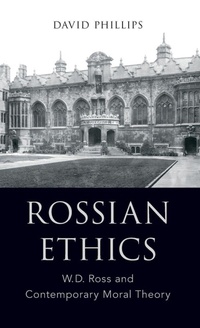
Rossian Ethics
W.D. Ross and Contemporary Moral Theory
Published on 12. August 2019
Book
Hardback
232 pages
978-0-19-060218-5 (ISBN)
Description
W.D. Ross (1877-1971) was the most important opponent of utilitarianism and consequentialism in British moral philosophy between 1861 and 1939. In Rossian Ethics, David Phillips offers the first monograph devoted exclusively to Ross's seminal contribution to moral philosophy.
The book has two connected aims. The first is to interpret and evaluate Ross's moral theory, focusing on its three key elements: his introduction of the concept of prima facie duty, his limited pluralism about the right, and his limited pluralism about the good. The metaethical and epistemological framework within which Ross develops his moral theory is the subject of the fifth and final chapter of the book.
The second aim is to articulate a distinctive view intermediate between consequentialism and absolutist deontology, which Phillips calls "classical deontology." According to classical deontology the most fundamental normative principles are principles of prima facie duty, principles which specify general kinds of reasons. Consequentialists are right to think that reasons always derive from goods; ideal utilitarians are right, contra hedonistic utilitarians, to think that there are a small number of distinct kinds of intrinsic goods. But consequentialists are wrong to think that all reasons have the same weight for all agents. Instead there are a small number of distinct kinds of agent-relative intensifiers: features that increase the importance of certain goods for certain agents. Phillips claims that classical deontology combines the best elements of the moral theories of Ross and of Sidgwick, ultimately arguing that Ross is best interpreted as a classical deontologist.
The book has two connected aims. The first is to interpret and evaluate Ross's moral theory, focusing on its three key elements: his introduction of the concept of prima facie duty, his limited pluralism about the right, and his limited pluralism about the good. The metaethical and epistemological framework within which Ross develops his moral theory is the subject of the fifth and final chapter of the book.
The second aim is to articulate a distinctive view intermediate between consequentialism and absolutist deontology, which Phillips calls "classical deontology." According to classical deontology the most fundamental normative principles are principles of prima facie duty, principles which specify general kinds of reasons. Consequentialists are right to think that reasons always derive from goods; ideal utilitarians are right, contra hedonistic utilitarians, to think that there are a small number of distinct kinds of intrinsic goods. But consequentialists are wrong to think that all reasons have the same weight for all agents. Instead there are a small number of distinct kinds of agent-relative intensifiers: features that increase the importance of certain goods for certain agents. Phillips claims that classical deontology combines the best elements of the moral theories of Ross and of Sidgwick, ultimately arguing that Ross is best interpreted as a classical deontologist.
Reviews / Votes
This is an excellent, thoughtful, and accessible book. * W. Simkulet, Park University, CHOICE * well-argued, engaging, with novel exegetical and philosophical insights... a welcome addition to the growing literature on intuitionism." * Philip Stratton-Lake, Notre Dame Philosophical Reviews *More details
Language
English
Place of publication
New York
United States
Dimensions
Height: 222 mm
Width: 145 mm
Thickness: 16 mm
Weight
424 gr
ISBN-13
978-0-19-060218-5 (9780190602185)
Copyright in bibliographic data and cover images is held by Nielsen Book Services Limited or by the publishers or by their respective licensors: all rights reserved.
Schweitzer Classification
Other editions
Additional editions
E-Book
06/2019
OUP eBook
€41.49
Available for download
E-Book
06/2019
OUP eBook
€31.99
Available for download
Person
David Phillips is Professor and Chair of the Department of Philosophy at the University of Houston. His research interests are in ethics and the history of ethics with a particular focus on British moral philosophers. He is the author of Sidgwickian Ethics (OUP 2011).
Content
- Chapter One: Introduction
- Chapter Two: What are Prima Facie Duties?
- Chapter Three: What Prima Facie Duties are there? Ross, Agent-Relativity, and the Rejection of Consequentialism
- Chapter Four: What Things are Good?
- Chapter Five: The Metaethical and Epistemological Framework