

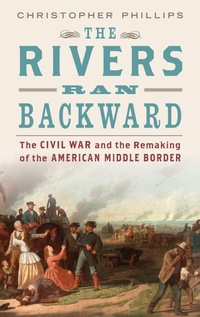
The Rivers Ran Backward
The Civil War and the Remaking of the American Middle Border
Published on 16. June 2016
Book
Hardback
528 pages
978-0-19-518723-6 (ISBN)
Description
Most Americans believe that the Ohio River was a clearly defined and static demographic and political boundary between North and South, an extension of the Mason-Dixon Line. Once settled, the new states west of the Appalachians -- the slave states of Kentucky and Missouri and of the free states of Illinois, Indiana, Ohio, and Kansas -- formed a fixed boundary between freedom and slavery, extending the border that inevitably produced the war. None of this is true, except perhaps the outcome of war. But the centrality of the Civil War and its outcome in the making of these tropes is undeniable.
Historian Christopher Phillips contests the assumption that regional identities throughout the "Middle Border" states were stable in the era of the Civil War. States such as Missouri and Kentucky tended to identify as more western than southern during the first half of the nineteenth century. Conversely, much of the population of the lower Midwestern states of Ohio, Illinois, and Indiana had stronger cultural, economic, and political ties to slave states than to New England or the Middle Atlantic. But across the region the Civil War left an indelible imprint on the way in which residents thought of themselves and other Americans, proving as much a shaper as a product of regional identities. A sweeping argument employing a strong narrative, telling vignettes, and the voices of regional and national figures, this book makes a major contribution to Civil War history and to American history on a broader scale.
Historian Christopher Phillips contests the assumption that regional identities throughout the "Middle Border" states were stable in the era of the Civil War. States such as Missouri and Kentucky tended to identify as more western than southern during the first half of the nineteenth century. Conversely, much of the population of the lower Midwestern states of Ohio, Illinois, and Indiana had stronger cultural, economic, and political ties to slave states than to New England or the Middle Atlantic. But across the region the Civil War left an indelible imprint on the way in which residents thought of themselves and other Americans, proving as much a shaper as a product of regional identities. A sweeping argument employing a strong narrative, telling vignettes, and the voices of regional and national figures, this book makes a major contribution to Civil War history and to American history on a broader scale.
Reviews / Votes
[A] sprawling account....Phillips' account of the middle border's Civil War is a welcome addition to a historiography of the Civil War that remains in many ways divided into North and South. * Nicole Myers Turner, The Michigan Historical Review * Despite the complex topic, The Rivers Ran Backward is a readable, well-written and exhaustively researched work (with a 47-page bibliography to prove it) and is certainly one of the most important Civil War books in recent memory. * Mark Christ, Kansas History * Phillips's thoroughly researched and well-argued account presents an original and persuasive interpretation that deserves wide attention. The Rivers Ran Backward should become a standard work on the trans-Appalachian West. * Jonathan M. Atkins, American Historical Review * essential reading for anyone interested in the American Civil War and its unforeseen consequences. * Robert Cook, Reviews in History * Phillips' expert command of Kentucky and Missouri history enables him to analyze incisively the war's impact in the Lower North ... [The subfield's] most important and wide-reaching title to date. * Civil War Book Review *More details
Language
English
Place of publication
New York
United States
Target group
College/higher education
Illustrations
25 illustrations
Dimensions
Height: 240 mm
Width: 161 mm
Thickness: 33 mm
Weight
951 gr
ISBN-13
978-0-19-518723-6 (9780195187236)
Copyright in bibliographic data and cover images is held by Nielsen Book Services Limited or by the publishers or by their respective licensors: all rights reserved.
Schweitzer Classification
Other editions
Additional editions
Christopher Phillips
The Rivers Ran Backward
The Civil War and the Remaking of the American Middle Border
E-Book
04/2016
1st Edition
OUP eBook
€9.99
Available for download
Christopher Phillips
The Rivers Ran Backward
The Civil War and the Remaking of the American Middle Border
E-Book
04/2016
1st Edition
OUP eBook
€9.99
Available for download
Person
Christopher Phillips is Professor of History and Department Head at the University of Cincinnati. He is the author of seven books, including Damned Yankee: The Life of General Nathaniel Lyon; Freedom's Port: The African American Community of Baltimore, 1790-1860; Missouri's Confederate: Claiborne Fox Jackson and the Creation of Southern Identity in the Border West; and The Civil War in the Border South.
Content
Prologue "There is a West" ; Introduction ; Interstice-White Salt, Black Servitude ; Chapter One: White Flows the River-Freedom and Unfreedom in the Early National ; West ; Interstice-North of Slavery, West of Abolition ; Chapter Two: Babel-Changed Persistence on Slavery's Borderland ; Interstice-Vox Populi ; Chapter Three: The Ten Year War-Sectional Politics in a Dividing Region ; Interstice-House of Cards ; Chapter Four: No North-No South-No East-No West-The Fiction of the ; Wartime Middle Ground ; Interstice-The Gates of Zion ; Chapter Five: Netherworld of War-Civilians, Soldiers, and the Dominion of War ; Interstice-War of Another Kind ; Chapter Six: Bitter Harvest-Emancipation and the Politics of Loyalty ; Interstice-The Art of Retaliation ; Chapter Seven: Shadow Wars-The Crucible of Social Violence ; Interstice-A River Between Them ; Chapter Eight: North Star, Southern Cross-The Politics of Irreconciliation4 ; Epilogue Rally Round the Flag ; Conclusion ; Abbreviations ; Notes ; Bibliography ; Acknowledgments ; Index