

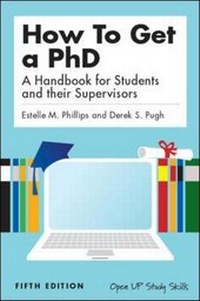
How to Get a PhD
a handbook for students and their supervisors
5th Edition
Published on 16. October 2010
Book
Paperback/Softback
280 pages
978-0-335-24202-3 (ISBN)
Description
"This handbook for students and their supervisors does exactly what it says 'on the tin' - it tells you how to get a PhD in a sensible, practical and informed fashion designed to debunk the myths and relieve you of any false allusions... The PhD is a challenging process and often feels more mysterious than it should be. This worthwhile offering makes the whole endeavour a much more 'open book' for the would-be Dr and comes highly recommended."
Wilma Clark, Institute of Education, University of London.Since the first edition of this innovative book, thousands of doctoral students have gained their doctorates by following the spot-on advice it gives. Across all faculties and disciplines, it remains the book of choice for both students and their supervisors, establishing it as a worldwide bestseller.This practical book guides students through all they need to know to approach the research, write and defend their ideas and ultimately produce a unique and robust academic thesis. It also gives supervisors and examiners invaluable tips on their role in the process.With vignettes from doctoral candidates, the book demonstrates how problems can be approached and overcome.Thoroughly updated to include new technologies and different forms of doctorate, new content includes coverage on:
Studying for a professional doctorate
The specifics of writing your PhD
Equal opportunities for non-traditional students and for students from minority groups
A self-evaluation questionnaire on doctoral supervisory practice (to complement the existing questionnaire on student progress)
How to Get a PhD is the essential handbook for doctoral students!
Wilma Clark, Institute of Education, University of London.Since the first edition of this innovative book, thousands of doctoral students have gained their doctorates by following the spot-on advice it gives. Across all faculties and disciplines, it remains the book of choice for both students and their supervisors, establishing it as a worldwide bestseller.This practical book guides students through all they need to know to approach the research, write and defend their ideas and ultimately produce a unique and robust academic thesis. It also gives supervisors and examiners invaluable tips on their role in the process.With vignettes from doctoral candidates, the book demonstrates how problems can be approached and overcome.Thoroughly updated to include new technologies and different forms of doctorate, new content includes coverage on:
Studying for a professional doctorate
The specifics of writing your PhD
Equal opportunities for non-traditional students and for students from minority groups
A self-evaluation questionnaire on doctoral supervisory practice (to complement the existing questionnaire on student progress)
How to Get a PhD is the essential handbook for doctoral students!
More details
Edition
5th edition
Language
English
Place of publication
Milton Keynes
United Kingdom
Target group
College/higher education
Dimensions
Height: 91 mm
Width: 60 mm
Thickness: 7 mm
Weight
1 gr
ISBN-13
978-0-335-24202-3 (9780335242023)
Copyright in bibliographic data and cover images is held by Nielsen Book Services Limited or by the publishers or by their respective licensors: all rights reserved.
Schweitzer Classification
Other editions
New editions
Estelle Phillips | Colin Johnson
How to Get a PhD: A Handbook for Students and Their Supervisors
A Handbook for Students and Their Supervisors
Book
08/2022
7th Edition
Open University Press
€32.09
Available immediately
Previous edition
Book
06/2005
4th Edition
Open University Press
€44.75
Shipment within 15-20 days
Persons
Dr Estelle M. Phillips has enjoyed a long career as an academic and independent educational consultant. She has published widely on the various aspects of the PhD process and has spoken at universities on four continents about the skills required to complete and supervise a PhD. Her involvement extends to helping with the transformation of the Australian PhD and the introduction of a European doctorate. Professor Derek S. Pugh is Emeritus Professor of International Management of the Open University Business School, UK. He has published 17 books and over 100 papers in his field and has considerable experience in the design of doctoral programmes and the successful supervision and examination of PhD students. In 2009 he was the recipient of a Lifetime Achievement Award of the British Academy of Management. His personal website is: www.derekpugh.com
Content
On becoming a research student Getting into the system
The nature of the PhD qualification
How not to get a PhD
How to do research
The form of a PhD thesis
Writing your PhD
The PhD process
How to manage your supervisors
Equal opportunities for non-traditional research students (i.e. women - with some comments for men - international, mature and part-time students)
Equal opportunities for minority group research students(i.e. ethnic minority students; gay, lesbian, bisexual and transgender students; students with chronic medical conditions; and disabled students)
The examination system
How to get a professional doctorate (ProfD)
How to supervise and examine
Institutional responsibilities
Appendix 1: Self-evaluation questionnaire on research student progress
Appendix 2: Self-evaluation questionnaire on doctoral supervisory practice
The nature of the PhD qualification
How not to get a PhD
How to do research
The form of a PhD thesis
Writing your PhD
The PhD process
How to manage your supervisors
Equal opportunities for non-traditional research students (i.e. women - with some comments for men - international, mature and part-time students)
Equal opportunities for minority group research students(i.e. ethnic minority students; gay, lesbian, bisexual and transgender students; students with chronic medical conditions; and disabled students)
The examination system
How to get a professional doctorate (ProfD)
How to supervise and examine
Institutional responsibilities
Appendix 1: Self-evaluation questionnaire on research student progress
Appendix 2: Self-evaluation questionnaire on doctoral supervisory practice