

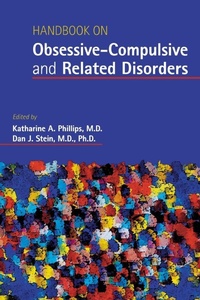
Handbook on Obsessive-Compulsive and Related Disorders
Published on 18. May 2015
Book
Paperback/Softback
312 pages
978-1-58562-489-8 (ISBN)
Description
Obsessive-compulsive and related disorders (OCRDs) are both
prevalent and a source of significant impairment for patients who suffer
from them, yet they remain underrecognized and underdiagnosed. Handbook
on Obsessive-Compulsive and Related Disorders provides comprehensive
and cutting-edge coverage of OCRDs for clinicians and trainees in the
context of the new classification framework established by the DSM-5.
Chapters cover OCD, body dysmorphic disorder (BDD), hoarding disorder,
trichotillomania (hair pulling disorder), excoriation (skin picking)
disorder, and illness anxiety disorder, among other related conditions,
ensuring that readers are current on both the research on and the standard
of care for these illnesses. In addition, each chapter employs a logical and
consistent structure, addressing diagnostic criteria and symptomatology,
epidemiology, etiology and pathophysiology, comorbidities, course and
prognosis, assessment and differential diagnosis, psychosocial impairment
and suicidality, and other topics such as cultural and gender-related
issues. Treatment approaches and considerations are explored
in-depth.
The Handbook's useful features are many:
* The first book focused on the OCRDs to be published since the
development of DSM-5, it reflects a deep understanding of the disorders and
the DSM-5 development process. Readers can depend on the utmost
compatibility with DSM-5 because the book was edited by the chair of the
DSM-5 work group, and the chair of the sub-work group, that oversaw the
development of the OCRD category. The editors have provided a helpful
introductory chapter that thoroughly addresses the changes from
DSM-IV.
* The book includes a chapter on disorders that were seriously
considered for, though ultimately not included in, the DSM-5 OCRD chapter
and for which research offers some support for a close relationship to OCD.
These include tic disorders, illness anxiety disorder (hypochondriasis), and
obsessive-compulsive personality disorder.
* Case studies are provided
in each chapter, as well as key clinical points, both of which help the
reader understand, contextualize, and make use of the book's content.
Recommended readings at the end of each chapter offer the opportunity to
deepen understanding.
The costs to society of undiagnosed and/or
untreated OCRD are high in both human and financial terms, and clinicians
need to master all available tools to help patients and families understand
and cope with these disorders. Handbook of Obsessive-Compulsive and
Related Disorders deserves a prominent position-both in the
literature and on the clinician's bookshelf.
prevalent and a source of significant impairment for patients who suffer
from them, yet they remain underrecognized and underdiagnosed. Handbook
on Obsessive-Compulsive and Related Disorders provides comprehensive
and cutting-edge coverage of OCRDs for clinicians and trainees in the
context of the new classification framework established by the DSM-5.
Chapters cover OCD, body dysmorphic disorder (BDD), hoarding disorder,
trichotillomania (hair pulling disorder), excoriation (skin picking)
disorder, and illness anxiety disorder, among other related conditions,
ensuring that readers are current on both the research on and the standard
of care for these illnesses. In addition, each chapter employs a logical and
consistent structure, addressing diagnostic criteria and symptomatology,
epidemiology, etiology and pathophysiology, comorbidities, course and
prognosis, assessment and differential diagnosis, psychosocial impairment
and suicidality, and other topics such as cultural and gender-related
issues. Treatment approaches and considerations are explored
in-depth.
The Handbook's useful features are many:
* The first book focused on the OCRDs to be published since the
development of DSM-5, it reflects a deep understanding of the disorders and
the DSM-5 development process. Readers can depend on the utmost
compatibility with DSM-5 because the book was edited by the chair of the
DSM-5 work group, and the chair of the sub-work group, that oversaw the
development of the OCRD category. The editors have provided a helpful
introductory chapter that thoroughly addresses the changes from
DSM-IV.
* The book includes a chapter on disorders that were seriously
considered for, though ultimately not included in, the DSM-5 OCRD chapter
and for which research offers some support for a close relationship to OCD.
These include tic disorders, illness anxiety disorder (hypochondriasis), and
obsessive-compulsive personality disorder.
* Case studies are provided
in each chapter, as well as key clinical points, both of which help the
reader understand, contextualize, and make use of the book's content.
Recommended readings at the end of each chapter offer the opportunity to
deepen understanding.
The costs to society of undiagnosed and/or
untreated OCRD are high in both human and financial terms, and clinicians
need to master all available tools to help patients and families understand
and cope with these disorders. Handbook of Obsessive-Compulsive and
Related Disorders deserves a prominent position-both in the
literature and on the clinician's bookshelf.
Reviews / Votes
This Handbook has a story that has its roots in thetext by Eric Hollander, Joseph Zohar, Paul J. Sirovatka & Darrel A.
Regier, Obsessive-Compulsive Spectrum Disorders. Refining the
Research Agenda for DSM-V (Washington, DC: American Psychiatric Publishing,
2011), and in the innovations that were introduced with the DSM-5: in
particular, the inclusion of obsessive compulsive disorder in a separate
sector compared to that in which it was previously placed, ie the area of
anxiety disorders. This change, in the opinion of the authors, has a
significant impact on improving the way in which clinicians diagnose and
treat patients who present the broad spectrum of situations that revolve
around obsessive and compulsive issues. But also, researchers can find in
this new arrangement - which, it should be remembered, includes different
configurations in addition to the classic obsessive-compulsive disorder - a
different and more useful basic framework (see pp. 271-306 of the DSM-5. and
statistics of mental disorders Milan: Raffaello Cortina, 2014).
The eleven chapters of the text, written by twenty-two authors who have
all been involved in the work of the Obsessive-Compulsive Spectrum Sub-Work
Group for the development of the DSM-5, covers a wide range of clinical
situations (from accumulation disorders to tic, trichotillomania and
excoriation disorders), especially considering the fundamental aspects of
diagnosis, differential diagnosis and treatment. About this second point the
indication that runs through the entire text is that of cognitive-behavioral
therapy (Cognitive-Bahavioral Therapy [CBT]), considered as the first-line
treatment together with the latest generation drugs, selective inhibitors of
the re-uptake of serotonin (known as SSRI, from the English Selective
Serotonin Reuptake Inhibitors).
A modest space is then reserved for
what is called "psychoeducation", while psychodynamic therapy is mentioned
en passant only once and critically. The interest in the complex of
obsessive-compulsive disorders also arises from the spread of these problems
and from the frequent situation of comorbidity (especially anxiety,
depressive and bipolar disorders). The age of onset is around nineteen years
and if it is not treated this disorder tends to fluctuate, exacerbating,
with a high possibility of becoming chronic. Several authors of the text
emphasize the high cost (social and financial) paid by the company because
of the impediments that force patients affected by this condition to fail to
cope with normal life commitments: as stated in the DSM-5, we estimates
that, at world level, the percentage of the affected population is between
1.1% and 1.8%, with a slight prevalence of females on males, observing that
the onset in the male population is often precocious, ie placed in the
childhood age. The text also includes three chapters dealing with topics
strongly related to obsessive and compulsive disorders, but which have been
placed in other areas of the Manual in the DSM-5: tic disorders, the new
version of hypochondria (called "Anxiety Disorder" of disease ") and
obsessive-compulsive personality disorder. On some topics related to the
topic covered in the text it may be useful to consult Trichotillomania, Skin
Picking, and Other Body-Focused Repetitive Behaviors, signed by Jon E.
Grant, Dan J. Stein, Douglas W. Woods & Nancy J. Keuthen (Washington,
DC: American Psychiatric Publishing, 2012). * Psicoterapia e Scienze Umane, 2017, Vol. 51, No. 1. *
More details
Language
English
Place of publication
VA
United States
Target group
US School Grade: College Graduate Student and over
Product notice
Paperback (trade)
Illustrations
2 Figures; 22 Tables, unspecified
Dimensions
Height: 229 mm
Width: 152 mm
Thickness: 16 mm
Weight
426 gr
ISBN-13
978-1-58562-489-8 (9781585624898)
Copyright in bibliographic data and cover images is held by Nielsen Book Services Limited or by the publishers or by their respective licensors: all rights reserved.
Schweitzer Classification
Other editions
Additional editions
Katharine A. Phillips | Dan J. Stein
Handbook on Obsessive-Compulsive and Related Disorders
E-Book
03/2015
1st Edition
American Psychiatric Association Publishing
€48.99
Available for download
Persons
Katharine A. Phillips, M.D., is Professor of
Psychiatry and Human Behavior at Alpert Medical School of Brown University;
and Senior Research Scientist and Director of the Body Dysmorphic Disorder
Program at Rhode Island Hospital in Providence, Rhode Island.
Dan
J. Stein, M.D., Ph.D., is Professor and Chair of the Department of
Psychiatry at the University of Cape Town in Cape Town, South Africa.
Psychiatry and Human Behavior at Alpert Medical School of Brown University;
and Senior Research Scientist and Director of the Body Dysmorphic Disorder
Program at Rhode Island Hospital in Providence, Rhode Island.
Dan
J. Stein, M.D., Ph.D., is Professor and Chair of the Department of
Psychiatry at the University of Cape Town in Cape Town, South Africa.
Content
Contributors
Foreword
Chapter 1. Introduction and
Major Changes for the Obsessive-Compulsive and Related Disorders in
DSM-5
Chapter 2. Obsessive-Compulsive Disorder
Chapter 3. Body
Dysmorphic Disorder
Chapter 4. Hoarding Disorder
Chapter 5.
Trichotillomania (Hair-Pulling Disorder)
Chapter 6. Excoriation
(Skin-Picking) Disorder
Chapter 7. Other Obsessive-Compulsive and
Related Disorders in DSM-5
Chapter 8. Tic Disorders
Chapter 9.
Illness Anxiety Disorder
Chapter 10. Obsessive-Compulsive Personality
Disorder
Chapter 11. Conclusions
Index
Foreword
Chapter 1. Introduction and
Major Changes for the Obsessive-Compulsive and Related Disorders in
DSM-5
Chapter 2. Obsessive-Compulsive Disorder
Chapter 3. Body
Dysmorphic Disorder
Chapter 4. Hoarding Disorder
Chapter 5.
Trichotillomania (Hair-Pulling Disorder)
Chapter 6. Excoriation
(Skin-Picking) Disorder
Chapter 7. Other Obsessive-Compulsive and
Related Disorders in DSM-5
Chapter 8. Tic Disorders
Chapter 9.
Illness Anxiety Disorder
Chapter 10. Obsessive-Compulsive Personality
Disorder
Chapter 11. Conclusions
Index