

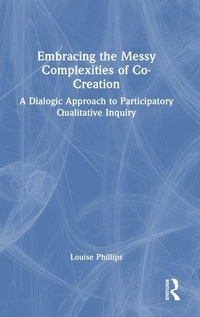
Embracing the Messy Complexities of Co-Creation
A Dialogic Approach to Participatory Qualitative Inquiry
1st Edition
Published on 30. December 2024
Book
Hardback
244 pages
978-1-032-36964-8 (ISBN)
Description
Co-creation in participatory, qualitative research has become commonplace. It supports a myriad of collaborative practices - from service-user involvement in health and social care, to community capacity-building, to bottom-up climate change projects. With its democratic ambitions, transformative power and (in some contexts) goals of social justice, co-creation has much to offer, particularly in these challenging times... but it is also complex and full of tensions.
This book offers an approach which recognises - and embraces - the messy complexities of co-creation. The approach is constructive - it revolves around creating openings for multiple voices; and, in particular, the voices of people with lived experience. And it is critical - it involves integrating critical, reflexive analyses of the intrinsic tensions in co-creation into the practice of research. The book brings participatory research into dialogue with poststructuralist, social constructionist and new materialist, posthumanist strands of qualitative inquiry. In an engaging and accessible way, the author weaves together personal storytelling and more detached analysis to illustrate her approach to producing and communicating knowledge as intertwined processes.
The book is written for all students and researchers with an interest in collaborative research practice.
This book offers an approach which recognises - and embraces - the messy complexities of co-creation. The approach is constructive - it revolves around creating openings for multiple voices; and, in particular, the voices of people with lived experience. And it is critical - it involves integrating critical, reflexive analyses of the intrinsic tensions in co-creation into the practice of research. The book brings participatory research into dialogue with poststructuralist, social constructionist and new materialist, posthumanist strands of qualitative inquiry. In an engaging and accessible way, the author weaves together personal storytelling and more detached analysis to illustrate her approach to producing and communicating knowledge as intertwined processes.
The book is written for all students and researchers with an interest in collaborative research practice.
Reviews / Votes
We rapidly approach a world condition in which we either collaborate or perish. Inquiry into the nature of dialogue, its potentials and limitations, is essential to our capacities to forge the future together. It is just here that the work of Louise Phillips is of central significance. Her scholarship, her sophisticated deliberations, and her experiences in participatory inquiry are without equal. All are reflected in this illuminating extension of her work into realms of embodied and artistic communication.--Kenneth J. Gergen, Ph.D., Senior Research Professor in Psychology at Swarthmore College, and the President of the Taos Institute
Books on participatory research and related approaches often present what Erving Goffman would call the ''front stage'' to show its methods and techniques, impact and democratic potential. Louise Phillips dares to share the ''back-stage'' narrating about the messy dynamics of in- and exclusion in the process of knowledge co-creation, enacting a 'discomforting reflexivity.' Herewith she paints a very realistic picture of the relational, ethical and political complexity of participatory research, and how to navigate the power differentials around ''co" in co-creation.
--Tineke Abma, Ph.D., Professor of Participation of Older People at the Department of Public Health and Primary Care at the Leiden University Medical Centre and Executive Director of Leyden Academy on Vitality and Ageing
The book makes such a useful and timely contribution to the field of social research in the way it brings participatory research, and its focus on power, together with new materialist and posthumanist forms of inquiry, and their focus on relational becoming.
-- Victoria Foster, Senior External Engagement Fellow, Edge Hill University, UK
More details
Language
English
Place of publication
London
United Kingdom
Publishing group
Taylor & Francis Ltd
Target group
College/higher education
Professional and scholarly
Academic, Postgraduate, and Professional Reference
Illustrations
11 s/w Photographien bzw. Rasterbilder, 1 s/w Zeichnung, 3 s/w Tabellen, 12 s/w Abbildungen
3 Tables, black and white; 1 Line drawings, black and white; 11 Halftones, black and white; 12 Illustrations, black and white
Dimensions
Height: 240 mm
Width: 161 mm
Thickness: 18 mm
Weight
552 gr
ISBN-13
978-1-032-36964-8 (9781032369648)
Copyright in bibliographic data and cover images is held by Nielsen Book Services Limited or by the publishers or by their respective licensors: all rights reserved.
Schweitzer Classification
Other editions
Additional editions
Louise Phillips
Embracing the Messy Complexities of Co-Creation
A Dialogic Approach to Participatory Qualitative Inquiry
Book
12/2024
1st Edition
Routledge
€57.30
Shipment within 10-20 days
Louise Phillips
Embracing the Messy Complexities of Co-Creation
A Dialogic Approach to Participatory Qualitative Inquiry
E-Book
12/2024
1st Edition
Routledge
€49.99
Available for download
Louise Phillips
Embracing the Messy Complexities of Co-Creation
A Dialogic Approach to Participatory Qualitative Inquiry
E-Book
12/2024
1st Edition
Routledge
€49.99
Available for download
Person
Louise Phillips is Professor of Communication, Department of Communication and Arts, Roskilde University
Content
Chapter 1: Offering a dialogic approach to conceptualizing co-creation. Chapter 2: Mapping the contested terrain of co-creation in participatory research and qualitative inquiry Chapter 3: Thinking with IFADIA - an overview. Chapter 4: Tracing the relational enactment of "co-creation": the Parkinson's Dance Research Project. Chapter 5: Working with the tension in co-creation between cultivating the creative process and producing specific results. Chapter 6: Conceptualising tensional temporalities and mutual care in co-creation. Chapter 7: A collaborative autoethnographic inquiry into "co-creation" from participants' perspectives. Chapter 8: Fostering embodied experiential knowing in dialogic research communication. Chapter 9: Epilogue.