

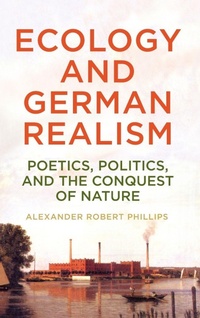
Ecology and German Realism
Poetics, Politics, and the Conquest of Nature
Published on 8. April 2025
Book
Hardback
190 pages
978-1-64014-201-5 (ISBN)
Description
Shows, contrary to the traditional view, that the major authors of German literary realism not only thematized environmental transformation but that it was central to their aesthetics.
In nineteenth-century Europe, and particularly in Germany, the industrial revolution led to air and water pollution, urban and industrial sprawl, and the physical reconstitution of natural landscapes. This book investigates the relationship between environmental degradation and German Realist aesthetics, challenging a longstanding argument in the scholarship that German Realism largely occluded urban and industrial realities by demonstrating that its major authors-Adalbert Stifter, Wilhelm Raabe, Theodor Storm, and Theodor Fontane-not only thematized environmental matters, but that environmental transformation became the very condition for their texts' reflections on the aesthetic representation of reality.
German Realist aesthetics in this sense are thus inseparable from environmental aesthetics. Environmental aesthetics, in turn, are inseparable from environmental politics, connected as they are to problems such as the loss of individual livelihoods, displacement of communities, and the legal and ethical standing of animals, plants and landscapes. By exploring how these problems appear in the fiction of the period, Alexander Phillips's book situates the literature in a longer genealogy of environmentalism and ecological aesthetics beyond Germany. That genealogy includes the early twentieth-century "Nature Fakers" debate in the United States, twentieth-century nature writing and contemporary ecocritical theory.
In nineteenth-century Europe, and particularly in Germany, the industrial revolution led to air and water pollution, urban and industrial sprawl, and the physical reconstitution of natural landscapes. This book investigates the relationship between environmental degradation and German Realist aesthetics, challenging a longstanding argument in the scholarship that German Realism largely occluded urban and industrial realities by demonstrating that its major authors-Adalbert Stifter, Wilhelm Raabe, Theodor Storm, and Theodor Fontane-not only thematized environmental matters, but that environmental transformation became the very condition for their texts' reflections on the aesthetic representation of reality.
German Realist aesthetics in this sense are thus inseparable from environmental aesthetics. Environmental aesthetics, in turn, are inseparable from environmental politics, connected as they are to problems such as the loss of individual livelihoods, displacement of communities, and the legal and ethical standing of animals, plants and landscapes. By exploring how these problems appear in the fiction of the period, Alexander Phillips's book situates the literature in a longer genealogy of environmentalism and ecological aesthetics beyond Germany. That genealogy includes the early twentieth-century "Nature Fakers" debate in the United States, twentieth-century nature writing and contemporary ecocritical theory.
More details
Series
Language
English
Place of publication
Columbia, MD
United States
Publishing group
Boydell & Brewer Ltd
Target group
Professional and scholarly
Product notice
Cloth over boards
Illustrations
3 Karten
3 Maps
Dimensions
Height: 235 mm
Width: 157 mm
Thickness: 15 mm
Weight
437 gr
ISBN-13
978-1-64014-201-5 (9781640142015)
Copyright in bibliographic data and cover images is held by Nielsen Book Services Limited or by the publishers or by their respective licensors: all rights reserved.
Schweitzer Classification
Person
ALEXANDER ROBERT PHILLIPS holds a PhD in German Studies from Cornell University and is Assistant Professor of English, Ashoka University, India.
Content
Acknowledgments
List of Illustrations
List of Abbreviations
Introduction: Industrialization, Environmental Degradation, and the Aesthetics of Realism
1. Environmental Counterfictions: The Ethical Domination of Nature in Adalbert Stifter
2. The Styx Flows through Arcadia: Environmental Depredation and Aesthetic Reflection in Wilhelm Raabe's Late Fiction
3. Hydrologic Engineering, Social Change, and the Persistence of the Fantastic in Theodor Storm's Der Schimmelreiter
4. The Poetics of an Emerging Anthropocene: Theodor Fontane's Der Stechlin
Conclusion The Nature of Realism
Bibliography
Index
List of Illustrations
List of Abbreviations
Introduction: Industrialization, Environmental Degradation, and the Aesthetics of Realism
1. Environmental Counterfictions: The Ethical Domination of Nature in Adalbert Stifter
2. The Styx Flows through Arcadia: Environmental Depredation and Aesthetic Reflection in Wilhelm Raabe's Late Fiction
3. Hydrologic Engineering, Social Change, and the Persistence of the Fantastic in Theodor Storm's Der Schimmelreiter
4. The Poetics of an Emerging Anthropocene: Theodor Fontane's Der Stechlin
Conclusion The Nature of Realism
Bibliography
Index