

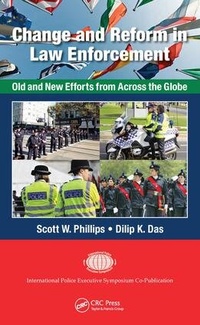
Change and Reform in Law Enforcement
Old and New Efforts from Across the Globe
1st Edition
Published on 26. October 2016
Book
Hardback
325 pages
978-1-4987-4168-2 (ISBN)
Description
This book provides broad exposure to a variety of policing reforms that have not received adequate attention. It includes information and examples from different countries regarding efforts to change aspects of policing that are problematic or involve changes in the way crimes are committed. Some of the efforts to improve the police are relatively recent (i.e., using social media) and some areas of policing that seem to require frequent attention (i.e., working with the public).
More details
Series
Language
English
Place of publication
New York
United States
Publishing group
Taylor & Francis Inc
Target group
College/higher education
Professional and scholarly
Illustrations
2 s/w Abbildungen, 31 s/w Tabellen
31 Tables, black and white; 2 Illustrations, black and white
Dimensions
Height: 234 mm
Width: 156 mm
Weight
630 gr
ISBN-13
978-1-4987-4168-2 (9781498741682)
Copyright in bibliographic data and cover images is held by Nielsen Book Services Limited or by the publishers or by their respective licensors: all rights reserved.
Schweitzer Classification
Other editions
Additional editions
Scott W. Phillips | Dilip K. Das
Change and Reform in Law Enforcement
Old and New Efforts from Across the Globe
Book
12/2019
1st Edition
Routledge
€73.90
Shipment within 15-20 days
Scott W. Phillips | Dilip K. Das
Change and Reform in Law Enforcement
Old and New Efforts from Across the Globe
E-Book
10/2016
1st Edition
Routledge
€67.49
Available for download
Scott W. Phillips | Dilip K. Das
Change and Reform in Law Enforcement
Old and New Efforts from Across the Globe
E-Book
10/2016
1st Edition
Routledge
€67.49
Available for download
Persons
Scott W. Phillips is an associate professor in the Criminal Justice Department at SUNY Buffalo State. He earned a PhD from SUNY Albany and his research focuses on empirical examinations of police decision making, police culture, and agency policy. His works have appeared in Journal of Criminal Justice, Police Research and Practice, Criminal Justice Policy Review, Policing: An International Journal of Police Strategies and Management, the International Journal of Police Science and Management, and Policing & Society.
Dilip K. Das is a professor of criminal justice, former police chief, founding editor-in-chief of Police Practice and Research: An International Journal, and a human rights consultant to the United Nations. Das served in the Indian Police Service for 14 years. In 1994, he founded the International Police Executive Symposium (IPES), which enjoys special consultative status in the United Nations. He has authored, edited, and coedited more than 30 books and numerous articles. He is editor-in-chief of two book series, Advances in Police Theory and Practice and Interviews with Global Leaders in Policing, Courts, and Prisons. Das has received several faculty excellence awards and is a Distinguished Faculty Lecturer.
Dilip K. Das is a professor of criminal justice, former police chief, founding editor-in-chief of Police Practice and Research: An International Journal, and a human rights consultant to the United Nations. Das served in the Indian Police Service for 14 years. In 1994, he founded the International Police Executive Symposium (IPES), which enjoys special consultative status in the United Nations. He has authored, edited, and coedited more than 30 books and numerous articles. He is editor-in-chief of two book series, Advances in Police Theory and Practice and Interviews with Global Leaders in Policing, Courts, and Prisons. Das has received several faculty excellence awards and is a Distinguished Faculty Lecturer.
Content
Section I: Police Officer Education
1. Benefits and Challenges of Academic Police Education
KATJA M. HALLENBERG
2. Indian Police Training Institutions, Universities, and Other Stakeholder Partnerships: Toward a Matrix Model for Better Policing
SONY KUNJAPPAN
3. Downsizing to a College-Educated Police Force
GREGORY E. WALSH
Section II: Policing and the Public
4. Correlates of Citizen Trust in the Ghanaian Police: A Regional Study
FRANCIS D. BOATENG
5. Staging "White Maleness" with Cops: A Diversity Training Case Analysis
DEBORAH S. DEMEESTER & DONALD R. LAMAGDELEINE
6. Reengineering the Delivery of Police Services: The Decision to Change Utilizing a Problem-Solving ModelRICHARD C. LUMB & JOHN B. ROGERS
7. Factors That Predict Citizen Support for Aggressive Policing
TIMOTHY A. LAVERY, AMIE M. SCHUCK, MEGAN A. ALDERDEN, RACHEL M. JOHNSTON, DENNIS P. ROSENBAUM, & CODY D. STEPHENS
8. Opposing Perspectives of Policing in Pakistan and Implications for ReformMARK SHAW
Section III: Past and Contemporary Changes in Policing
9. Assessing the Current Status of Women in Policing: The Presence of the PastVENESSA GARCIA
10. Police Downsizing and Change Processes in Northern Ireland: Retired Police Officers' Views on the Implementation of the Patten Report on Policing
PAUL KENNETH GILBERT, CHRISTOPHER ALAN LEWIS, & CONOR MC GUCKIN
11. Reflections on Police Corruption: Faltering Developments in Regulating Police Conduct in Australia
BERNADINE TUCKER & ANN-CLAIRE LARSEN
12. Policing Terrorism: The Significance of the FBI Joint Terrorism Task Force Program
CHRISTOPHER W. ORTIZ
13. Police Web Presence: Engaging with the Digital Frontier
MICHAEL F. AIELLO & VIKAS K. GUMBHIR
14. The Role of Facebook in Policing: Linking Law Enforcement and the CommunityMICHELLE KILBURN, LAURA KRIEGER, CRYSTAL CECIL, & LUKE MORAVEC
15. A Dynamical Spider Web of Change: The Process of Changing Policy in Law Enforcement
MICHELE MUNI
16. Conclusion
SCOTT W. PHILLIPS
1. Benefits and Challenges of Academic Police Education
KATJA M. HALLENBERG
2. Indian Police Training Institutions, Universities, and Other Stakeholder Partnerships: Toward a Matrix Model for Better Policing
SONY KUNJAPPAN
3. Downsizing to a College-Educated Police Force
GREGORY E. WALSH
Section II: Policing and the Public
4. Correlates of Citizen Trust in the Ghanaian Police: A Regional Study
FRANCIS D. BOATENG
5. Staging "White Maleness" with Cops: A Diversity Training Case Analysis
DEBORAH S. DEMEESTER & DONALD R. LAMAGDELEINE
6. Reengineering the Delivery of Police Services: The Decision to Change Utilizing a Problem-Solving ModelRICHARD C. LUMB & JOHN B. ROGERS
7. Factors That Predict Citizen Support for Aggressive Policing
TIMOTHY A. LAVERY, AMIE M. SCHUCK, MEGAN A. ALDERDEN, RACHEL M. JOHNSTON, DENNIS P. ROSENBAUM, & CODY D. STEPHENS
8. Opposing Perspectives of Policing in Pakistan and Implications for ReformMARK SHAW
Section III: Past and Contemporary Changes in Policing
9. Assessing the Current Status of Women in Policing: The Presence of the PastVENESSA GARCIA
10. Police Downsizing and Change Processes in Northern Ireland: Retired Police Officers' Views on the Implementation of the Patten Report on Policing
PAUL KENNETH GILBERT, CHRISTOPHER ALAN LEWIS, & CONOR MC GUCKIN
11. Reflections on Police Corruption: Faltering Developments in Regulating Police Conduct in Australia
BERNADINE TUCKER & ANN-CLAIRE LARSEN
12. Policing Terrorism: The Significance of the FBI Joint Terrorism Task Force Program
CHRISTOPHER W. ORTIZ
13. Police Web Presence: Engaging with the Digital Frontier
MICHAEL F. AIELLO & VIKAS K. GUMBHIR
14. The Role of Facebook in Policing: Linking Law Enforcement and the CommunityMICHELLE KILBURN, LAURA KRIEGER, CRYSTAL CECIL, & LUKE MORAVEC
15. A Dynamical Spider Web of Change: The Process of Changing Policy in Law Enforcement
MICHELE MUNI
16. Conclusion
SCOTT W. PHILLIPS