

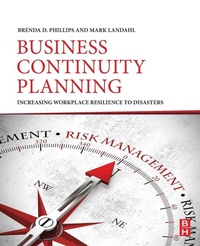
Business Continuity Planning
Increasing Workplace Resilience to Disasters
Published on 26. November 2020
Book
Paperback/Softback
194 pages
978-0-12-813844-1 (ISBN)
Description
Terrorism, natural disasters, or hazardous materials threaten the viability for all types of businesses. With an eye toward business scale, scope, and diversity, Business Continuity Planning: Increasing Workplace Resilience to Disasters, addresses a range of potential businesses from home-based to large corporations in the face of these threats, including the worldwide COVID-19 pandemic. Information on business continuity planning is easy to find but can be difficult to work through. Terminology, required content, and planning barriers often prevent progress. This volume solves such problems by guiding readers, step-by-step, through such actions as identifying hazards and assessing risks, writing critical functions, forming teams, and encouraging stakeholder participation. In essence, this volume serves as a business continuity planning coach for people new to the process or seeking to strengthen and deepen their ongoing efforts. By engaging stakeholders in a business continuity planning process, businesses can protect employees, customers, and their financial stability. Coupled with examples from recent disasters, planners will be able to inspire and involve stakeholders in creating a more resilient workplace. Designed for both educators and practitioners, Business Continuity Planning: Increasing Workplace Resilience to Disasters walks users through how to understand and execute the essential steps of business continuity planning.
More details
Language
English
Place of publication
Woburn
United States
Publishing group
Elsevier - Health Sciences Division
Target group
College/higher education
Primary: Emergency Managers, Business Continuity Planners, and Risk Managers.
Secondary: Emergency Management education/degree programs.
Product notice
Paperback (trade)
Dimensions
Height: 235 mm
Width: 191 mm
Thickness: 11 mm
Weight
354 gr
ISBN-13
978-0-12-813844-1 (9780128138441)
Copyright in bibliographic data and cover images is held by Nielsen Book Services Limited or by the publishers or by their respective licensors: all rights reserved.
Schweitzer Classification
Other editions
Additional editions
Brenda D. Phillips | Mark Landahl
Business Continuity Planning
Increasing Workplace Resilience to Disasters
E-Book
11/2020
Butterworth-Heinemann
€69.95
Available for download
Persons
Brenda D. Phillips, Ph.D., is the Dean of Liberal Arts and Sciences and Professor of Sociology at Indiana University South Bend. Previously, she taught emergency management at Oklahoma State University and has served as a subject-matter expert, consultant, and volunteer for multiple agencies, communities, educational institutions, and voluntary organizations. She is the author of Disaster Recovery, Mennonite Disaster Service, and Qualitative Disaster Research, the co-author of Introduction to Emergency Management, and the co-editor of Social Vulnerability to Disaster and co-author of the forthcoming Business Continuity Planning. She has written numerous peer-reviewed journal articles in the discipline of emergency management and disaster science with direct experience in researching hurricanes, tornadoes, earthquakes, tsunamis, and hazardous materials accidents, much of which has been funded by the National Science Foundation. Dr. Phillips has been invited to assist or speak at disaster programs in the United States, Canada, Mexico, People's Republic of China, Costa Rica, New Zealand, Germany, Sweden, and Australia where she has promoted evidence-based best practices for community safety.
Dr. Phillips firmly believes in the extension of faculty expertise through volunteer service.
With over thirty years of experience in the field of emergency management education, Dr. Phillips has volunteered for local emergency management planning committees and voluntary organizations, especially for high risk populations. She has served as an unpaid reviewer of city and agency emergency management plans and assisted with planning around disaster-time domestic violence, safety for people with disabilities, and elderly evacuation. She has led business continuity planning at multiple academic institutions and businesses. Her most meaningful volunteer activities have helped to rescue animals and rebuild homes (and docks that support sustainable livelihoods) after disasters. Mark Landahl, Ph.D., CEM (R) has more than 23 years of experience spanning the fields of law enforcement, emergency management, homeland security, and higher education. After retiring as the Homeland Security Commander for the Frederick County (MD) Sheriff's Office, he began service in his current position as the Emergency Manager for the City of Rockville (MD). In addition to professional practice, Dr. Landahl teaches at several universities as an adjunct professor.
Dr. Phillips firmly believes in the extension of faculty expertise through volunteer service.
With over thirty years of experience in the field of emergency management education, Dr. Phillips has volunteered for local emergency management planning committees and voluntary organizations, especially for high risk populations. She has served as an unpaid reviewer of city and agency emergency management plans and assisted with planning around disaster-time domestic violence, safety for people with disabilities, and elderly evacuation. She has led business continuity planning at multiple academic institutions and businesses. Her most meaningful volunteer activities have helped to rescue animals and rebuild homes (and docks that support sustainable livelihoods) after disasters. Mark Landahl, Ph.D., CEM (R) has more than 23 years of experience spanning the fields of law enforcement, emergency management, homeland security, and higher education. After retiring as the Homeland Security Commander for the Frederick County (MD) Sheriff's Office, he began service in his current position as the Emergency Manager for the City of Rockville (MD). In addition to professional practice, Dr. Landahl teaches at several universities as an adjunct professor.
Content
Chapter One. The Challenges of Business Continuity Planning
Introduction
What Most Businesses Do (Not Do) in a Disaster
Hazards that Become (Business) Disasters
Natural Hazards
Tsunamis and Cascading Events
Hurricanes and Cyclones
Floods
Earthquakes
Volcanos
Tornadoes
Hazardous Materials
Technological Disruptions
Terrorism and Active Attackers
Pandemics
Types of Disaster Planning
Mitigation Planning
Preparedness and Planning
Response Planning
Recovery and Business Continuity Planning
The Benefits of Business Continuity Planning (BCP)
Mission fulfillment
The financial bottom line
Loss containment
Customer bases
Human resources
Diversity in the business community
Essential Principles for BC Planning
Involvement and inclusion
Planning is a process
Evidence-based planning
A culture of continuity
Upcoming Chapters
Chapter Two. Setting the Stage
The Challenges of Business Continuity Planning
Getting people's attention
Securing a commitment from the CEO
Lack of knowledge or understanding
Educating and involving people on planning as a process
The Effects of Disasters on Businesses
Direct impacts
Indirect impacts
Downtime
Displacement
Impacts on employees
Impacts on customers
Businesses that fail
Essential Actions for Starting the Planning Process
Get a team together
Establish a timeline
Kick off the BCP effort
Build and maintain momentum
Chapter Three. Pre-planning Steps to Launch BCP
Introduction
Hazard Identification
Sources of hazard information
How to write up a hazard identification
Risk Assessment
Understanding probabilities and historic trends
Crafting Scenarios
Loss Estimation
Kinds of losses to estimate
Broader community impacts
Business impact analysis
Determining Acceptable Losses
Mitigating Losses
Essential Actions
Chapter Four. Parts of a Business Continuity Plan
Scenarios and Decision-Making
Pandemic
Technology Disruptions
Natural Disasters
Critical Functions
Prioritizing Critical Functions
Work Teams
Assets and Workarounds
Essential Partnerships
Essential Actions to Take
Chapter Five. Managing Disruptions
Introduction
Infrastructure Disruptions
Anticipating Disruptions
Utilities
Communication and Information Technology
Transportation arteries and supply chains
Downtime Management
How utilities get back on
The role of critical function work teams
Displacement Management
Site displacement
Functional displacement
Population displacement
Restoring Critical Functions
Essential Actions
Chapter Six. Managing Human Resources
Introduction
Case Examples
Terrorism
Natural Disaster
Pandemic
The Critical Role of Human Resources Management
Business Continuity Planning for Human Resource Management
Preparing Employees for Disruptions
What Employees May Experience
Personal Impacts
Professional Impacts
What Employers May Experience
Coping with Employee Impacts
Coping with Immediate Business Impacts
Navigating Recovery
Transitioning from Response to Recovery
The 2004 Tsunami
The 1989 Loma Prieta Earthquake
Recognizing and Rewarding Employees
Essential Actions
Chapter 7. Strengthening and Testing your Business Continuity Plan
Introduction
Training on the BCP
Why you need to know the plan
Teachable moments
Training options
What to train on
Creating scenarios
??????Exercises
Tabletop
Full scale
Field
Virtual/Simulations
??????Creating a culture of preparedness
Essential Actions
Chapter 8. Becoming More Resilient
Introduction
Disaster losses and future predictions
Resilience
The Sendai Framework
Mitigation
The purpose of mitigation
Becoming a champion for mitigation
The Recovery Process
Employee support
Flexibility
Sustainability
Essential Actions
Appendix1. Emergency Response Planning Basics2. Mitigation Planning Basics3. Essential Tools and Resources for BCP (worksheets, checklists, etc.)
Introduction
What Most Businesses Do (Not Do) in a Disaster
Hazards that Become (Business) Disasters
Natural Hazards
Tsunamis and Cascading Events
Hurricanes and Cyclones
Floods
Earthquakes
Volcanos
Tornadoes
Hazardous Materials
Technological Disruptions
Terrorism and Active Attackers
Pandemics
Types of Disaster Planning
Mitigation Planning
Preparedness and Planning
Response Planning
Recovery and Business Continuity Planning
The Benefits of Business Continuity Planning (BCP)
Mission fulfillment
The financial bottom line
Loss containment
Customer bases
Human resources
Diversity in the business community
Essential Principles for BC Planning
Involvement and inclusion
Planning is a process
Evidence-based planning
A culture of continuity
Upcoming Chapters
Chapter Two. Setting the Stage
The Challenges of Business Continuity Planning
Getting people's attention
Securing a commitment from the CEO
Lack of knowledge or understanding
Educating and involving people on planning as a process
The Effects of Disasters on Businesses
Direct impacts
Indirect impacts
Downtime
Displacement
Impacts on employees
Impacts on customers
Businesses that fail
Essential Actions for Starting the Planning Process
Get a team together
Establish a timeline
Kick off the BCP effort
Build and maintain momentum
Chapter Three. Pre-planning Steps to Launch BCP
Introduction
Hazard Identification
Sources of hazard information
How to write up a hazard identification
Risk Assessment
Understanding probabilities and historic trends
Crafting Scenarios
Loss Estimation
Kinds of losses to estimate
Broader community impacts
Business impact analysis
Determining Acceptable Losses
Mitigating Losses
Essential Actions
Chapter Four. Parts of a Business Continuity Plan
Scenarios and Decision-Making
Pandemic
Technology Disruptions
Natural Disasters
Critical Functions
Prioritizing Critical Functions
Work Teams
Assets and Workarounds
Essential Partnerships
Essential Actions to Take
Chapter Five. Managing Disruptions
Introduction
Infrastructure Disruptions
Anticipating Disruptions
Utilities
Communication and Information Technology
Transportation arteries and supply chains
Downtime Management
How utilities get back on
The role of critical function work teams
Displacement Management
Site displacement
Functional displacement
Population displacement
Restoring Critical Functions
Essential Actions
Chapter Six. Managing Human Resources
Introduction
Case Examples
Terrorism
Natural Disaster
Pandemic
The Critical Role of Human Resources Management
Business Continuity Planning for Human Resource Management
Preparing Employees for Disruptions
What Employees May Experience
Personal Impacts
Professional Impacts
What Employers May Experience
Coping with Employee Impacts
Coping with Immediate Business Impacts
Navigating Recovery
Transitioning from Response to Recovery
The 2004 Tsunami
The 1989 Loma Prieta Earthquake
Recognizing and Rewarding Employees
Essential Actions
Chapter 7. Strengthening and Testing your Business Continuity Plan
Introduction
Training on the BCP
Why you need to know the plan
Teachable moments
Training options
What to train on
Creating scenarios
??????Exercises
Tabletop
Full scale
Field
Virtual/Simulations
??????Creating a culture of preparedness
Essential Actions
Chapter 8. Becoming More Resilient
Introduction
Disaster losses and future predictions
Resilience
The Sendai Framework
Mitigation
The purpose of mitigation
Becoming a champion for mitigation
The Recovery Process
Employee support
Flexibility
Sustainability
Essential Actions
Appendix1. Emergency Response Planning Basics2. Mitigation Planning Basics3. Essential Tools and Resources for BCP (worksheets, checklists, etc.)