

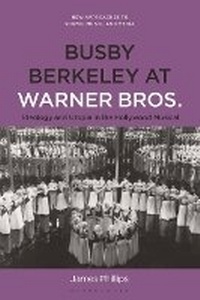
Busby Berkeley at Warner Bros.
Ideology and Utopia in the Hollywood Musical
Published on 20. February 2025
Book
Hardback
256 pages
979-8-7651-2481-9 (ISBN)
Description
Busby Berkeley's big-production numbers are emblematic of the Hollywood dream factory.
Exploring the tensions between escapism and ideological over-coding in the Warner Bros. musical, this book tracks the ways in which Berkeley created spectacles that are both critical and complacent in relation to the society that produced and received them.
Berkeley carried into his images of utopia the assembly plant, the misogyny, the fascism and racism of his day, but his collaboration with the filmmakers (Enright, Bacon and LeRoy) into whose narratives his numbers were spliced likewise involved taking care to draw a line between spectacle and the everyday. The book makes the case that the Warner Bros. musical, with its attention to the specificity and containment of the aesthetic dimension, has corrective lessons to impart for the aestheticized politics not only of the 1930s, but also of the current age.
Exploring the tensions between escapism and ideological over-coding in the Warner Bros. musical, this book tracks the ways in which Berkeley created spectacles that are both critical and complacent in relation to the society that produced and received them.
Berkeley carried into his images of utopia the assembly plant, the misogyny, the fascism and racism of his day, but his collaboration with the filmmakers (Enright, Bacon and LeRoy) into whose narratives his numbers were spliced likewise involved taking care to draw a line between spectacle and the everyday. The book makes the case that the Warner Bros. musical, with its attention to the specificity and containment of the aesthetic dimension, has corrective lessons to impart for the aestheticized politics not only of the 1930s, but also of the current age.
Reviews / Votes
With his riveting assessment of Busby Berkeley's contributions to the Hollywood musical in the 1930s, James Phillips offers sharp insights into a body of work that was not only shaped by the cultural politics of its time but continues to influence popular culture in the twenty-first century. Phillips's smart analysis opens up the tensions and ambiguities that make Berkeley's work deliciously provocative to this day. * Dominic Broomfield-McHugh, Professor in Musicology, University of Sheffield, UK * James Phillips' book will be a treat for anyone who is both fascinated and uneased by the Busby Berkeley movies-as Phillips himself clearly is. Focusing on just a handful of the films made for Warner Bros., Phillips situates Berkeley's kaleidoscopic imagery within multiple contexts, exploring the aesthetics of labor, the allure of camp, the challenge of censorship and the iconicity of spectacle. The book is wonderfully informed, intelligently written and as absorbing to read as Berkeley's sequences are to watch. * Dominic Symonds, Professor of Musical Theatre, University of Lincoln, UK *More details
Series
Language
English
Place of publication
New York
United States
Publishing group
Bloomsbury Publishing Plc
Target group
Professional and scholarly
Dimensions
Height: 232 mm
Width: 158 mm
Thickness: 20 mm
Weight
480 gr
ISBN-13
979-8-7651-2481-9 (9798765124819)
Copyright in bibliographic data and cover images is held by Nielsen Book Services Limited or by the publishers or by their respective licensors: all rights reserved.
Schweitzer Classification
Other editions
Additional editions
E-Book
01/2025
Bloomsbury Academic USA
€100.99
Available for download
E-Book
01/2025
Bloomsbury Academic USA
€100.99
Available for download
Person
James Phillips is Associate Professor in Philosophy at University of New South Wales, Australia. He is the author of Heidegger's Volk: Between National Socialism and Poetry (2005), The Equivocation of Reason: Kleist Reading Kant (2007) and Sternberg and Dietrich: The Phenomenology of Spectacle (2019), the editor of Cinematic Thinking (2008) and co-editor, with John Severn, of Barrie Kosky's Transnational Theatres (2021).
Content
Introduction
1 Women and the Machinery of Escape
2 In the Lair of the Cyclops
3 Love and Censorship
4 Placing Spectacle and the Unfinished Business of Fascism
Pre-Code Coda: She Had to Say Yes
Afterword: Contemporary Lessons from the Aesthetics of the 1930s
Notes
Bibliography
Index
1 Women and the Machinery of Escape
2 In the Lair of the Cyclops
3 Love and Censorship
4 Placing Spectacle and the Unfinished Business of Fascism
Pre-Code Coda: She Had to Say Yes
Afterword: Contemporary Lessons from the Aesthetics of the 1930s
Notes
Bibliography
Index