

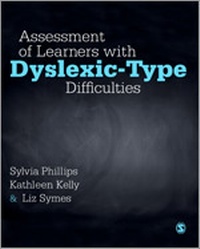
Assessment of Learners with Dyslexic-Type Difficulties
1st Edition
Published on 20. August 2013
Book
Hardback
344 pages
978-1-4462-6022-7 (ISBN)
Description
This comprehensive guide enables teachers to understand a range of approaches to the assessment of children with dyslexic-type difficulties. Linking theory, research and practice, practitioners will gain critical knowledge of procedures to analyse, interpret and use in appropriate assessments which will facilitate setting targets for teaching.
The book covers:
- how to use both informal and formal assessment procedures
- frameworks for evaluating published and teacher-made assessments
- the professional development needs of any teacher involved in assessment
Ideal for those training to be specialist teachers of learners with dyslexia, this text is equally useful to all teachers and SENCOS (Special Educational Needs Co-ordinators) and complements the authors' book Teaching Literacy to Learners with Dyslexia to provide comprehensive guidance for assessing and teaching learners with dyslexic-type difficulties.
Sylvia Phillips is an experienced Special Educational Needs educator, and currently leads Glyndwr University's specialist course for teachers of learners with dyslexia. Kath Kelly is Programme Leader for the Masters in Specific Learning Difficulties, Manchester Metropolitan University. Liz Symes is Senior Lecturer in SEN (Special Educational Needs) and Professional Studies, Manchester Metropolitan University.
The book covers:
- how to use both informal and formal assessment procedures
- frameworks for evaluating published and teacher-made assessments
- the professional development needs of any teacher involved in assessment
Ideal for those training to be specialist teachers of learners with dyslexia, this text is equally useful to all teachers and SENCOS (Special Educational Needs Co-ordinators) and complements the authors' book Teaching Literacy to Learners with Dyslexia to provide comprehensive guidance for assessing and teaching learners with dyslexic-type difficulties.
Sylvia Phillips is an experienced Special Educational Needs educator, and currently leads Glyndwr University's specialist course for teachers of learners with dyslexia. Kath Kelly is Programme Leader for the Masters in Specific Learning Difficulties, Manchester Metropolitan University. Liz Symes is Senior Lecturer in SEN (Special Educational Needs) and Professional Studies, Manchester Metropolitan University.
Reviews / Votes
'Assessment for Learners with Dyslexia-Type Difficulties will become an invaluable and indispensible resource to every school in the country. Both a reference and a practitioner's guide it provides exactly the type of information that is needed to conduct, report and draw conclusions from an assessment. It discusses every aspect of assessment from screening to formal approaches. The section on Informal Approaches is relevant to all teachers and Part III on Formal Approaches will be eagerly welcomed by the growing number of specialist teachers in this field. Sylvia Phillips, Kathleen Kelly and Liz Symes together have a vast range of experience in this field and this is evident in the breadth, detail, and relevance of the 21 chapters in the book, which have increasing relevance for teachers and 'specialist assessors'. This book is essential reading for those involved in assessment and is a 'must have' for every school'-Dr. Gavin Reid,
Independent Educational Psychologist The book will be of significant use to all teachers who need information and guidance on how to assess for a purpose and the authors provide step by step instructions. Examples are provided to illustrate their points and any technical language is clearly explained. I agree with Dr Gavin Red that this book is a 'must have' for schools. -- Special Educational Needs Magazine This text would be useful in all schools as a reference book as well as a training manual. It would be equally useful for specialist teachers and psychologists and for those who are preparing to apply for the renewal of their Assessment Practising Certificate. -- Lois Hood
More details
Language
English
Place of publication
London
United Kingdom
Target group
Professional and scholarly
Dimensions
Height: 232 mm
Width: 186 mm
Weight
758 gr
ISBN-13
978-1-4462-6022-7 (9781446260227)
Copyright in bibliographic data and cover images is held by Nielsen Book Services Limited or by the publishers or by their respective licensors: all rights reserved.
Schweitzer Classification
Other editions
New editions
Sylvia Phillips | Kathleen Kelly
Assessment of Learners with Dyslexic-Type Difficulties
Book
06/2018
2nd Edition
SAGE Publications Ltd
€198.30
Shipment within 15-20 days
Persons
Sylvia Phillips, BA, DASE, MEd (SEN), AMBDA, Cert. TESL, began her career as a teacher of English in secondary schools where she first became interested in why some learners had severe literacy difficulties. She later joined Manchester Metropolitan University where she was a Principal Lecturer, Head of SEN, and then Head of Continuing Professional Development. At MMU she developed the first courses for specialist teachers of learners with dyslexia at both undergraduate and postgraduate levels. During that time she worked in primary, secondary and special schools both with teachers and directly with pupils. She taught on several SEND courses for teachers (particularly training SENDCos) and was the UK partner (with Italy, Belgium and Spain) developing and teaching courses on 'Inclusion and SEN' for European educationalists. She has served on the Accreditation Board of the British Dyslexia Association but left when she became a specialist member of the SEND Tribunal service. She has been involved in several dyslexia research projects developing teaching materials. In recent years she led the AMBDA courses for Wrexham Glyndwr University and was a part-time tutor to the AMBDA course at Stanmillis University College, Belfast. She is co-author of Phillips and Kelly (2018) Assessment of Learners with Dyslexic- Type Difficulties, 2nd edition.
Dr Kathleen Kelly PhD, MA (SEN), Dip TESL, AMBDA, is an independent consultant and trainer in the field of specific learning difficulties. For many years she was a Senior Lecturer at Manchester Metropolitan University in the Centre for Inclusion and Disability Studies where she was Programme Leader for the MA in Specific Learning Difficulties and the Post Graduate Certificate in Dyscalculia. For several years she has taught courses on specific learning difficulties as part of the initial teacher training programme in addition to postgraduate awards. She has presented papers in this area at a number of international conferences and was part of the MMU research team that evaluated the Department for Education funded project 'Teaching for neurodiversity' led and coordinated by the British Dyslexia Association (2017). She has considerable experience in delivering courses to meet the criteria set out by the British Dyslexia Association for Approved Teacher Status (ATS) and is an Associate Member of the British Dyslexia Association (AMBDA). She was a member of the SASC/BDA working party (2019) which was set up to develop a new definition of dyscalculia and to produce guidance on identification and assessment.
Kathleen has taught a wide range of learners with dyslexia, from children as young as 4 years to 16 years. She has worked in both mainstream and special schools, for language support and learning support services, as a SENCO in a primary school, and as Head of Sixth Form in a special school. She has many years of experience in supporting multilingual children with special educational needs (including specific learning difficulties). Multilingualism and dyslexia is a particular area of interest, and her doctorate was also in this area. She is co-author of Phillips and Kelly (2018) Assessment of Learners with Dyslexic-Type Difficulties, 2nd edition and author of Kelly (2020) Identifying, Assessing and Supporting Learners with Dyscalculia.
Dr Kathleen Kelly PhD, MA (SEN), Dip TESL, AMBDA, is an independent consultant and trainer in the field of specific learning difficulties. For many years she was a Senior Lecturer at Manchester Metropolitan University in the Centre for Inclusion and Disability Studies where she was Programme Leader for the MA in Specific Learning Difficulties and the Post Graduate Certificate in Dyscalculia. For several years she has taught courses on specific learning difficulties as part of the initial teacher training programme in addition to postgraduate awards. She has presented papers in this area at a number of international conferences and was part of the MMU research team that evaluated the Department for Education funded project 'Teaching for neurodiversity' led and coordinated by the British Dyslexia Association (2017). She has considerable experience in delivering courses to meet the criteria set out by the British Dyslexia Association for Approved Teacher Status (ATS) and is an Associate Member of the British Dyslexia Association (AMBDA). She was a member of the SASC/BDA working party (2019) which was set up to develop a new definition of dyscalculia and to produce guidance on identification and assessment.
Kathleen has taught a wide range of learners with dyslexia, from children as young as 4 years to 16 years. She has worked in both mainstream and special schools, for language support and learning support services, as a SENCO in a primary school, and as Head of Sixth Form in a special school. She has many years of experience in supporting multilingual children with special educational needs (including specific learning difficulties). Multilingualism and dyslexia is a particular area of interest, and her doctorate was also in this area. She is co-author of Phillips and Kelly (2018) Assessment of Learners with Dyslexic-Type Difficulties, 2nd edition and author of Kelly (2020) Identifying, Assessing and Supporting Learners with Dyscalculia.
Content
Introduction
PART ONE: DYSLEXIC-TYPE DIFFICULTIES AND ASSESSMENT SETTING THE CONTEXT
Dyslexia-Type Difficulties: Implications for Assessment
Purposes and Types of Assessment
Legislation, Policy and Practice
PART TWO: INFORMAL APPROACHES TO ASSESSMENT
Informal Approaches: Identification and Screening
Gathering Information from Others
Informal Approaches: Assessing Difficulties in Reading
Informal Approaches: Assessing Spelling Difficulties
Informal Approaches: Assessing Difficulties in Handwriting
Assessing Alphabetic Knowledge
Assessing Cognitive Processing Skills
Assessing Difficulties in Mathematics
Principles and Concepts of Psychometrics
PART THREE: FORMAL ASSESSMENT
Screening Procedures for Dyslexic-type Difficulties
Standardised Assessment of Reading
Standardised Assessment of Spelling and Handwriting
The Assessment of Underlying Ability
Standardised Assessment of Cognitive Processing Skills
Identifying Specific Learning Difficulties in Mathematics, including Dyscalculia
PART FOUR: CONDUCTING ASSESSMENT
Conducting Assessment
Writing an Assessment Report
Assessment by Other Professionals
Bibliography
Glossary
Appendices
Index
PART ONE: DYSLEXIC-TYPE DIFFICULTIES AND ASSESSMENT SETTING THE CONTEXT
Dyslexia-Type Difficulties: Implications for Assessment
Purposes and Types of Assessment
Legislation, Policy and Practice
PART TWO: INFORMAL APPROACHES TO ASSESSMENT
Informal Approaches: Identification and Screening
Gathering Information from Others
Informal Approaches: Assessing Difficulties in Reading
Informal Approaches: Assessing Spelling Difficulties
Informal Approaches: Assessing Difficulties in Handwriting
Assessing Alphabetic Knowledge
Assessing Cognitive Processing Skills
Assessing Difficulties in Mathematics
Principles and Concepts of Psychometrics
PART THREE: FORMAL ASSESSMENT
Screening Procedures for Dyslexic-type Difficulties
Standardised Assessment of Reading
Standardised Assessment of Spelling and Handwriting
The Assessment of Underlying Ability
Standardised Assessment of Cognitive Processing Skills
Identifying Specific Learning Difficulties in Mathematics, including Dyscalculia
PART FOUR: CONDUCTING ASSESSMENT
Conducting Assessment
Writing an Assessment Report
Assessment by Other Professionals
Bibliography
Glossary
Appendices
Index