

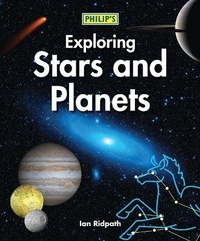
Philip's Exploring Stars and Planets
Philip's (Publisher)
Published on 2. May 2011
Book
Hardback
80 pages
978-1-84907-144-4 (ISBN)
Description
Philip's Exploring Stars and Planets is a completely updated and redesigned edition of the popular children's book formerly titled 'Philip's Atlas of Stars and Planets'. Written specially for 8 to 14 year olds, Philip's Exploring Stars and Planets is a colourful and entertaining introduction to the exciting world of astronomy. The book is illustrated with more than 200 colour photographs, artworks and maps, as the author describes the latest developments in the fast-moving fields of space exploration and astronomy. Concise chapters introduce the Sun, the Earth and all the other planets in our Solar System. Then, moving further into space, the author introduces the stars and galaxies, and explores the origin of the Universe.Philip's Exploring Stars and Planets includes a set of star charts showing all the stars visible to the naked eye. A budding astronomer will be able to use these charts to learn the constellations from any point on Earth. A large photograph of the Moon, with its major features clearly labelled, will encourage anyone with binoculars or a telescope to start Moon-watching.Packed with fascinating facts and figures about the wonders of the Universe, Philip's Exploring Stars and Planets concludes with a series of quiz questions, so that the reader can test how much he or she has learned.
Philip's Exploring Stars and Planets is a completely updated and redesigned edition of the popular children's book formerly titled 'Philip's Atlas of Stars and Planets'. Written specially for 8 to 14 year olds, Philip's Exploring Stars and Planets is a colourful and entertaining introduction to the exciting world of astronomy. The book is illustrated with more than 200 colour photographs, artworks and maps, as the author describes the latest developments in the fast-moving fields of space exploration and astronomy. Concise chapters introduce the Sun, the Earth and all the other planets in our Solar System. Then, moving further into space, the author introduces the stars and galaxies, and explores the origin of the Universe.Philip's Exploring Stars and Planets includes a set of star charts showing all the stars visible to the naked eye. A budding astronomer will be able to use these charts to learn the constellations from any point on Earth. A large photograph of the Moon, with its major features clearly labelled, will encourage anyone with binoculars or a telescope to start Moon-watching.Packed with fascinating facts and figures about the wonders of the Universe, Philip's Exploring Stars and Planets concludes with a series of quiz questions, so that the reader can test how much he or she has learned.
Philip's Exploring Stars and Planets is a completely updated and redesigned edition of the popular children's book formerly titled 'Philip's Atlas of Stars and Planets'. Written specially for 8 to 14 year olds, Philip's Exploring Stars and Planets is a colourful and entertaining introduction to the exciting world of astronomy. The book is illustrated with more than 200 colour photographs, artworks and maps, as the author describes the latest developments in the fast-moving fields of space exploration and astronomy. Concise chapters introduce the Sun, the Earth and all the other planets in our Solar System. Then, moving further into space, the author introduces the stars and galaxies, and explores the origin of the Universe.Philip's Exploring Stars and Planets includes a set of star charts showing all the stars visible to the naked eye. A budding astronomer will be able to use these charts to learn the constellations from any point on Earth. A large photograph of the Moon, with its major features clearly labelled, will encourage anyone with binoculars or a telescope to start Moon-watching.Packed with fascinating facts and figures about the wonders of the Universe, Philip's Exploring Stars and Planets concludes with a series of quiz questions, so that the reader can test how much he or she has learned.
More details
Language
English
Place of publication
London
United Kingdom
Publishing group
Octopus Publishing Group
Dimensions
Height: 297 mm
Width: 246 mm
Thickness: 12 mm
Weight
640 gr
ISBN-13
978-1-84907-144-4 (9781849071444)
Copyright in bibliographic data and cover images is held by Nielsen Book Services Limited or by the publishers or by their respective licensors: all rights reserved.
Schweitzer Classification
Other editions
Additional editions
Philip's Maps
Philip's Exploring Stars and Planets
E-Book
11/2012
1st Edition
Octopus
€6.49
Available for download
Previous edition

Book
09/2004
Philip's OS Publications
€33.61
Article exhausted; check for reprint
Person
Ian Ridpath is a full-time writer, broadcaster and lecturer on astronomy. He is a Fellow of the Royal Astronomical Society and a member of the Association of British Science Writers. A former editor of Popular Astronomy, he is a regular contributor to Astronomy Now. Ian Ridpath's many books include Collins Guide to Stars and Planets, Gem Stars and The Monthly Sky Guide. He is also the editor of the highly respected Norton's Star Atlas - a must-have publication for most practical astronomers - and the Oxford Dictionary of Astronomy.
Ian Ridpath is a full-time writer, broadcaster and lecturer on astronomy. He is a Fellow of the Royal Astronomical Society and a member of the Association of British Science Writers. A former editor of Popular Astronomy, he is a regular contributor to Astronomy Now. Ian Ridpath's many books include Collins Guide to Stars and Planets, Gem Stars and The Monthly Sky Guide. He is also the editor of the highly respected Norton's Star Atlas - a must-have publication for most practical astronomers - and the Oxford Dictionary of Astronomy.
Ian Ridpath is a full-time writer, broadcaster and lecturer on astronomy. He is a Fellow of the Royal Astronomical Society and a member of the Association of British Science Writers. A former editor of Popular Astronomy, he is a regular contributor to Astronomy Now. Ian Ridpath's many books include Collins Guide to Stars and Planets, Gem Stars and The Monthly Sky Guide. He is also the editor of the highly respected Norton's Star Atlas - a must-have publication for most practical astronomers - and the Oxford Dictionary of Astronomy.