

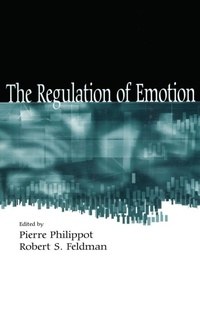
The Regulation of Emotion
Published on 2. June 2004
Book
Hardback
424 pages
978-0-8058-4201-2 (ISBN)
Description
The main goal of this volume is to present, in an integrated framework, the newest, most contemporary perspectives on emotion regulation. The book includes empirically-grounded work and theories that are central to our understanding of the processes that constitute emotion regulation and their consequences.
This volume has several secondary aims, as well. One is to highlight several newer subareas in the domain of emotion regulation that hold much promise, such as the relationship between psychopathology and emotion regulation. The book also presents data and theory that have applied value that may be useful for people working in such fields as communication, psychotherapy, and counseling. Finally, the volume gathers contributions across a variety of subfields and includes authors working not just in North America but in other areas of the world.
To help achieve these goals, the volume has been organized to begin with the presentation of the most molecular aspects of emotion regulation and to end with the most molar ones. It comprises four parts, each integrating different lines of research from related domains. Part I is devoted to basic processes in emotion regulation, such as neurological, physiological or cognitive processes; part II examines the interplays between emotion regulation and individual regulation; part III presents work on individual differences and developmental processes in emotion regulation; and part IV examines the social functions and constraints of emotion regulation.
This volume has several secondary aims, as well. One is to highlight several newer subareas in the domain of emotion regulation that hold much promise, such as the relationship between psychopathology and emotion regulation. The book also presents data and theory that have applied value that may be useful for people working in such fields as communication, psychotherapy, and counseling. Finally, the volume gathers contributions across a variety of subfields and includes authors working not just in North America but in other areas of the world.
To help achieve these goals, the volume has been organized to begin with the presentation of the most molecular aspects of emotion regulation and to end with the most molar ones. It comprises four parts, each integrating different lines of research from related domains. Part I is devoted to basic processes in emotion regulation, such as neurological, physiological or cognitive processes; part II examines the interplays between emotion regulation and individual regulation; part III presents work on individual differences and developmental processes in emotion regulation; and part IV examines the social functions and constraints of emotion regulation.
Reviews / Votes
"Highly Recommended."-CHOICE
More details
Language
English
Place of publication
Philadelphia
United States
Publishing group
Taylor & Francis Inc
Target group
College/higher education
Professional and scholarly
Dimensions
Height: 235 mm
Width: 157 mm
Thickness: 27 mm
Weight
764 gr
ISBN-13
978-0-8058-4201-2 (9780805842012)
Copyright in bibliographic data and cover images is held by Nielsen Book Services Limited or by the publishers or by their respective licensors: all rights reserved.
Schweitzer Classification
Other editions
Additional editions
Pierre Philippot | Robert S. Feldman
The Regulation of Emotion
Book
01/2013
1st Edition
Psychology Press Ltd
€84.80
Shipment within 15-20 days
Pierre Philippot | Robert S. Feldman
The Regulation of Emotion
E-Book
07/2004
Psychology Press Ltd
€77.49
Available for download
Pierre Philippot | Robert S. Feldman
The Regulation of Emotion
E-Book
07/2004
Psychology Press Ltd
€77.49
Available for download
Pierre Philippot | Robert S. Feldman
The Regulation of Emotion
E-Book
07/2004
1st Edition
Psychology Press
€96.59
Available for download
Persons
Pierre Philippot, Robert S. Feldman
Content
Contents: P. Philippot, R.S. Feldman, Preface. Part I:Basic Physiological and Cognitive Processes in the Regulation of Emotion.A. Bechara, A Neural View of the Regulation of Complex Cognitive Functions by Emotion. G. Stemmler, Physiological Processes During Emotion. P. Philippot, C. Baeyens, C. Douilliez, B. Francart, Cognitive Regulation of Emotion: Application to Clinical Disorders. Part II:Social and Motivational Aspects of Emotional Regulation.E.A. Butler, J.J. Gross, Hiding Feelings in Social Contexts: Out of Sight Is Not Out of Mind. M.N. Shiota, B. Campos, D. Keltner, M.J. Hertenstein, Positive Emotion and the Regulation of Interpersonal Relationships. E. Zech, B. Rime, F. Nils, Social Sharing of Emotion, Emotional Recovery, and Interpersonal Aspects. A. Fisher, A.S.R. Manstead, C. Evers, M. Timmers, G. Valk, Motives and Norms Underlying Emotion Regulation. Part III:Self-Presentation and Emotion Regulation.D.M. Tice, R.F. Baumeister, L. Zhang, The Role of Emotion in Self-Regulation: Differing Role of Positive and Negative Emotions. D. Hrubes, R.S. Feldman, J. Tyler, Emotion-Focused Deception: The Role of Deception in the Regulation of Emotion. S. Kitayama, M. Karasawa, B. Mesquita, Collective and Personal Processes in Regulating Emotions: Emotion and Self in Japan and the United States. Part IV:Individual Differences and the Development of Emotion Regulation.N. Eisenberg, T.L. Spinrad, C.L. Smith, Emotion-Related Regulation: Its Conceptualization, Relations to Social Functioning, and Socialization. S.D. Calkins, R.B. Howse, Individual Differences in Self-Regulation: Implications for Childhood Adjustment. C.A. Pauls, Physiological Consequences of Emotion Regulation: Taking Into Account the Effects of Strategies, Personality, and Situation. A.M. Kring, K.H. Werner, Emotion Regulation and Psychopathology.