

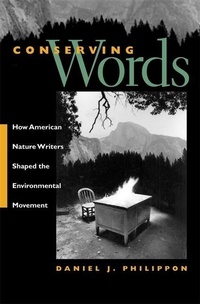
Conserving Words
How American Nature Writers Shaped the Environmental Movement
Will be published approx. on 1. September 2005
Book
Paperback/Softback
391 pages
978-0-8203-2759-4 (ISBN)
Description
Conserving Words looks at five authors of seminal works of nature writing who also founded or revitalized important environmental organizations: Theodore Roosevelt and the Boone and Crockett Club, Mabel Osgood Wright and the National Audubon Society, John Muir and the Sierra Club, Aldo Leopold and the Wilderness Society, and Edward Abbey and Earth First! These writers used powerfully evocative and galvanizing metaphors for nature, metaphors that Daniel J. Philippon calls "conserving" words: frontier (Roosevelt), garden (Wright), park (Muir), wilderness (Leopold), and utopia (Abbey). Integrating literature, history, biography, and philosophy, this ambitious study explores how "conserving" words enabled narratives to convey environmental values as they explained how human beings should interact with the nonhuman world.
Reviews / Votes
Conserving Words richly evokes the larger social context of American nature writing in the era between Roosevelt and Abbey. Daniel Philippon's skill in interweaving the literature with the friendships, letters, official reports, and public debates that informed it makes this book both illuminating and delightful. -- John Elder * author of <i>Reading the Mountains of Home</i> * Philippon does an extraordinarily thorough and lucid job of telling the life stories of these five writers, focusing on their involvement in the environmental movement. . . . In seeking to discern the political and social impact of environmental writing, Conserving Words makes an important contribution to one of the central issues in contemporary ecocriticism. -- Scott Slovic * University of Nevada, Reno * Gets beyond the surface appeals of nature writing which is ordinarily lumped together by most readers. -- <i>University Press Book Review</i> Philippon shows in meticulous fashion how his five writer-activists played integral, complex roles in the development of these important organizations, and how often these people and their organizations interacted. -- <i>ISLE</i> Writers who write about a need to protect the environment and readers who revere them should have high praise for Philippon's Conserving Words. -- <i>Salt Lake City Tribune</i> A readable, lucid examination of how five Americans shaped the environmental movement through their writing . . . Making a significant contribution to the relatively new field of environmental humanities, this book-though classed as natural history-contains so much biography and anecdote that it will appeal to readers across many disciplines. -- <i>Choice</i> A valuable overview of the development of Progressive-era conservation and modern-day environmentalism . . . Conserving Words is an extremely valuable book for its case studies and for its thought-provoking Introduction and Conclusion. -- <i>Science</i> [An] excellent analysis for the eco-critic and academic. -- <i>Southeastern Naturalist</i>More details
Language
English
Place of publication
Georgia
United States
Target group
College/higher education
Professional and scholarly
Product notice
Paperback (trade)
Illustrations
6 b&w photos, 2 figures
Dimensions
Height: 233 mm
Width: 151 mm
Thickness: 27 mm
Weight
561 gr
ISBN-13
978-0-8203-2759-4 (9780820327594)
Copyright in bibliographic data and cover images is held by Nielsen Book Services Limited or by the publishers or by their respective licensors: all rights reserved.
Schweitzer Classification
Person
DANIEL J. PHILIPPON is an associate professor of rhetoric at the University of Minnesota, Twin Cities, where he is also director of the Program in Agricultural, Food, and Environmental Ethics. He is editor of a critical edition of Mabel Osgood Wright's The Friendship of Nature and coeditor of the anthology The Height of Our Mountains.