

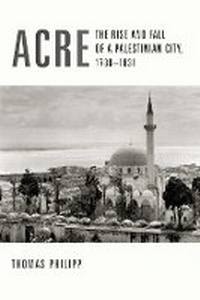
Acre
The Rise and Fall of a Palestinian City, 1730-1831
Published on 27. March 2002
Book
Paperback/Softback
208 pages
978-0-231-12327-3 (ISBN)
Description
Thomas Philipp's study of Acre combines the most extensive use to date of local Arabic sources with commercial records in Europe to shed light on a region and power center many identify as the beginning of modern Palestinian history. The third largest city in eighteenth-century Syria-after Aleppo and Damascus-Acre was the capital of a politically and economically unique region on the Mediterranean coast that included what is today northern Israel and southern Lebanon. In the eighteenth century, Acre grew dramatically from a small fishing village to a fortified city of some 25,000 inhabitants. Cash crops (first cotton, then grain) made Acre the center of trade and political power and linked it inextricably to the world economy. Acre was markedly different from other cities in the region: its urban society consisted almost exclusively of immigrants seeking their fortune. The rise and fall of Acre in the eighteenth and nineteenth centuries, Thomas Philipp argues, must be seen against the background of the decay of central power in the Ottoman empire.
Destabilization of imperial authority allowed for the resurfacing of long-submerged traditional power centers and the integration of Arab regions into European and world economies. This larger imperial context proves the key to addressing many questions about the local history of Acre and its peripheries. How were the new sources of wealth and patterns of commerce that remade Acre reconciled with traditional forms of political power and social organization? Were these forms really traditional? Or did entirely new classes develop under the circumstances of an immigrant society and new commercial needs? And why did Acre, after such propitious beginnings as a center of export trade and political and military power strong enough to defy Napoleon, give way to the dazzling rise of Beirut in the nineteenth century? For centuries the object of the Crusader's fury and the trader's envy, Acre is here restored to its full significance at a crucial moment in Middle Eastern history.
Destabilization of imperial authority allowed for the resurfacing of long-submerged traditional power centers and the integration of Arab regions into European and world economies. This larger imperial context proves the key to addressing many questions about the local history of Acre and its peripheries. How were the new sources of wealth and patterns of commerce that remade Acre reconciled with traditional forms of political power and social organization? Were these forms really traditional? Or did entirely new classes develop under the circumstances of an immigrant society and new commercial needs? And why did Acre, after such propitious beginnings as a center of export trade and political and military power strong enough to defy Napoleon, give way to the dazzling rise of Beirut in the nineteenth century? For centuries the object of the Crusader's fury and the trader's envy, Acre is here restored to its full significance at a crucial moment in Middle Eastern history.
Reviews / Votes
Both scholars and lay readers will appreciate Philipp's decision to relegate detailed information on population, trade, and administrative structure to appendices that constitute about a third of the book... Future researchers interested in these questions will thank their stars for Philipp's solid research on the key actors, events, and overall political context of this fascinating chapter in the history of Ottoman Palestine. -- Beshara B. Doumani Journal of Palestine Studies Philipp's book provides a testament to the dynamism of eighteenth-century societies. International History Review Philipp's Acre is a solid and noteworthy piece of research and brings to the fore important and much-overlooked aspects of the history of the period and area. History Philipp has mined his... sources intelligently and judicially to capture Acre's moment in history. -- Philip S. Khoury American Historical ReviewMore details
Series
Language
English
Place of publication
New York
United States
Target group
Professional and scholarly
Product notice
Paperback (trade)
Illustrations
9 graphs, 8 maps
Dimensions
Height: 229 mm
Width: 152 mm
Weight
440 gr
ISBN-13
978-0-231-12327-3 (9780231123273)
Copyright in bibliographic data and cover images is held by Nielsen Book Services Limited or by the publishers or by their respective licensors: all rights reserved.
Schweitzer Classification
Other editions
Additional editions
E-Book
10/2015
1st Edition
De Gruyter
from
€26.95
Available for download
Book
03/2002
Columbia University Press
€124.00
Article not available at the moment
Person
Thomas Philipp, professor of politics and modern history of the Middle East at Erlangen University in Germany, has taught at Harvard, Dartmouth, and Shiraz universities.
Content
Introduction 1. Southwest Syria in the 18th Century: Sea Lanes, Highways, and Demography 2. The Politics of Acre 3. Trade: Local Rulers and the World Economy 4. Government, Military, and Administration 5. The Society and its Structure in Acre Concluding Observations A. The population of Acre, 1700--1880 B. Trade: Tables and Figures C. Administrative Positions and Their Occupants D. Maps