

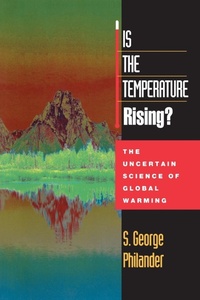
Is the Temperature Rising?
The Uncertain Science of Global Warming
Published on 5. March 2000
Book
Paperback/Softback
240 pages
978-0-691-05034-8 (ISBN)
Description
Most of us have heard the dire predictions about global warming. Some experts insist that warming has already started, and they warn of such impending disasters as the sea level rising to flood coastal cities. Others, however, have issued loud counterclaims, assuring us that global warming is a myth based on misleading data. How can we tell who is right, and how we should respond? And why is there no scientific consensus on a matter of such vital importance? George Philander addresses these questions in this book, as he guides the nonscientific reader through new ideas about the remarkable and intricate factors that determine the world's climate. In simple, nontechnical language, Philander describes how the interplay between familiar yet endlessly fascinating phenomena--winds and clouds, light and air, land and sea--maintains climates that permit a glorious diversity of fauna and flora to flourish on Earth.
That interplay also creates such potent weather disrupters as El Nino and La Nina, translates modest fluctuations in sunlight into global climate changes as dramatic as the Ice Age, and determines the Earth's response to the gases we are discharging into the atmosphere, such as those that led to the ozone hole over Antarctica and those that are likely to cause global warming. In his discussion of these matters, Philander emphasizes that our planet is so complex that the scientific results will always have uncertainties. To continue to defer action on environmental problems, on the grounds that more accurate scientific results will soon be available, could lead to a crisis. To make wise decisions, it will help if the public is familiar with the geosciences, which explore the processes that make ours a habitable planet. The book is an excellent introduction to the basics of the Earth's climate and weather, and will be an important contribution to the debate about climate change and the relationship between scientific knowledge and public affairs.
That interplay also creates such potent weather disrupters as El Nino and La Nina, translates modest fluctuations in sunlight into global climate changes as dramatic as the Ice Age, and determines the Earth's response to the gases we are discharging into the atmosphere, such as those that led to the ozone hole over Antarctica and those that are likely to cause global warming. In his discussion of these matters, Philander emphasizes that our planet is so complex that the scientific results will always have uncertainties. To continue to defer action on environmental problems, on the grounds that more accurate scientific results will soon be available, could lead to a crisis. To make wise decisions, it will help if the public is familiar with the geosciences, which explore the processes that make ours a habitable planet. The book is an excellent introduction to the basics of the Earth's climate and weather, and will be an important contribution to the debate about climate change and the relationship between scientific knowledge and public affairs.
Reviews / Votes
"S. George Philander ... writes with skill and cool reserve. Is the Temperature Rising? ... is a careful, step-by-step look at confusing data and clarifying science. He is literate, quoting Shelley, Coleridge, and Eliot. And he is reasonably sure we are digging our own grave, though he says so with such understatement that it is easy to overlook the doom and gloom."--William J. Broad, The New York Times Book Review "[The author] guides us through this learning experience with grace, wit, and clarity... Dr. Philander has tried to help us gain ... appreciation [for how significantly human activity is changing atmospheric chemistry] ... and he succeeds."--Robert C. Cowen, Christian Science Monitor "The author explains complex scientific concepts in a precise language and with delightful illustrations... The book is a pleasure to read."--Hans von Storch, Nature "In Is the Temperature Rising?, S. George Philander examines the question historically, meteorologically, chemically and every other way. At the end of the well-written survey, you will know every detail of the subject..."--New Scientist "Ought to be required reading for every eco-preacher."--John Emsley, Times Literary Supplement "A book that can be easily understood by policymakers and scientists, but yet does not sacrifice any detail in background and process is most welcome. Philander may be the first author to write such a comprehensive book ... Indeed, the author deserves immense credit for such a skillful presentation."--Geerat J. Vermeij, The Quarterly Review of BiologyMore details
Language
English
Place of publication
New Jersey
United States
Target group
Professional and scholarly
College/higher education
Product notice
Paperback (trade)
Illustrations
85 line illus
Dimensions
Height: 234 mm
Width: 156 mm
Thickness: 15 mm
Weight
430 gr
ISBN-13
978-0-691-05034-8 (9780691050348)
Copyright in bibliographic data and cover images is held by Nielsen Book Services Limited or by the publishers or by their respective licensors: all rights reserved.
Schweitzer Classification
Other editions
Additional editions
E-Book
11/2018
1st Edition
Princeton University Press
€45.99
Available for download
Person
S. George Philander is Professor of Geosciences at Princeton University. He is the author of El Nino, La Nina, and the Southern Oscillation.
Content
Preface1Between the Idea and the Reality32Is Our Planet Fragile or Robust?113Light and Air314Why the Peak of a Mountain Is Cold555Capricious Clouds766The Climate Tapestry897Weather, the Music of Our Sphere1068The Ocean in Motion1259El Nino, La Nina, and the Southern Oscillation14310The Paradox of the Faint Sun but Warm Earth16111Why Summer Is Warmer than Winter: The Cycles of Seasons and of Ice Ages17012The Ozone Hole, a Cautionary Tale18313Global Warming, Risky Business191App. A1.1Exponential Growth and Decay209App. A1.2Establishing a Chronology210App. A2.1Gaia214App. A2.2Chaos215App. A3.1Earthshine217App. A3.2The Scattering of Light217App. A3.3Blackbody Radiation218App. A3.4Effective Temperatures of the Planets219App. A3.5The Greenhouse Effect221App. A4.1The Scale Height of the Atmosphere226App. A4.2The Adiabatic Lapse Rate228App. A5.1Measuring Moisture in the Atmosphere231App. A5.2Earth's Energy Budget232App. A5.3How Many of Your Molecules Have Been to the Moon?233App. A6.1Conservation of Angular Momentum234App. A6.2The Coriolis Force235App. A6.3Shape of Earth237App. A6.4Gradient Winds237App. A7.1Predicting the Weather240App. A8.1The Seasonal Thermocline242App. A8.2The Perpetual Salt Fountain242App. 9El Nino, La Nina, and the Southern Oscillation244App. A10.1Weathering246App. A10.2Properties of the Planets247App. 11Earth's Sensitivity to Perturbations248App. 12The Ozone Layer249App. 13Global Warming250Glossary251References257Index259