

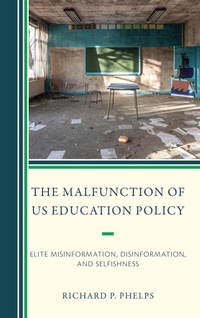
The Malfunction of US Education Policy
Elite Misinformation, Disinformation, and Selfishness
Published on 12. April 2023
Book
Hardback
196 pages
978-1-4758-6993-4 (ISBN)
Description
A 2023 Choice Reviews Outstanding Academic Title
The Malfunction of US Education Policy: Elite Misinformation, Disinformation, and Selfishness biased and inefficient information dissemination that has degraded US education research and policy since the year 2001, when a series of unfortunate disruptions began:
first, the No Child Left Behind (NCLB) Act and federal imposition of an idiosyncratic and ineffectual testing program;second, the "big bang" reorganization of the US education testing industry from a stable, cooperative oligopoly run by psychometricians to a commercially competitive free-for-all with more opportunist and customer-pleasing ambitions; andthird, the Common Core standards, which mandated homogenous lower content standards onto the still required NCLB testing structure.Billions from the federal government and wealthy foundations have transformed many once-independent national education organizations into "cargo cult" dependents and promoters of the new order, intolerant of divergent points of view. The research and policy brain trust responsible comprised an alliance of convenience among two "citation cartels" of establishment and reform scholars and politicos, and an astonishingly cooperative and un-skeptical group of journalists. It succeeded in focusing attention on their work, while diverting attention away from a much larger universe of others' work (by ignoring, dismissing, or demeaning it) that included a century's worth of mostly experimental scholarship in the fields of psychology and program evaluation.
The Malfunction of US Education Policy: Elite Misinformation, Disinformation, and Selfishness biased and inefficient information dissemination that has degraded US education research and policy since the year 2001, when a series of unfortunate disruptions began:
first, the No Child Left Behind (NCLB) Act and federal imposition of an idiosyncratic and ineffectual testing program;second, the "big bang" reorganization of the US education testing industry from a stable, cooperative oligopoly run by psychometricians to a commercially competitive free-for-all with more opportunist and customer-pleasing ambitions; andthird, the Common Core standards, which mandated homogenous lower content standards onto the still required NCLB testing structure.Billions from the federal government and wealthy foundations have transformed many once-independent national education organizations into "cargo cult" dependents and promoters of the new order, intolerant of divergent points of view. The research and policy brain trust responsible comprised an alliance of convenience among two "citation cartels" of establishment and reform scholars and politicos, and an astonishingly cooperative and un-skeptical group of journalists. It succeeded in focusing attention on their work, while diverting attention away from a much larger universe of others' work (by ignoring, dismissing, or demeaning it) that included a century's worth of mostly experimental scholarship in the fields of psychology and program evaluation.
Reviews / Votes
Many who work in America's public schools, teacher preparation programs, school district offices, and other such places often marvel at how out-of-touch education policy seems and wonder why it ignores the basic problems facing those in the trenches. In a masterful work, Phelps suggests this disconnect stems from the misinformation, disinformation, and selfishness of policy makers. The book's eight chapters address the view of education policy from 2001, the triumph of strategic scholarship, the education establishment cartel, linchpins of the cartel alliance, the education reform cartel, the dense web of Common Core confederates, the permanent education press, and the view from 2023. While many of these topics have been examined before, Phelps brings a fresh, piercing, and astute outlook. This book would be a superb complement for a class using Fullan's Leading in a Culture of Change (Jossey-Bass 2020), Sizer's Horace's Compromise (Harper, 2004), or Duke's Leadership for Low-Performing Schools (Rowman & Littlefield, 2015). While essential for those interested in school leadership and change, the work will also be of interest to those interested in public policy, ethics, or the political process. Essential. Advanced undergraduates through faculty; professionals; general readers. * Choice Reviews * Do not be deceived by the title of this book into thinking that it should only be of interest to those focused on education policy. It is a clear-eyed analysis of how bad incentives, well-intentioned defense of free speech, and scholarly cartels are a recipe for a toxic brew of misinformation. Phelps' book is a must-read for anyone concerned with how we engage in the Sisyphean task of growing closer to the truth-and that should be all of us. -- Ivan Oransky, Editor in Chief, Spectrum; Co-Founder, Retraction Watch I am delighted to see that Richard Phelps has written this particularly well-supported and thoughtful assessment of relatively recent national education reform efforts and the paucity of objective evidence of their, in the language of medicine, efficacy and toxicity. No one has a better demonstrated record writing about and giving voice to knowledgeable early critics of some of these efforts that never seem to be willing to allow anything but fawning praise until they are replaced with the next shiny object. Well studied traditional assessments of educational progress of students are dismissed as being inappropriate for these new and improved innovations. Regrettably, education writers are not nearly as knowledgeable nor as critical as their role should imply. Their work almost appears to have been written by the reformers themselves as opposed to objective neutral observers. -- Wayne Bishop, Professor of Mathematics, California State University Los Angeles As a college professor, I've seen the long-term effects of the dominance of certain flawed education policies on the poor preparedness of students by the time they reach college. Why? The ability of a person or groups of people, they are academics, but I won't call them scholars, to promote themselves and their ideas to the suppression of contrary but important works are behind our failing system of public K-12 education. Dr. Phelps, a distinguished expert in the field of standardized testing, clearly and persuasively reveals how the effective obliteration of contrary and essential scholarly work by "education cartels" has brought us to a dangerous point in American education. This book serves as a wake-up call to scholars, policy makers, and parents. -- Therese Ann Markow, PhD, Professor Emeritus, University of California San Diego Richard Phelps' latest publication (The Malfunction of U.S. Education Policy) addresses a badly needed topic-testing, or as is the actual thrust of much current education policy writing, anti-testing. Phelps' book explains why the social sciences in particular do not provide a sturdy foundation for much if not most education policy today. Readers may find the claim that "no previous research" on important details exists. Thus, society and science are impoverished if not damaged by a truncated process for specific education policies that may reflect laziness or excessive reliance on one academic "celebrity" or publication. -- Sandra Stotsky, professor emerita, University of Arkansas The Malfunction of U.S. Education Policy is not just a must-read for education scholars and policy folks. Elite capture of an information base for policy making is something that could happen to any body of knowledge, and it likely is ongoing in many more knowledge areas than we realize. Elite capture can occur without a brilliant analysis as a starting point, but it's not good even when prominence arises from a brilliant analysis. Richard Phelps uses a massive literature review to credibly assert the existence of an Education Establishment Cartel and an Education Reform Cartel and he demonstrates that such information base cartels are stable. * The Independent Review: A Journal of Political Economy *More details
Language
English
Place of publication
United States
Publishing group
Bloomsbury Publishing Plc
Target group
Professional and scholarly
Illustrations
2 b/w illustrations; 8 tables
Dimensions
Height: 235 mm
Width: 157 mm
Thickness: 15 mm
Weight
443 gr
ISBN-13
978-1-4758-6993-4 (9781475869934)
Copyright in bibliographic data and cover images is held by Nielsen Book Services Limited or by the publishers or by their respective licensors: all rights reserved.
Schweitzer Classification
Other editions
Additional editions
Richard P. Phelps
The Malfunction of US Education Policy
Elite Misinformation, Disinformation, and Selfishness
E-Book
03/2023
1st Edition
Rowman & Littlefield Publishers
€24.49
Available for download
Richard P. Phelps
The Malfunction of US Education Policy
Elite Misinformation, Disinformation, and Selfishness
E-Book
03/2023
1st Edition
Bloomsbury eBooks US
€24.49
Available for download
Person
Richard P. Phelps is founder of the muck-raking Nonpartisan Education Group, and editor and co-author of Correcting Fallacies about Educational and Psychological Testing (American Psychological Association) and Defending Standardized Testing (Psychology Press). He holds degrees from Washington and Harvard Universities, and a PhD in Public Policy Analysis from the University of Pennsylvania's Wharton School.
Content
Preface: Protecting Endangered Theses
Introduction:The Cartel Alliance and Honest Terminology
Chapter 1. The View from 2001
Chapter 2. The Triumph of Strategic Scholarship
Chapter 3. The Education Establishment Cartel
Chapter 4. Linchpin of the Cartel Alliance: Koretz, Cannell, and the Ghost of Test Security
Chapter 5. The Education Reform Cartel
Chapter 6. A Dense Web of Common Core Confederates
Chapter 7. The Permanent Education Press: A Breed Apart
Chapter 8. The View from 2022
Conclusion: When What is Left Out is More Important
About the Author
Introduction:The Cartel Alliance and Honest Terminology
Chapter 1. The View from 2001
Chapter 2. The Triumph of Strategic Scholarship
Chapter 3. The Education Establishment Cartel
Chapter 4. Linchpin of the Cartel Alliance: Koretz, Cannell, and the Ghost of Test Security
Chapter 5. The Education Reform Cartel
Chapter 6. A Dense Web of Common Core Confederates
Chapter 7. The Permanent Education Press: A Breed Apart
Chapter 8. The View from 2022
Conclusion: When What is Left Out is More Important
About the Author