

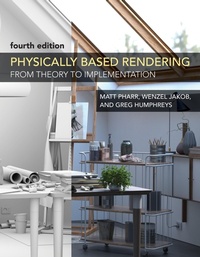
Physically Based Rendering, fourth edition
From Theory to Implementation
Published on 28. March 2023
Book
Hardback
1312 pages
978-0-262-04802-6 (ISBN)
Description
A comprehensive update of the leading-edge computer graphics textbook that sets the standard for physically-based rendering in the industry and the field, with new material on GPU ray tracing.
Photorealistic computer graphics are ubiquitous in today’s world, widely used in movies and video games as well as product design and architecture. Physically-based approaches to rendering, where an accurate modeling of the physics of light scattering is at the heart of image synthesis, offer both visual realism and predictability. Now in a comprehensively updated new edition, this best-selling computer graphics textbook sets the standard for physically-based rendering in the industry and the field.
Physically Based Rendering describes both the mathematical theory behind a modern photorealistic rendering system as well as its practical implementation. A method known as literate programming combines human-readable documentation and source code into a single reference that is specifically designed to aid comprehension. The book’s leading-edge algorithms, software, and ideas—including new material on GPU ray tracing—equip the reader to design and employ a full-featured rendering system capable of creating stunning imagery. This essential text represents the future of real-time graphics.
Photorealistic computer graphics are ubiquitous in today’s world, widely used in movies and video games as well as product design and architecture. Physically-based approaches to rendering, where an accurate modeling of the physics of light scattering is at the heart of image synthesis, offer both visual realism and predictability. Now in a comprehensively updated new edition, this best-selling computer graphics textbook sets the standard for physically-based rendering in the industry and the field.
Physically Based Rendering describes both the mathematical theory behind a modern photorealistic rendering system as well as its practical implementation. A method known as literate programming combines human-readable documentation and source code into a single reference that is specifically designed to aid comprehension. The book’s leading-edge algorithms, software, and ideas—including new material on GPU ray tracing—equip the reader to design and employ a full-featured rendering system capable of creating stunning imagery. This essential text represents the future of real-time graphics.
- Detailed and rigorous but accessible approach guides readers all the way from theory to practical software implementation
- Fourth edition features new chapter on GPU ray tracing essential for game developers
- The premier reference for professionals learning about and working in the field
- Won its authors a 2014 Academy Award for Scientific and Technical Achievement
- Includes a companion site complete with source code
More details
Language
English
Place of publication
Cambridge (Massachusetts)
United States
Publishing group
MIT Press Ltd
Illustrations
450 colour
Dimensions
Height: 257 mm
Width: 212 mm
Thickness: 53 mm
Weight
2394 gr
ISBN-13
978-0-262-04802-6 (9780262048026)
Copyright in bibliographic data and cover images is held by Nielsen Book Services Limited or by the publishers or by their respective licensors: all rights reserved.
Schweitzer Classification
Other editions
Additional editions

Matt Pharr | Wenzel Jakob | Greg Humphreys
Physically Based Rendering, fourth edition
From Theory to Implementation
E-Book
05/2023
MIT Press
€118.99
Available for download
Persons
Matt Pharr is a Distinguished Research Scientist at NVIDIA. He previously worked at Google, co-founded Neoptica, and co-founded Exluna. Wenzel Jakob is Assistant Professor of Computer Science at the École polytechnique fédérale de Lausanne (EPFL), where he leads the Realistic Graphics Lab. Greg Humphreys is a software engineer at a stealth startup. He previously worked on the Chrome graphics team at Google and as a professor of computer science at the University of Virginia.
Content
Chapter 01. Introduction 1
Chapter 02. Monte Carlo Integration 53
Chapter 03. Geometry and Transformations 81
Chapter 04. Radiometry, Spectra, and Color 145
Chapter 05. Cameras and Film 205
Chapter 06. Shapes 261
Chapter 07. Primitives and Intersection Acceleration 397
Chapter 08. Sampling and Reconstruction 445
Chapter 09. Reflection Models 535
Chapter 10. Textures and Materials 633
Chapter 11. Volume Scattering 697
Chapter 12. Light Sources 739
Chapter 13. Light Transport I: Surface Reflection 813
Chapter 14. Light Transport II: Volume Rendering 853
Chapter 15. Wavefront Rendering on GPUS 917
Chapter 16. Retrospective and the Future 977
Appendixes
A Sampling Algorithms 993
B Utilities 1031
C Processing the Scene Description 1119
References 1141
Index of Fragments 1183
Index of Classes and their Members 1201
Index of Miscellaneous Identifiers 1213
Subject Index 1215
Colophon 1245
Chapter 02. Monte Carlo Integration 53
Chapter 03. Geometry and Transformations 81
Chapter 04. Radiometry, Spectra, and Color 145
Chapter 05. Cameras and Film 205
Chapter 06. Shapes 261
Chapter 07. Primitives and Intersection Acceleration 397
Chapter 08. Sampling and Reconstruction 445
Chapter 09. Reflection Models 535
Chapter 10. Textures and Materials 633
Chapter 11. Volume Scattering 697
Chapter 12. Light Sources 739
Chapter 13. Light Transport I: Surface Reflection 813
Chapter 14. Light Transport II: Volume Rendering 853
Chapter 15. Wavefront Rendering on GPUS 917
Chapter 16. Retrospective and the Future 977
Appendixes
A Sampling Algorithms 993
B Utilities 1031
C Processing the Scene Description 1119
References 1141
Index of Fragments 1183
Index of Classes and their Members 1201
Index of Miscellaneous Identifiers 1213
Subject Index 1215
Colophon 1245