

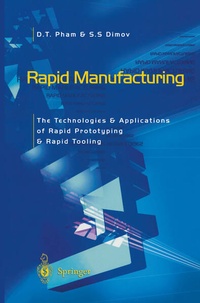
Rapid Manufacturing
The Technologies and Applications of Rapid Prototyping and Rapid Tooling
Published on 9. November 2011
Book
Paperback/Softback
XII, 214 pages
978-1-4471-1182-5 (ISBN)
Description
Rapid Manufacturing is a term that embraces rapid prototyping and rapid tooling.
Rapid prototyping is an exciting new technology for quickly creating physical models and functional prototypes directly from CAD models. Rapid tooling generally concerns the production of tooling using parts manufactured by rapid prototyping. Rapid prototyping and rapid tooling are means for compressing the time-to-market of products and, as such are competitiveness enhancing technologies.
The book describes the characteristics and capabilities of the main known rapid prototyping processes.
It covers in detail commercially available processes, such as:
- Stereolithography (SLA);
- Selective Laser Sintering (SLS);
- Fused Deposition Modelling (FDM);
- Solid Ground Curing (SGC);
- Laminated Object Manufacturing (LOM)
and provides information on several other processes still under development.
The book discusses various direct and indirect methods of producing soft tooling, firm tooling (or bridge tooling) and hard tooling based on rapid prototyping. The discussion is wide- ranging and not found in other books published to-date. Also special to the book is material on process optimisation. This was derived from work at the authors'Centre and is not available in other texts. The book places a strong emphasis on practical applications, devoting special chapters to both the applications of rapid prototyping and rapid tooling. The book contains an abundance of photographs and diagrams, some in colour, to illustrate clearly the principles of the machines and processes involved. The book does not require any special background. It should be of interest to manufacturing, industrial, production, mechanical and materials engineers wishing to up date themselves on some of the most important developments in modern manufacture. (The authors are from the Manufacturing Engineering Centre, which conducts leading-edge research into advanced manufacturing as well as providinga commercial rapid prototyping and tooling service to several hundred industrial customers).
Rapid prototyping is an exciting new technology for quickly creating physical models and functional prototypes directly from CAD models. Rapid tooling generally concerns the production of tooling using parts manufactured by rapid prototyping. Rapid prototyping and rapid tooling are means for compressing the time-to-market of products and, as such are competitiveness enhancing technologies.
The book describes the characteristics and capabilities of the main known rapid prototyping processes.
It covers in detail commercially available processes, such as:
- Stereolithography (SLA);
- Selective Laser Sintering (SLS);
- Fused Deposition Modelling (FDM);
- Solid Ground Curing (SGC);
- Laminated Object Manufacturing (LOM)
and provides information on several other processes still under development.
The book discusses various direct and indirect methods of producing soft tooling, firm tooling (or bridge tooling) and hard tooling based on rapid prototyping. The discussion is wide- ranging and not found in other books published to-date. Also special to the book is material on process optimisation. This was derived from work at the authors'Centre and is not available in other texts. The book places a strong emphasis on practical applications, devoting special chapters to both the applications of rapid prototyping and rapid tooling. The book contains an abundance of photographs and diagrams, some in colour, to illustrate clearly the principles of the machines and processes involved. The book does not require any special background. It should be of interest to manufacturing, industrial, production, mechanical and materials engineers wishing to up date themselves on some of the most important developments in modern manufacture. (The authors are from the Manufacturing Engineering Centre, which conducts leading-edge research into advanced manufacturing as well as providinga commercial rapid prototyping and tooling service to several hundred industrial customers).
More details
Edition
Softcover reprint of the original 1st ed. 2001
Language
English
Place of publication
London
United Kingdom
Target group
Professional and scholarly
Professional/practitioner
Illustrations
XII, 214 p.
Dimensions
Height: 235 mm
Width: 155 mm
Thickness: 14 mm
Weight
382 gr
ISBN-13
978-1-4471-1182-5 (9781447111825)
DOI
10.1007/978-1-4471-0703-3
Schweitzer Classification
Other editions
Additional editions
Duc Pham | S.S. Dimov
Rapid Manufacturing
The Technologies and Applications of Rapid Prototyping and Rapid Tooling
E-Book
12/2012
Springer
€139.09
Available for download

Duc Pham | S.S. Dimov
Rapid Manufacturing
The Technologies and Applications of Rapid Prototyping and Rapid Tooling
Book
04/2001
Springer
€85.55
Article exhausted; check different version
Persons
Content
1 Introduction.- 1.1 Historical Perspectives.- 1.2 Rapid Prototyping - An Integral Part of Time Compression Engineering.- 1.3 RP Information Workflow.- 1.4 Summary.- References.- 2 Rapid Prototyping Processes.- 2.1 Classification of Rapid Prototyping Processes.- 2.2 Processes Involving a Liquid.- 2.3 Processes Involving Discrete Particles.- 2.4 Processes Involving Solid Sheets.- 2.5 Summary.- References.- 3 Technical Characteristics and Technological Capabilities of Rapid Prototyping Systems.- 3.1 Stereolithography Apparatus (3D Systems).- 3.2 Solid Ground Curing Systems (Cubital Ltd).- 3.3 Fused Deposition Modelling Systems (Stratasys, Inc.).- 3.4 Selective Laser Sintering Systems (DTM Corp. and EOS GmbH).- 3.5 Laminated Object Manufacturing Systems (Helisys, Inc.).- 3.6 Paper Lamination Technology (Kira Corp).- 3.7 Laser Engineering Net Shaping (LENSTM) Systems (Optomec Design Co.).- 3.8 Summary.- References.- 4 Technical Characteristics and Technological Capabilities of Concept Modellers.- 4.1 3D Systems ThermoJetT Printer.- 4.2 Sanders ModelMaker II (Inkjet Modelling Technology).- 4.3 Z-Corporation Z402 3D Printer (Three Dimensional Printing).- 4.4 Stratasys Genisys Xs 3D Printer.- 4.5 JP System 5.- 4.6 Objet Quadra System.- 4.7 Summary.- References.- 5 Applications of Rapid Prototyping Technology.- 5.1 Functional Models.- 5.2 Pattern for Investment and Vacuum Casting.- 5.3 Medical Models.- 5.4 Art Models.- 5.5 Engineering Analysis Models.- 5.6 Summary.- References.- 6 Indirect Methods for Rapid Tool Production.- 6.1 Role of Indirect Methods in Tool Production.- 6.2 Metal Deposition Tools.- 6.3 RTV Tools.- 6.4 Epoxy Tools.- 6.5 Ceramic Tools.- 6.6 Cast Metal Tools.- 6.7 Investment Casting.- 6.8 Fusible Metallic Core.- 6.9 Sand Casting.- 6.10 KeltoolT Process.-6.11 Summary.- References.- 7 Direct Methods for Rapid Tool Production.- 7.1 Classification of Direct Rapid Tool Methods.- 7.2 Direct ACEST Injection Moulds (AIMT).- 7.3 Laminated Object Manufactured (LOM) Tools.- 7.4 DTM RapidToolT Process.- 7.5 SandFormT.- 7.6 EOS DirectToolT Process.- 7.7 Direct Metal Tooling using 3DPT.- 7.8 Topographic Shape Formation (TSF).- 7.9 Summary.- References.- 8 Applications of Rapid Tooling Technology.- 8.1 Insert Design.- 8.2 Insert Finishing.- 8.3 Rapid Tooling Inserts Wear Resistance.- 8.4 Case Studies.- 8.5 Summary.- References.- 9 Rapid Prototyping Process Optimisation.- 9.1 Factors Influencing Accuracy.- 9.2 Selection of Part Build Orientation.- 9.3 Summary.- References.- Author Index.