

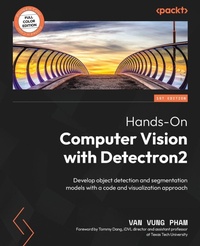
Hands-On Computer Vision with Detectron2
Develop object detection and segmentation models with a code and visualization approach
Published on 14. April 2023
Book
Paperback/Softback
318 pages
978-1-80056-162-5 (ISBN)
Description
Explore Detectron2 using cutting-edge models and learn all about implementing future computer vision applications in custom domains
Purchase of the print or Kindle book includes a free PDF eBook
Key Features
Learn how to tackle common computer vision tasks in modern businesses with Detectron2
Leverage Detectron2 performance tuning techniques to control the model's finest details
Deploy Detectron2 models into production and develop Detectron2 models for mobile devices
Book DescriptionComputer vision is a crucial component of many modern businesses, including automobiles, robotics, and manufacturing, and its market is growing rapidly. This book helps you explore Detectron2, Facebook's next-gen library providing cutting-edge detection and segmentation algorithms. It's used in research and practical projects at Facebook to support computer vision tasks, and its models can be exported to TorchScript or ONNX for deployment.
The book provides you with step-by-step guidance on using existing models in Detectron2 for computer vision tasks (object detection, instance segmentation, key-point detection, semantic detection, and panoptic segmentation). You'll get to grips with the theories and visualizations of Detectron2's architecture and learn how each module in Detectron2 works. As you advance, you'll build your practical skills by working on two real-life projects (preparing data, training models, fine-tuning models, and deployments) for object detection and instance segmentation tasks using Detectron2. Finally, you'll deploy Detectron2 models into production and develop Detectron2 applications for mobile devices.
By the end of this deep learning book, you'll have gained sound theoretical knowledge and useful hands-on skills to help you solve advanced computer vision tasks using Detectron2.What you will learn
Build computer vision applications using existing models in Detectron2
Grasp the concepts underlying Detectron2's architecture and components
Develop real-life projects for object detection and object segmentation using Detectron2
Improve model accuracy using Detectron2's performance-tuning techniques
Deploy Detectron2 models into server environments with ease
Develop and deploy Detectron2 models into browser and mobile environments
Who this book is forIf you are a deep learning application developer, researcher, or software developer with some prior knowledge about deep learning, this book is for you to get started and develop deep learning models for computer vision applications. Even if you are an expert in computer vision and curious about the features of Detectron2, or you would like to learn some cutting-edge deep learning design patterns, you will find this book helpful. Some HTML, Android, and C++ programming skills are advantageous if you want to deploy computer vision applications using these platforms.
Purchase of the print or Kindle book includes a free PDF eBook
Key Features
Learn how to tackle common computer vision tasks in modern businesses with Detectron2
Leverage Detectron2 performance tuning techniques to control the model's finest details
Deploy Detectron2 models into production and develop Detectron2 models for mobile devices
Book DescriptionComputer vision is a crucial component of many modern businesses, including automobiles, robotics, and manufacturing, and its market is growing rapidly. This book helps you explore Detectron2, Facebook's next-gen library providing cutting-edge detection and segmentation algorithms. It's used in research and practical projects at Facebook to support computer vision tasks, and its models can be exported to TorchScript or ONNX for deployment.
The book provides you with step-by-step guidance on using existing models in Detectron2 for computer vision tasks (object detection, instance segmentation, key-point detection, semantic detection, and panoptic segmentation). You'll get to grips with the theories and visualizations of Detectron2's architecture and learn how each module in Detectron2 works. As you advance, you'll build your practical skills by working on two real-life projects (preparing data, training models, fine-tuning models, and deployments) for object detection and instance segmentation tasks using Detectron2. Finally, you'll deploy Detectron2 models into production and develop Detectron2 applications for mobile devices.
By the end of this deep learning book, you'll have gained sound theoretical knowledge and useful hands-on skills to help you solve advanced computer vision tasks using Detectron2.What you will learn
Build computer vision applications using existing models in Detectron2
Grasp the concepts underlying Detectron2's architecture and components
Develop real-life projects for object detection and object segmentation using Detectron2
Improve model accuracy using Detectron2's performance-tuning techniques
Deploy Detectron2 models into server environments with ease
Develop and deploy Detectron2 models into browser and mobile environments
Who this book is forIf you are a deep learning application developer, researcher, or software developer with some prior knowledge about deep learning, this book is for you to get started and develop deep learning models for computer vision applications. Even if you are an expert in computer vision and curious about the features of Detectron2, or you would like to learn some cutting-edge deep learning design patterns, you will find this book helpful. Some HTML, Android, and C++ programming skills are advantageous if you want to deploy computer vision applications using these platforms.
More details
Language
English
Place of publication
Birmingham
United Kingdom
Target group
Professional and scholarly
Dimensions
Height: 235 mm
Width: 191 mm
Thickness: 17 mm
Weight
597 gr
ISBN-13
978-1-80056-162-5 (9781800561625)
Copyright in bibliographic data and cover images is held by Nielsen Book Services Limited or by the publishers or by their respective licensors: all rights reserved.
Schweitzer Classification
Persons
Van Vung Pham is a passionate research scientist in machine learning, deep learning, data science, and data visualization. He has years of experience and numerous publications in these areas. He is currently working on projects that use deep learning to predict road damage from pictures or videos taken from roads. One of the projects uses Detectron2 and Faster R-CNN to predict and classify road damage and achieve state-of-the-art results for this task. Dr. Pham obtained his PhD from the Computer Science Department, at Texas Tech University, Lubbock, Texas, USA. He is currently an assistant professor at the Computer Science Department, Sam Houston State University, Huntsville, Texas, USA.
Content
Table of Contents
An Introduction to Detectron2 and Computer Vision Tasks
Developing Computer Vision Applications Using Existing Detectron2 Models
Data Preparation for Object Detection Applications
The Architecture of the Object Detection Model in Detectron2
Training Custom Object Detection Models
Inspecting Training Results and Fine-Tuning Detectron2's Solver
Fine-Tuning Object Detection Models
Image Data Augmentation Techniques
Applying Train-Time and Test-Time Image Augmentations
Training Instance Segmentation Models
Fine-Tuning Instance Segmentation Models
Deploying Detectron2 Models into Server Environments
Deploying Detectron2 models into Browsers and Mobile Environments
An Introduction to Detectron2 and Computer Vision Tasks
Developing Computer Vision Applications Using Existing Detectron2 Models
Data Preparation for Object Detection Applications
The Architecture of the Object Detection Model in Detectron2
Training Custom Object Detection Models
Inspecting Training Results and Fine-Tuning Detectron2's Solver
Fine-Tuning Object Detection Models
Image Data Augmentation Techniques
Applying Train-Time and Test-Time Image Augmentations
Training Instance Segmentation Models
Fine-Tuning Instance Segmentation Models
Deploying Detectron2 Models into Server Environments
Deploying Detectron2 models into Browsers and Mobile Environments