

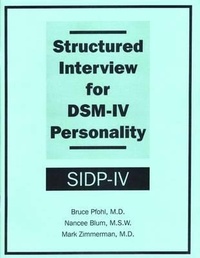
Structured Interview for DSM-IV (R) Personality (SIDP-IV)
Published on 31. December 1997
Book
Paperback/Softback
48 pages
978-0-88048-937-9 (ISBN)
Description
Updated for DSM-IV, the Structured Interview for DSM-IV
Personality (SIDP-IV) is a semi-structured interview that uses
nonpejorative questions to examine behavior and personality traits from the
patient's perspective. The SIDP-IV is organized by topic sections rather
than disorder to allow for a more natural conversational flow, a method that
gleans useful information from related interview questions and produces a
more accurate diagnosis. Designed as a follow-up to a general psychiatric
interview and chart review that assesses episodic psychiatric disorders, the
SIDP-IV helps the interviewer to more easily distinguish lifelong behavior
from temporary states that result from an episodic psychiatric disorder.
During the session, the interviewer can also refer to the specific DSM-IV
criterion associated with that question set. In the event that the clinician
decides to interview a third-party informant such as family members or close
friends, a consent form is provided at the end of the interview.
With
this useful, concise interview in hand, clinicians can move quickly from
diagnosis to treatment and begin to improve their patient's quality of life.
This is a package of 5.
Personality (SIDP-IV) is a semi-structured interview that uses
nonpejorative questions to examine behavior and personality traits from the
patient's perspective. The SIDP-IV is organized by topic sections rather
than disorder to allow for a more natural conversational flow, a method that
gleans useful information from related interview questions and produces a
more accurate diagnosis. Designed as a follow-up to a general psychiatric
interview and chart review that assesses episodic psychiatric disorders, the
SIDP-IV helps the interviewer to more easily distinguish lifelong behavior
from temporary states that result from an episodic psychiatric disorder.
During the session, the interviewer can also refer to the specific DSM-IV
criterion associated with that question set. In the event that the clinician
decides to interview a third-party informant such as family members or close
friends, a consent form is provided at the end of the interview.
With
this useful, concise interview in hand, clinicians can move quickly from
diagnosis to treatment and begin to improve their patient's quality of life.
This is a package of 5.
More details
Language
English
Place of publication
VA
United States
Target group
Professional and scholarly
US School Grade: College Graduate Student and over
Product notice
Paperback (trade)
Illustrations
Not illustrated
Dimensions
Height: 279 mm
Width: 217 mm
Thickness: 4 mm
Weight
136 gr
ISBN-13
978-0-88048-937-9 (9780880489379)
Copyright in bibliographic data and cover images is held by Nielsen Book Services Limited or by the publishers or by their respective licensors: all rights reserved.
Schweitzer Classification
Persons
Bruce Pfohl, M.D., is Professor of Psychiatry in the
Department of Psychiatry at the University of Iowa, Iowa City,
Iowa.
Nancee Blum, M.S.W., is a Social Work Specialist in
the Department of Psychiatry at the University of Iowa, Iowa City,
Iowa.
Mark Zimmerman, M.D., is Associate Professor of
Psychiatry in the Department of Psychiatry at Brown University, Providence,
Rhode Island.
Department of Psychiatry at the University of Iowa, Iowa City,
Iowa.
Nancee Blum, M.S.W., is a Social Work Specialist in
the Department of Psychiatry at the University of Iowa, Iowa City,
Iowa.
Mark Zimmerman, M.D., is Associate Professor of
Psychiatry in the Department of Psychiatry at Brown University, Providence,
Rhode Island.
Content
Instructions. Introduction to SIDP-IV interview. Interests
and activities. Work style. Close relationships. Social relationships.
Emotions. Observational criteria. Self-perception. Perception of others.
Stress and anger. Social conformity. SIDP-IV scoresheet.
and activities. Work style. Close relationships. Social relationships.
Emotions. Observational criteria. Self-perception. Perception of others.
Stress and anger. Social conformity. SIDP-IV scoresheet.