

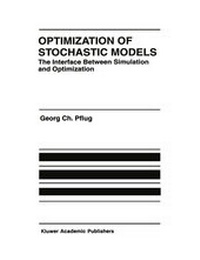
Optimization of Stochastic Models
The Interface Between Simulation and Optimization
Published on 14. October 1997
Book
Paperback/Softback
XIV, 382 pages
978-1-4612-8631-8 (ISBN)
Description
Stochastic models are everywhere. In manufacturing, queuing models are used for modeling production processes, realistic inventory models are stochastic in nature. Stochastic models are considered in transportation and communication. Marketing models use stochastic descriptions of the demands and buyer's behaviors. In finance, market prices and exchange rates are assumed to be certain stochastic processes, and insurance claims appear at random times with random amounts.
To each decision problem, a cost function is associated. Costs may be direct or indirect, like loss of time, quality deterioration, loss in production or dissatisfaction of customers. In decision making under uncertainty, the goal is to minimize the expected costs. However, in practically all realistic models, the calculation of the expected costs is impossible due to the model complexity. Simulation is the only practicable way of getting insight into such models. Thus, the problem of optimal decisions can be seen as getting simulation and optimization effectively combined.
The field is quite new and yet the number of publications is enormous. This book does not even try to touch all work done in this area. Instead, many concepts are presented and treated with mathematical rigor and necessary conditions for the correctness of various approaches are stated.
Optimization of Stochastic Models: The Interface Between Simulation and Optimization is suitable as a text for a graduate level course on Stochastic Models or as a secondary text for a graduate level course in Operations Research.
To each decision problem, a cost function is associated. Costs may be direct or indirect, like loss of time, quality deterioration, loss in production or dissatisfaction of customers. In decision making under uncertainty, the goal is to minimize the expected costs. However, in practically all realistic models, the calculation of the expected costs is impossible due to the model complexity. Simulation is the only practicable way of getting insight into such models. Thus, the problem of optimal decisions can be seen as getting simulation and optimization effectively combined.
The field is quite new and yet the number of publications is enormous. This book does not even try to touch all work done in this area. Instead, many concepts are presented and treated with mathematical rigor and necessary conditions for the correctness of various approaches are stated.
Optimization of Stochastic Models: The Interface Between Simulation and Optimization is suitable as a text for a graduate level course on Stochastic Models or as a secondary text for a graduate level course in Operations Research.
More details
Series
Edition
Softcover reprint of the original 1st ed. 1996
Language
English
Place of publication
NY
United States
Target group
Professional and scholarly
Illustrations
XIV, 382 p.
Dimensions
Height: 27.9 cm
Width: 21 cm
ISBN-13
978-1-4612-8631-8 (9781461286318)
DOI
10.1007/978-1-4613-1449-3
Schweitzer Classification
Other editions
Additional editions
E-Book
12/2012
Springer
€213.99
Available for download
Book
09/1996
Kluwer Academic Publishers
€213.99
Shipment within 15-20 days
Content
1. Optimization. 2. Discrete-Event Processes. 3. Derivatives. 4. Simulation and Sensitivity Estimation. 5. Stochastic Approximation. A: Metric Spaces. B: Sequences and Series. C: Matrix Algebra. D: Derivatives. E: Convexity and Convex Projections. F: Set-Wise Convergence.G: Duality and Lagrangians. H: Probability Spaces and Random Variables. I: Convergence of Random Variables. J: The Wasserstein Distance. K: Conditional Expectations. L: Martingales. M: Choquet Theory. N: Coupling. Index.